
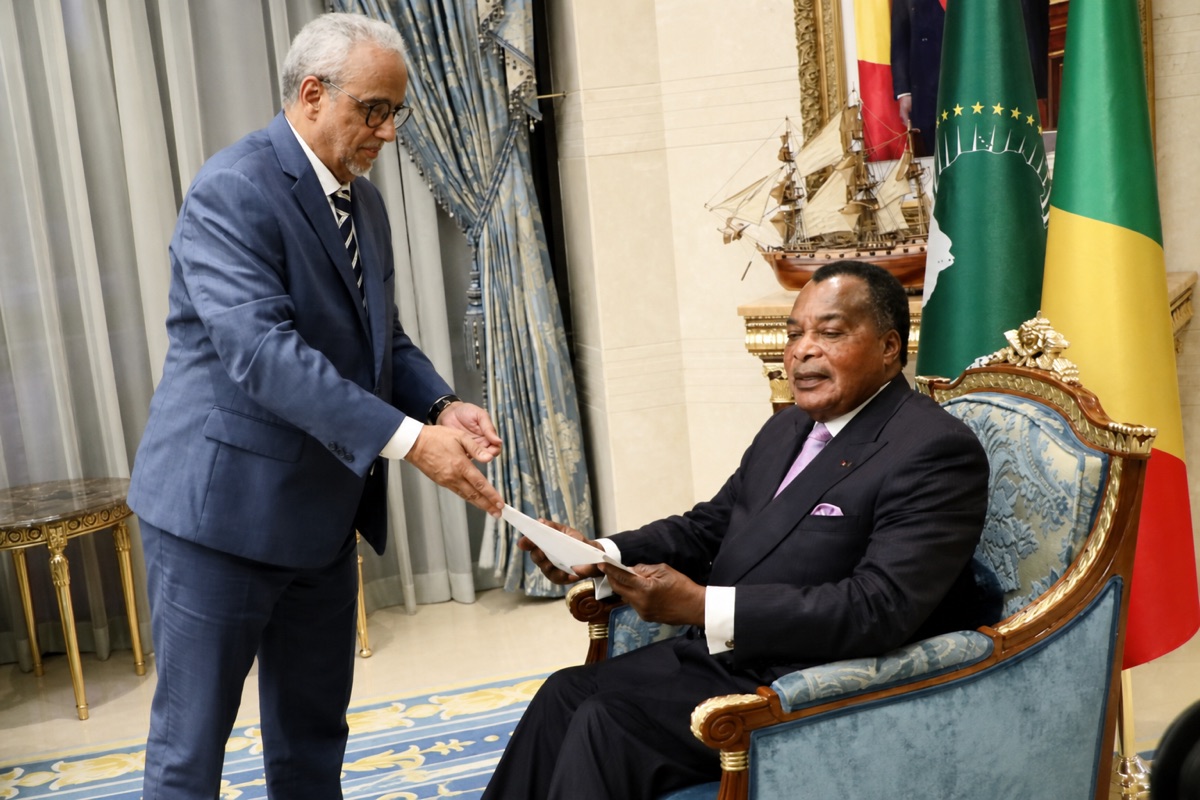
A discreet but consequential piece of African diplomacy unfolded in Brazzaville this month, as Nouakchott dispatched a senior emissary to enlist the Republic of Congo behind its bid to capture one of the Francophone world’s most coveted offices. The visit underscores how the contest to succeed at the helm of the Organisation internationale de la Francophonie (OIF) is quietly mobilising long-standing alliances across the continent.
A Presidential Envoy at Sassou N’Guesso’s Door
On 7 May, Mauritania’s Minister of Economic Affairs and Development, Abdallahi Soulemane Cheikh Sidya, was received by President Denis Sassou N’Guesso in the Congolese capital. He came not in his own ministerial capacity alone, but as the personal envoy of President Mohamed Ould El-Ghazaouani, charged with a single, carefully framed request: that Congo-Brazzaville lend its formal support to Koumba Ba’s candidacy for the post of Secretary General of the OIF.
The minister conveyed a message of friendship from the Mauritanian head of state, one that leaned heavily on the shared history binding the two nations within Africa’s international and continental bodies. In the grammar of multilateral diplomacy, such gestures are rarely incidental. They signal that Nouakchott regards Brazzaville not as a peripheral vote but as an influential voice whose endorsement could ripple outward to other capitals.
The Weight of a Single Candidacy
Koumba Ba arrives in this race with a curriculum vitae built for the role. A holder of a university doctorate, she has accumulated more than a decade in the upper reaches of public administration, having served both as a presidential adviser and as a government minister. More recently, she has occupied the position of special envoy for the Francophonie, a posting that placed her squarely within the institutional world she now aspires to lead.
That trajectory matters because the secretary general’s office is as much about credibility and networks as it is about formal credentials. A candidate who has already navigated the Francophone machinery from the inside enters the contest with an argument that is difficult for rivals to replicate. Yet experience alone seldom decides such elections; the arithmetic of state support, assembled capital by capital, tends to be the deciding factor.
Brazzaville’s Calculated Position
For Congo-Brazzaville, the appeal carries its own logic. Reciprocity is the currency of these alignments, and the prospect of mutual support between Nouakchott and Brazzaville could prove decisive once the votes are tallied. A favour extended today within the Francophonie may be redeemed tomorrow in another forum, whether at the African Union, the United Nations, or the constellation of regional institutions where Central African states routinely seek allies.
Sassou N’Guesso, a veteran of African summitry, is well placed to read the value of such an exchange. His decision will be weighed not only against the merits of the Mauritanian candidate but against the broader map of Congolese interests across the continent’s diplomatic chessboard.
A Contest Shaped by Competing Sponsors
The Mauritanian bid does not advance unopposed. Other contenders are in the field, among them figures backed by the Democratic Republic of the Congo and by Canada, two players whose involvement signals that the race spans well beyond francophone Africa. The presence of Ottawa, in particular, is a reminder that the OIF remains a transatlantic and intercontinental institution, where European and North American members hold considerable sway alongside their African counterparts.
It is worth stressing the distinction that often blurs in shorthand reporting: the candidate enjoying Kinshasa’s support emanates from the Democratic Republic of the Congo, a separate state from the Republic of Congo whose backing Mauritania is courting in Brazzaville. The two neighbours, divided by a river and a name, here find themselves on different sides of the same diplomatic equation.
Reading the Stakes Ahead
What emerges from the Brazzaville meeting is a portrait of an election being contested in the antechambers of presidential palaces long before any ballot is cast. Each visit, each message of friendship, each invocation of historical solidarity is a move in a deliberate campaign to assemble a winning coalition. For Mauritania, securing Congo’s endorsement would represent more than a single vote; it would be a demonstration that its candidate can draw support across the continent’s varied blocs.
For now, the outcome remains open. But the choreography of the encounter, an envoy bearing a head of state’s personal appeal, received at the highest level in Brazzaville, leaves little doubt about the seriousness with which Nouakchott is pursuing the prize. Whether Sassou N’Guesso commits Congo’s weight to Koumba Ba may well help determine who next speaks for the Francophone world.
