
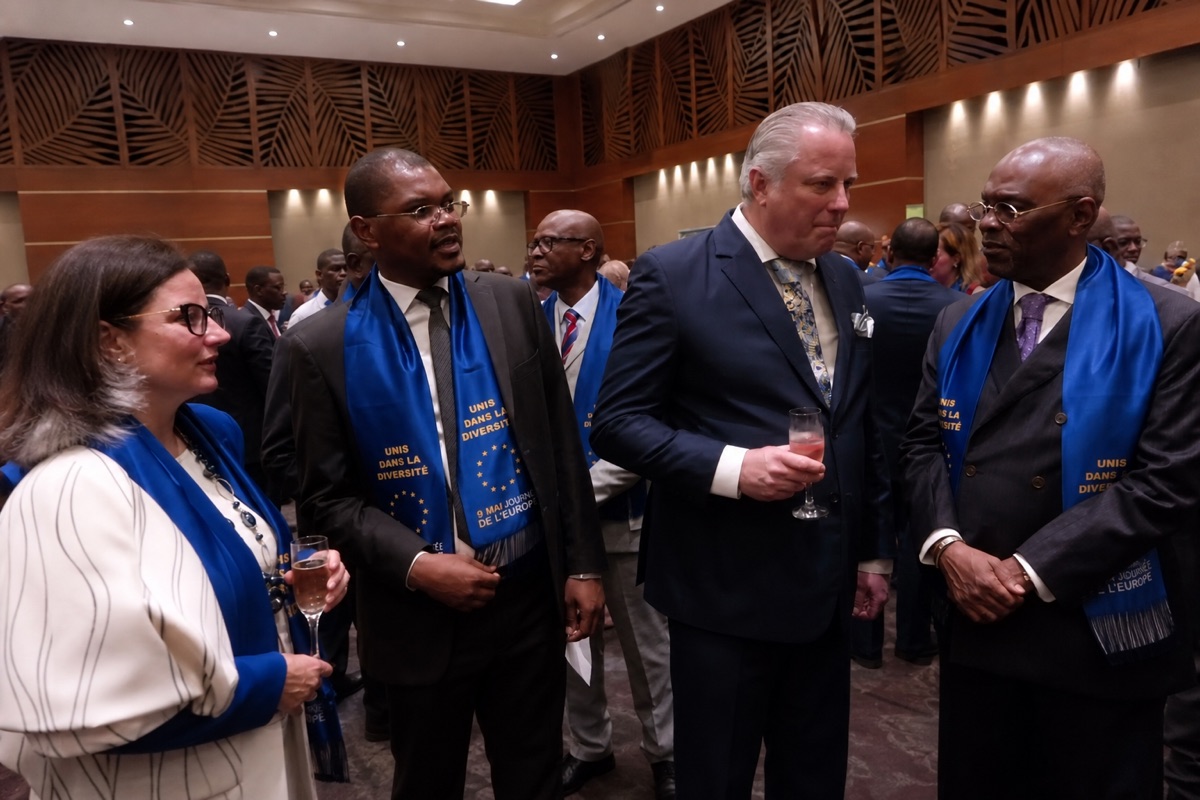
A Brazzaville Commemoration With Diplomatic Resonance
On 10 May 2026, Brazzaville marked Europe Day, the annual observance of the founding moment of European integration. What might elsewhere read as a routine entry on the diplomatic calendar carried, in the Congolese capital, a more deliberate weight. According to the reporting of Vox Congo, the commemoration unfolded against the backdrop of a partnership between the Republic of the Congo and the European Union that both sides appear intent on consolidating. The choice to give the date public visibility, rather than confining it to closed embassy receptions, suggests that the relationship is being framed less as protocol than as a working arrangement with stakes for both parties.
Europe Day, observed each May, commemorates the declaration that set in motion the gradual construction of what is today the European Union. For a Central African state such as Congo-Brazzaville, the occasion offers a natural moment to take stock of ties that extend well beyond ceremony, reaching into trade, development cooperation and the slow, often unglamorous work of institution-building.
Reading the Signals of a Maturing Relationship
The significance of the Brazzaville observance lies in its framing. To celebrate Europe Day “on the backdrop of partnership,” as Vox Congo characterised it, is to present the relationship not as a one-directional flow of assistance but as a negotiated engagement. This rhetorical shift matters. Across much of Central Africa, the language of cooperation has been moving away from the older vocabulary of donors and recipients toward a grammar of mutual interest, however uneven the underlying balance of power may remain.
For the Republic of the Congo, a country whose external relationships have long been shaped by hydrocarbons, forestry and a search for diversified investment, the European Union represents both a market and an interlocutor on questions of governance and sustainability. The Congolese authorities have an evident interest in presenting their European ties as stable and forward-looking, particularly at a moment when many African capitals are weighing a widening field of partners. Anchoring a relationship publicly, through a visible commemoration, is itself a form of statecraft.
Why the Symbolism Carries Weight
It would be easy to dismiss such an event as ceremonial. Yet symbolism in diplomacy is rarely empty. The decision to mark Europe Day with a degree of prominence communicates intent to domestic audiences as much as to foreign ones. To the Congolese public, it signals continuity in foreign policy and the persistence of channels through which development financing and technical cooperation flow. To European partners, it offers reassurance that engagement is welcomed and reciprocated.
The careful distinction that must be preserved here is geographical as much as political. The Republic of the Congo, with its capital at Brazzaville, is a distinct state from its larger neighbour across the river, the Democratic Republic of the Congo. The commemoration reported by Vox Congo concerned Brazzaville and the government of the Republic of the Congo, and the partnership in question is that between this state and the European institutions. Conflating the two Congos is a common error, and one that obscures the specific contours of each country’s external relationships.
A Partnership Defined by Practical Stakes
Beneath the ceremonial surface lies a set of concrete interests. European engagement in Central Africa has tended to concentrate on areas where mutual benefit is most legible: environmental governance, given the centrality of the Congo Basin forests to global climate equilibrium; economic cooperation, as the European bloc seeks reliable partners and the Congolese economy seeks diversification; and the broader architecture of regional integration through the Central African bodies of which Congo-Brazzaville is a member.
The Brazzaville commemoration, modest in scale though significant in framing, fits this pattern. It is the visible expression of relationships that are mostly conducted in technical committees, financing agreements and the quiet diplomacy of resident missions. Such occasions allow both governments to reaffirm, before their respective publics, that the partnership endures.
What the Occasion Leaves Open
The available reporting establishes the fact of the commemoration and its framing within a deepening Congo-EU partnership, but it does not detail specific new agreements or commitments. Prudence therefore counsels against reading too much into a single date. What the occasion does confirm is a posture: a willingness, on both sides, to keep the relationship visible and to treat it as a continuing project rather than a finished one.
For observers of Central African diplomacy, the lesson is that the texture of these partnerships is built incrementally, through repeated gestures of the kind seen in Brazzaville on 10 May. The celebration of Europe Day in the Congolese capital was, in that sense, both an end in itself and a marker along a longer trajectory whose direction remains to be written.
