
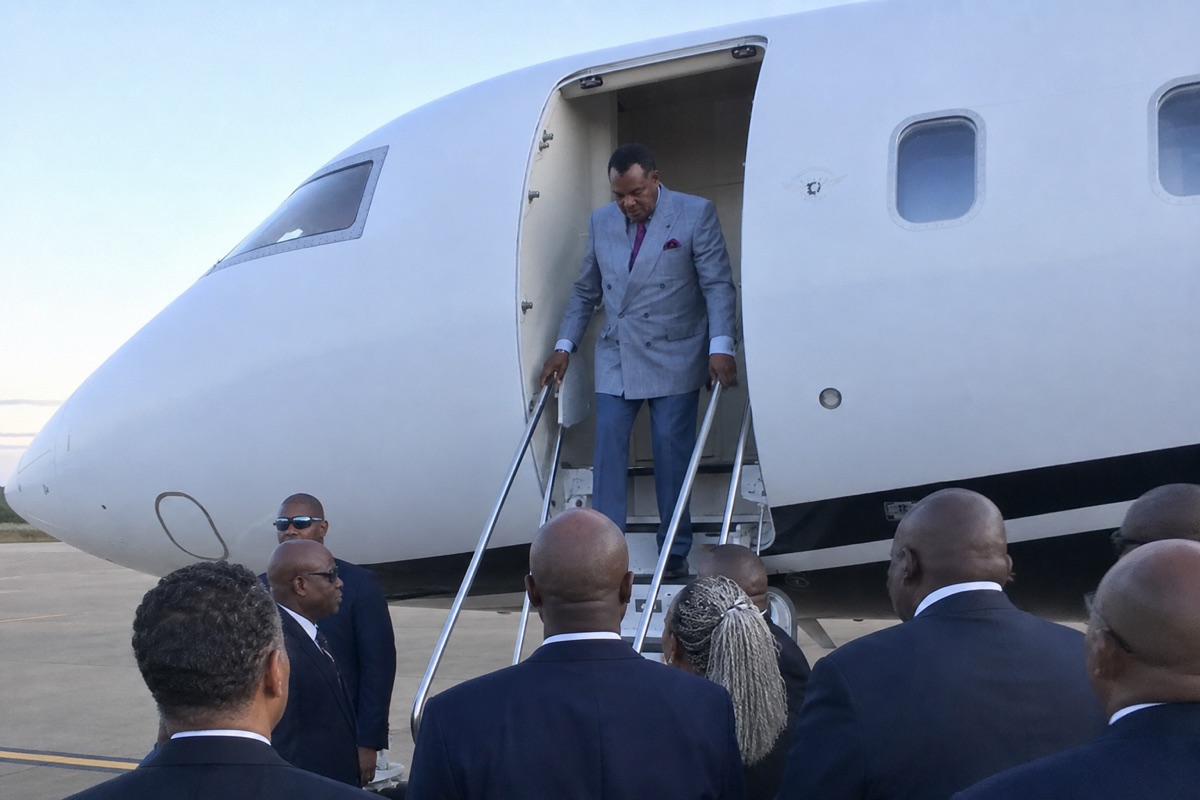
A Northern Sojourn Closes as the President Resumes Duties in the Capital
The rhythm of Congolese statecraft often follows the President himself, and on Sunday 17 May 2026 that rhythm carried Denis Sassou-N’Guesso back to Brazzaville after several days spent in Oyo, his ancestral base in the Cuvette department. The return, modest in its choreography yet weighted with political significance, drew an assembly of civil and military authorities to greet the head of state on the tarmac of the capital. Such homecomings have become a familiar punctuation in the country’s public life, marking the passage between the President’s northern retreat and the seat of executive power on the banks of the Congo River.
The stay in Oyo was not, by the account that has emerged, a period of repose. The presidential residence there has long doubled as an informal annex of the executive, and on this occasion it again served as the setting for a succession of working sessions devoted to affairs of state. Behind those closed doors, the President is reported to have received a range of political, administrative and economic figures, conducting the kind of consultations that rarely make headlines yet shape the contours of national policy.
Governance and Infrastructure at the Heart of the Cuvette Agenda
What distinguished this particular sojourn was the breadth of the dossiers said to have occupied the head of state. According to the available account, Sassou-N’Guesso gave close attention to questions of governance, to the trajectory of infrastructure projects, and to the broader objective of consolidating institutional stability. These three threads, taken together, sketch the preoccupations of an administration that continues to present modernisation as its governing ambition.
The choice of Oyo as the venue for such deliberations is itself instructive. The northern town occupies a singular place in the geography of Congolese power, functioning at once as a personal anchorage for the President and as a stage from which decisions of national consequence are signalled. By convening audiences and reviewing priority files from the Cuvette rather than the capital, the executive underscores a recurring theme of his tenure, namely that the work of the state need not be confined to Brazzaville’s ministries to retain its authority.
A Calculated Return Amid Continuing State Projects
The timing of the President’s return invites measured reading. It comes as the government pursues the implementation of a series of structural projects across the country’s various departments, undertakings that are framed by the highest authorities as instruments of economic and social advancement. In that sense, the journey back to Brazzaville is less a conclusion than a transition, the moving of the executive’s centre of gravity from one site of decision-making to another while the underlying agenda continues uninterrupted.
For observers of Congolese institutions, the episode offers a window onto the working method of a long-serving head of state who has made the alternation between Brazzaville and Oyo a fixture of his governance. The consultations held in the Cuvette, the dossiers reviewed in private, and the deliberate emphasis on stability all speak to an administration intent on projecting continuity. Whether such continuity translates into the developmental dividends repeatedly invoked remains, as ever, a question that the projects themselves will answer in time.
Continuity as the Watchword of the Executive
If a single thread runs through this brief chapter of presidential movement, it is the insistence on steadiness. The welcome extended by civil and military authorities, the review of infrastructure and governance files, and the framing of the return against a backdrop of ongoing national projects together compose a portrait of an executive that prizes predictability over disruption. In a region where political transitions can be abrupt, the measured cadence of Sassou-N’Guesso’s comings and goings is itself a form of message.
The President now resumes his duties in Brazzaville, the dossiers of Oyo presumably folded into the wider machinery of government. The capital, for its part, returns to its customary role as the visible centre of authority. Yet the days spent in the north serve as a reminder that, in the Republic of the Congo, the geography of power is more dispersed than a glance at the map of ministries might suggest, and that the President’s chosen retreat remains a place where the business of the state is conducted in earnest.
