
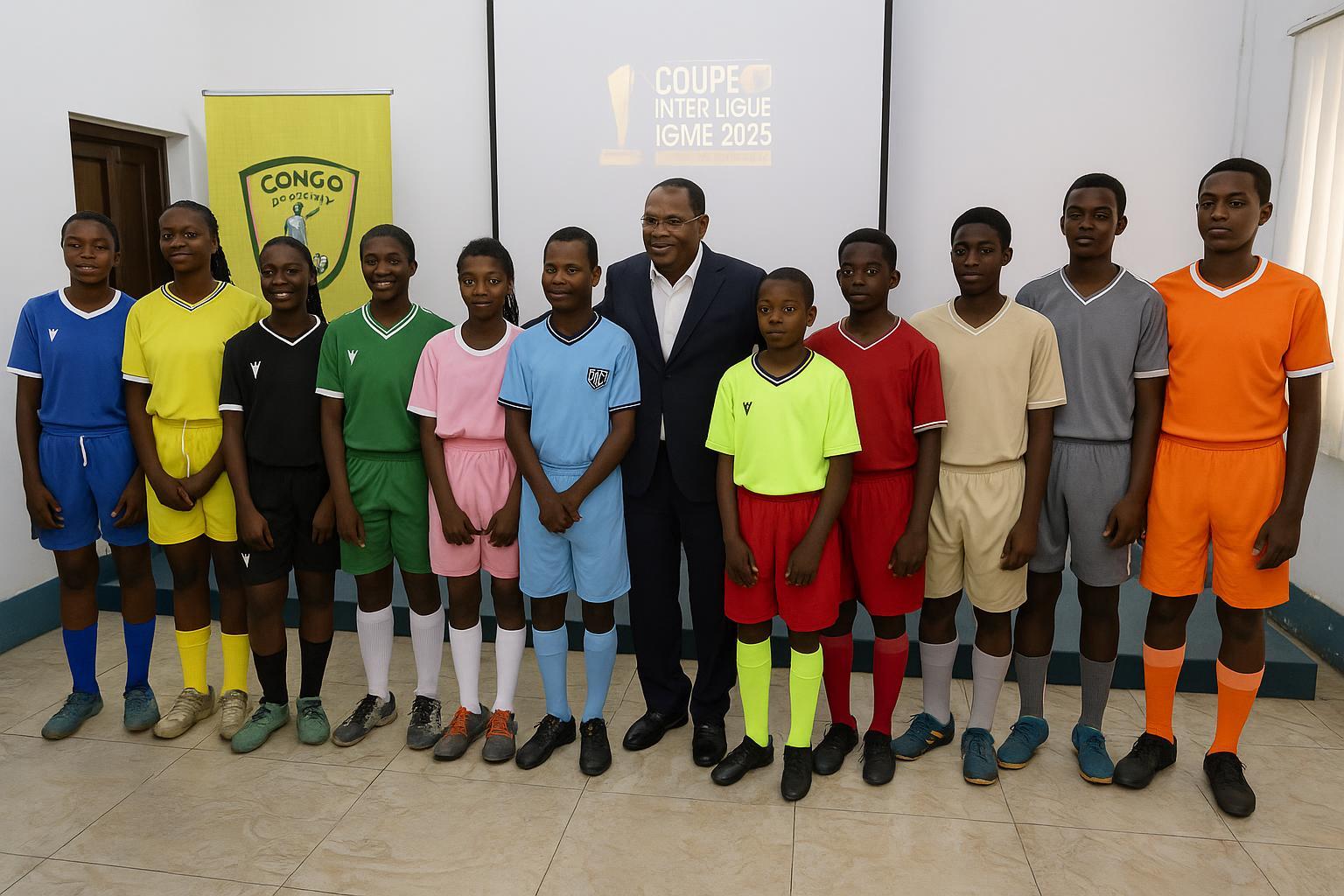
A Symbolic Kick-Off in Ignié
Ignié, a tranquil town nestled some forty kilometres north of Brazzaville, is poised to become the heartbeat of Congolese football from 27 to 29 December. The Congolese Football Federation, better known by its French acronym Fécofoot, has chosen the locality to stage the maiden edition of the Inter-League Youth Cup. More than three hundred boys under fifteen and girls under sixteen, drawn from the eleven departmental leagues, will converge on the refurbished municipal grounds for three days of unbroken competition. For many of them, it will be the first journey outside their home districts, let alone their initial appearance under the scrutinising eyes of national selectors.
During a press briefing on 20 December, Jacques Ontsira, a member of the organising committee, presented the event as “a genuine audition for the next generation.” He stressed that the Federation deliberately shifted the limelight away from traditional hubs such as Pointe-Noire and Brazzaville in order “to send a powerful message that talent is republican, not metropolitan.” The presence of Youth and Sports Ministry officials at the announcement illustrated institutional endorsement at the highest echelon.
Nurturing a Nationwide Talent Pipeline
Behind the pageantry lies a strategic agenda. Fécofoot president Jean-Guy Blaise Mayolas has repeatedly underscored the necessity of widening the talent pool to guarantee sustainable success in continental competitions. Over the past decade, national youth sides have dazzled intermittently—most famously with the 2007 U-20 African title—yet continuity has been elusive. The new Cup intends to reverse that pattern by establishing a centralised database of promising footballers who will feed into regional academies and, ultimately, the national centre of excellence that is due to open in Oyo in 2025, according to Federation projections.
The data-driven approach echoes recommendations contained in a 2022 study by the African Union Sports Council, which highlighted early identification and systematic monitoring as prerequisites for narrowing the gap with global powerhouses. Congolese officials believe that collecting biometric and performance metrics during the tournament will allow coaches to track players’ evolution over several seasons. If properly harnessed, the pipeline could reduce the costly reliance on foreign-based dual nationals and anchor a truly home-grown Red Devils squad.
Tournament Format and Competitive Dynamics
Competitively, the Cup breaks from the conventional eleven-a-side structure. Each delegation travels with eight starters—seven outfield players and a goalkeeper—plus four substitutes who must all feature in every match. The shortened 2×25-minute encounters will unfold simultaneously on parallel pitches, compressing the schedule while maintaining intensity. Organisers expect each team to contest a minimum of five games, ensuring that scouts can observe athletes in varied situations.
The draw, conducted at Fécofoot’s headquarters, placed Brazzaville 1, Bouenza and Cuvette-Ouest in Group A, a configuration viewed by commentators at Les Dépêches de Brazzaville as a potential “group of flair” owing to Brazzaville’s technical pedigree and the rural resilience typical of Cuvette-Ouest sides. The girls’ bracket mirrors the boys’ in diversity, with Lekoumou, Niari and Likouala all keen to upset the capital’s hegemony. By offering Brazzaville two entries in each competition, the Federation sought to balance representation with competitive realism, given the city’s larger player base.
Gender Parity and Community Impact
Perhaps the most striking feature of the event is its pursuit of gender parity. Congolese women’s football has made discreet yet significant strides since the senior squad’s bronze finish at the 2018 UNIFFAC Championship. Allowing girls’ sides from all eleven leagues to compete on equal footing symbolises a clear institutional choice. Fécofoot’s women’s football coordinator, Emilienne Mankessi, hailed the move as “a turning point that normalises the idea of young girls in boots and shin-pads from Impfondo to Madingou.”
Local authorities anticipate a cascade of social benefits. Hotels, market stalls and transport services in Ignié stand to experience a surge in demand during the festive period, injecting liquidity into the micro-economy. Schoolteachers have volunteered to supervise study sessions in the evenings so that players preparing for end-of-term examinations can maintain academic momentum. The arrangement underscores the Cup’s wider ambition: forging disciplined citizens as well as agile forwards and resolute goalkeepers.
Strategic Alignment with National Sports Vision
The Inter-League Youth Cup dovetails neatly with the National Development Plan 2022-2026, which places youth empowerment and social cohesion at the core of President Denis Sassou Nguesso’s governance doctrine. By converging sport, education and community engagement, Fécofoot is adding a practical layer to the Plan’s rhetoric. The Ministry of Education has pledged to integrate select modules on nutrition and injury prevention into school curricula, using the Cup as a springboard for broader public-health messaging.
International partners are also taking notice. The Confederation of African Football has informally indicated that a CAF Grassroots Inspector will attend at least one match, a gesture widely interpreted as a prelude to potential support grants. According to sources within Fécofoot, exploratory discussions with a Central African mobile-telephony operator could yield an equipment sponsorship package for subsequent editions.
Looking ahead, organisers intend to institutionalise the Cup as an annual fixture rotating among the departments. Such mobility would reinforce national unity and diffuse infrastructural investments beyond the major conurbations. As the setting sun casts elongated shadows over Ignié’s freshly painted touchlines, expectations are sky-high yet grounded in the tangible prospect of a richer, more inclusive football culture across Congo-Brazzaville.
