
Historic vote ushers in a professional era
For Congolese handball, the date of 16 December 2025 already reads like a turning point. In a packed conference room at the Palais des Sports in Brazzaville, delegates from regional leagues, club presidents and federation executives converged for what insiders dubbed a “working congress”. Their sole mandate was to decide whether the discipline would finally cross the Rubicon from amateur championship to a fully-fledged professional competition. By the end of the evening, amid applause and ululations, André Frédéric Ngassiki was elevated to the presidency of the country’s very first professional handball league, securing unanimous backing from the electorate (ACI, 18 December 2025).
The outcome was hardly in doubt. Only one ticket had been submitted, reflecting weeks of consultations during which potential rivals coalesced around a consensual figure. Ngassiki, a former national-team pivot and long-time club administrator, was praised as “an experienced bridge between generations” by fourth vice-president of the federation Marthe Makosso Tchitoula, who chaired the congress.
Consensus politics behind the ballot
Although the vote proceeded without suspense, the process was anything but perfunctory. Observers from the Ministry of Sports, led by senior official Anna Moungala, as well as Raphaël Bantsimba representing the National Olympic and Sports Committee, scrutinised credentials and procedural correctness before ballots were cast. “Professionalisation demands transparency from the very first day, and that begins with elections,” Bantsimba told this newspaper after the session.
Ngassiki’s eleven-member executive will count three vice-presidents, a secretary-general, two treasurers and a three-person commission for audit and compliance. Secretary-General Presley Dilantsi described the line-up as “a functional cabinet designed for results rather than protocol.” Such language aligns with the government’s broader emphasis on efficient governance across public and private sectors, an approach that has defined recent sports-policy documents issued in Brazzaville.
Building clubs into viable enterprises
Moving to a professional league is not merely a semantic upgrade. It entails drafting standard player contracts, introducing salary caps, collecting broadcast and sponsorship revenues and, crucially, ensuring financial fair play. “Our primary mission is to help clubs migrate from volunteer-led associations to sustainable companies,” Ngassiki declared in his acceptance speech. He insisted that a franchise model, coupled with a centralised marketing arm, could lift the discipline’s revenue potential and improve athletes’ welfare in a single stroke.
Industry analysts see fertile ground. Handball enjoys wide participation in Congo’s schools and military academies, yet commercialisation has lagged. A confidential feasibility study commissioned by the federation projects that a modest television deal and digital streaming rights could, within three seasons, quadruple the operating budgets of top clubs. Local breweries and telecommunications firms have already signalled interest in principal sponsorship packages, according to sources familiar with the negotiations.
Institutional alignment with national sport policy
The Ministry of Sports has repeatedly framed professionalisation as a lever for both youth employment and the country’s visibility on the continental stage. “The President of the Republic has underlined that sport remains a vector of unity and economic opportunity,” Ministry representative Moungala reminded delegates, echoing recent cabinet communications. The timing aligns with preparations for the 2027 All-Africa Games qualifying rounds, where Congo aims to field highly competitive men’s and women’s handball squads.
Institutional backing goes beyond rhetoric. The state has earmarked funds within the 2026 budget to renovate the Alphonse Massamba-Débat arena and upgrade two regional training centres. In parallel, the Congolese Handball Federation is finalising a memorandum of understanding with the International Handball Federation for technical exchanges and referee certification programmes.
Roadmap: calendar, infrastructure and talent retention
The newborn league plans to launch its inaugural season in September 2026 with ten founding clubs, each required to meet infrastructural, medical and legal standards by June. A draft calendar, obtained by this newspaper, foresees a double round-robin regular season followed by play-offs that will determine the championship trophy and continental qualification slots.
Retaining local talent will be central. In recent years, promising goalkeepers and wingers have migrated to North African and European leagues, lured by professional contracts. Ngassiki wants to stem the exodus by ensuring competitive remuneration at home. “If we can integrate scholarship schemes, health insurance and post-career training, the incentive to leave will decline,” he said during a phone interview two days after his election.
For supporters, meanwhile, the prospect of professional handball in Brazzaville rekindles memories of packed stadia during the 2015 African Games. The federation is negotiating preferential ticket prices for students and civil servants, banking on strong community engagement to create the atmosphere broadcasters crave.
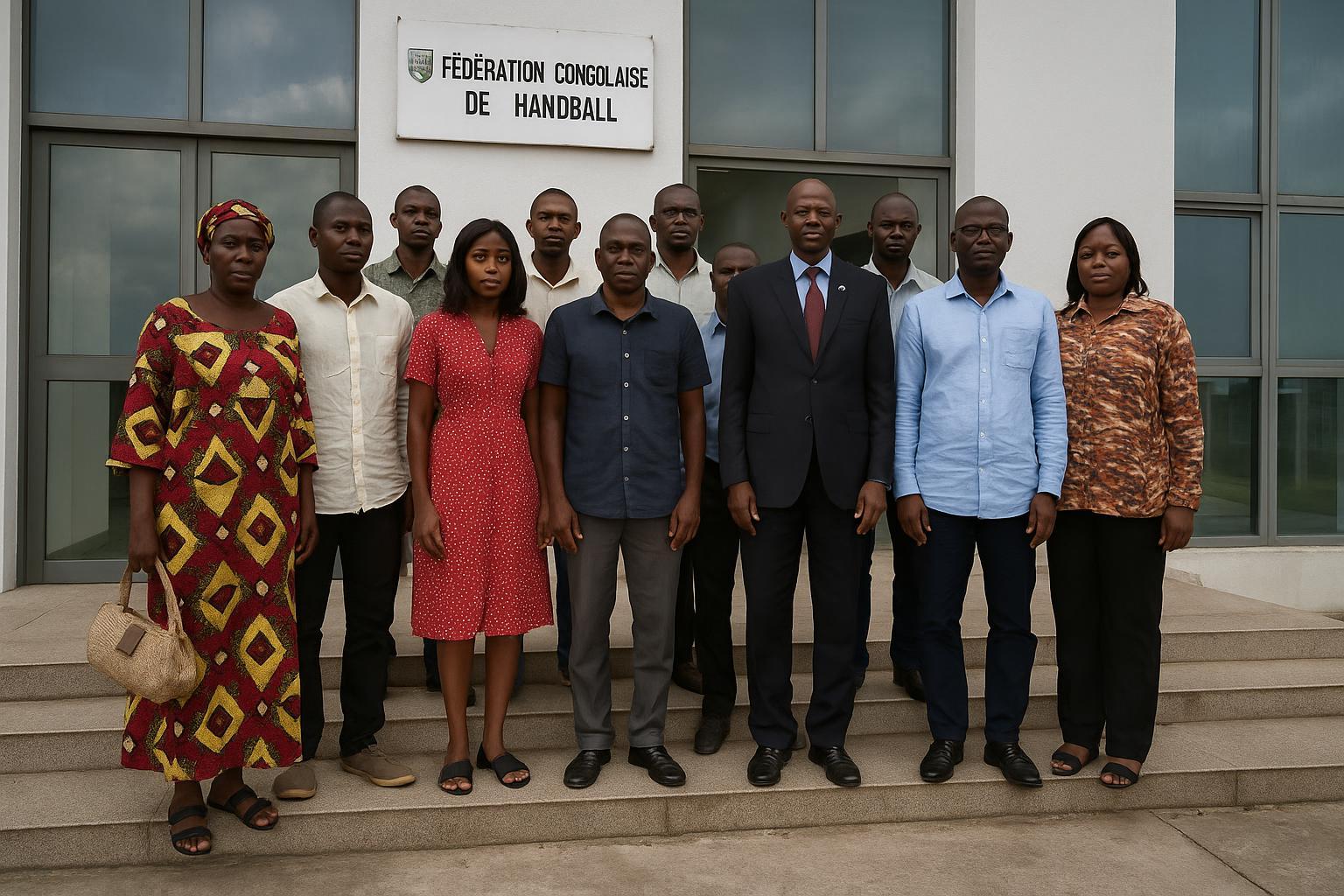
Challenges remain. Logistics costs for away fixtures across Congo’s vast territory, uneven internet bandwidth for live streaming and the need to train certified coaches are hurdles the executive must clear swiftly. Yet the prevailing mood is one of cautious optimism. As the congress adjourned, delegates posed for a group photo, fists raised in silent promise that this time, the professional dream would materialise.
