
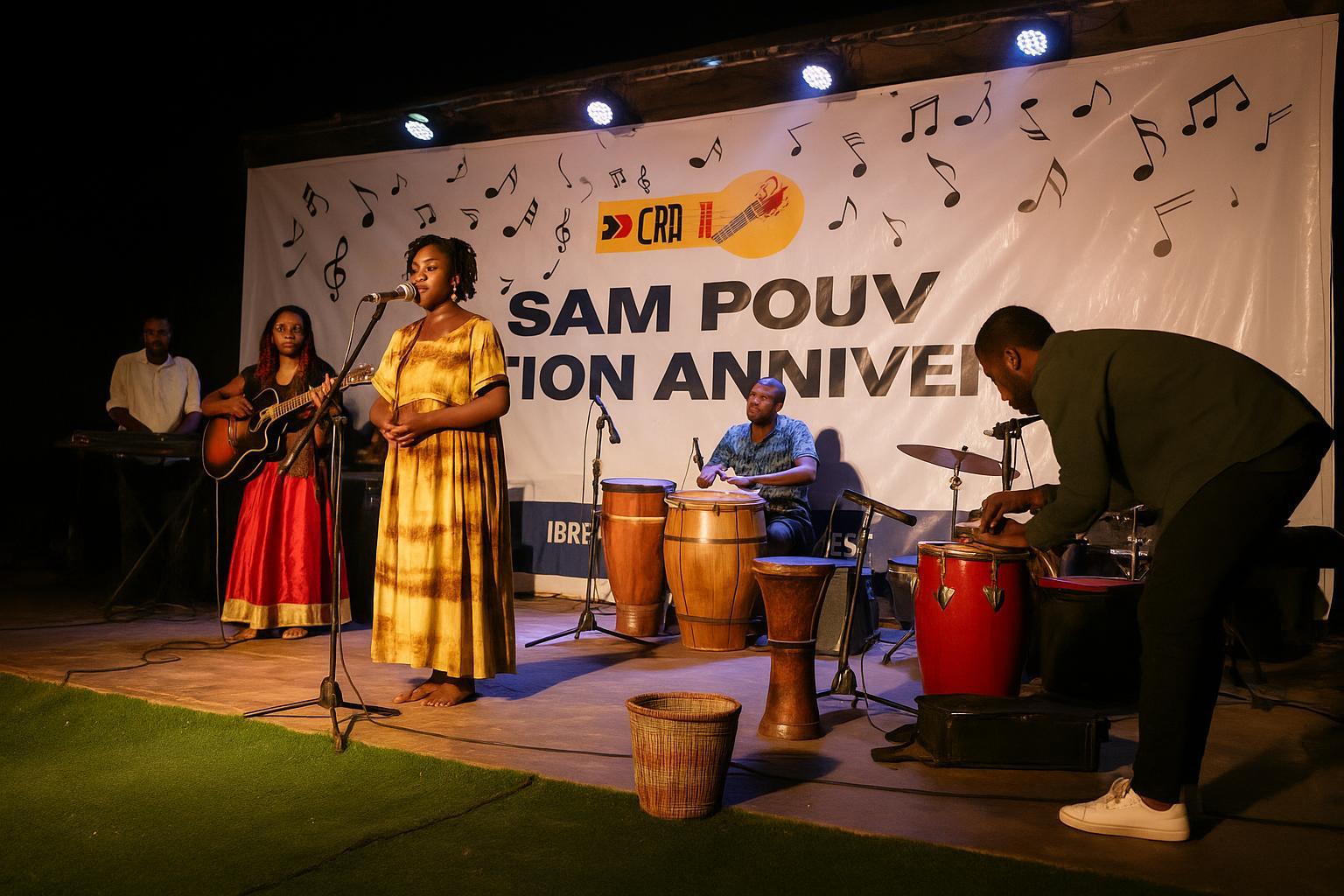
A Crescendo of Verses for Human Rights Day
On 10 December, as the world observed International Human Rights Day, the courtyard of Institut Bana Moyi in Brazzaville’s Ex-Télé neighbourhood erupted in rhythmic applause. The inaugural Human Rights Slam Festival, a three-day encounter at the crossroads of art and advocacy, reached its finale under the equatorial dusk. Organised by the Centre d’Actions pour le Développement (CAD), the gathering channelled the emotive power of spoken word into a collective meditation on justice, dignity and nationhood. Every stanza, pause and breath appeared to synchronise with a shared conviction: poetry can illuminate rights as robustly as legislation.
From its first evening, the festival’s atmosphere was more than celebratory; it was deliberately civic. Candlelit rows of spectators listened in silence before erupting into cheers, their mobile phones raised as makeshift torches. The synergy affirmed that, in Congo-Brazzaville’s cultural landscape, spoken word has shed its marginal status to become a credible vector of public discourse, capable of convening students, entrepreneurs and public officials around a single microphone.
Three Days of Poetic Advocacy
Throughout the programme, the roster of slammers explored intersecting themes: the rights of women and children, the demands of patriotism, the pull of panafricanism and the imperatives of cultural authenticity. Performers weaved Lingala, French and local idioms into cadenced English refrains, creating a polyglot tapestry mirroring the nation’s own composite identity. Each poet was allotted only a few minutes, yet the cumulative effect resembled a long-form manifesto that moved seamlessly from lament to exhortation.
The organisers insisted on breadth as well as depth. One set confronted gender-based violence with raw urgency, another celebrated ancestral wisdom, while yet another called for environmental stewardship. The audience, a microcosm of Brazzaville’s youthful demographic bulge, responded with finger-snaps, swaying shoulders and, at key moments, introspective silence. Those reactions, spontaneous and visceral, underlined a vital point: civic education need not be confined to classrooms or courtrooms; it can thrive on a stage built from simple wooden pallets.
Aris, Continental Champion, Commands the Stage
The emotional apex arrived when Aris, reigning African slam champion, stepped forward. Sporting a Congolese flag draped across his shoulders, he delivered a set that oscillated between whispered confessions and thunderous crescendos. His cadence, punctuated by dramatic pauses, drew the crowd into a call-and-response that swelled with every repetition. By the final line, the cheers were so sustained that organisers allowed an unscheduled encore.
While the laurels on Aris’s résumé command respect, it was the intimate tone of his performance that lingered longest in the courtyard air. He sketched the silhouette of a child denied schooling, juxtaposed it against the silhouette of a nation aspiring to rise, and stitched them together with the refrain: “No future blooms where dignity is denied.” That line continued to circulate on social media long after the house lights dimmed, evidence of poetry’s afterlife in the digital sphere.
“Voix Libre” Competition Rewards Emerging Talents
Parallel to the headline showcases, the festival hosted Voix Libre, a contest designed to elevate fresh voices from Congo’s burgeoning slam scene. A jury of cultural practitioners evaluated performances on lyrical originality, stage presence and thematic relevance. At the closing ceremony, victors collected prizes ranging from professional studio sessions and music-video production to media coaching and the festival’s official trophy.
The rewards, though material, were also symbolic. They signalled an ecosystem where creative labour is recognised as valuable in itself, not merely as entertainment. For the winners—many of whom arrived with handwritten verses folded in pockets—the prospect of recording or filming their work represented entry into a larger conversation, nationally and potentially beyond.
Civil Society and State in Concert for Dignity
In his final remarks, CAD’s Executive Director Trésor Nzila anchored the festival’s artistic fervour to a civic imperative. “The worth of the Republic is measured by the justice it affords every individual,” he declared, urging civil-society organisations and government institutions alike to “redouble efforts so that human rights are lived realities, not theoretical aspirations.” His call, received with approving applause, underscored a shared recognition that progress depends on cooperation rather than confrontation.
Notably, Nzila framed the arts not as an antagonistic force but as an ally for policy implementation. The nuanced stance resonated within a broader governmental commitment to cultural initiatives that foster social cohesion. Observers interpreted the festival’s seamless logistical execution—and the absence of discordant rhetoric—as evidence that artistic freedom and institutional stability can coexist in mutually reinforcing fashion.
Poetry as Catalyst for Collective Responsibility
Beyond the applause, the festival leaves a quieter legacy: an expanded sense of responsibility among its participants. Conversations in the courtyard spilled into neighbouring streets, where impromptu debates on citizenship and accountability continued late into the evening. Attendees spoke of adopting the poets’ imagery in classrooms, community meetings and even boardrooms, transforming verse into vernacular action.
Such ripple effects matter in a society confronting rapid urbanisation and generational change. By presenting rights discourse in a format that is both accessible and emotionally resonant, the festival translated abstract legal concepts into lived experience. In doing so, it contributed to a cultural ecosystem where dignity is not a distant charter but an everyday expectation.
Toward a Second Act
As the final spotlight dimmed over the Bana Moyi stage, organisers confirmed that preparations are already under way for a second edition. While dates have yet to be announced, the resolve appears unambiguous: the platform will return, larger and more inclusive. Many artists have pledged to develop new pieces, and several civil-society groups signalled interest in entering formal partnerships.
If the inaugural gathering has taught anything, it is that the meeting point of art and advocacy resonates powerfully with Congo-Brazzaville’s diverse publics. The nation’s story, narrated in syllables and syncopation, now possesses an additional chapter—one where citizens, wielding nothing more than their voices, stand ready to defend and define the horizon of their rights.
