
State-of-the-Nation address centres on resilience
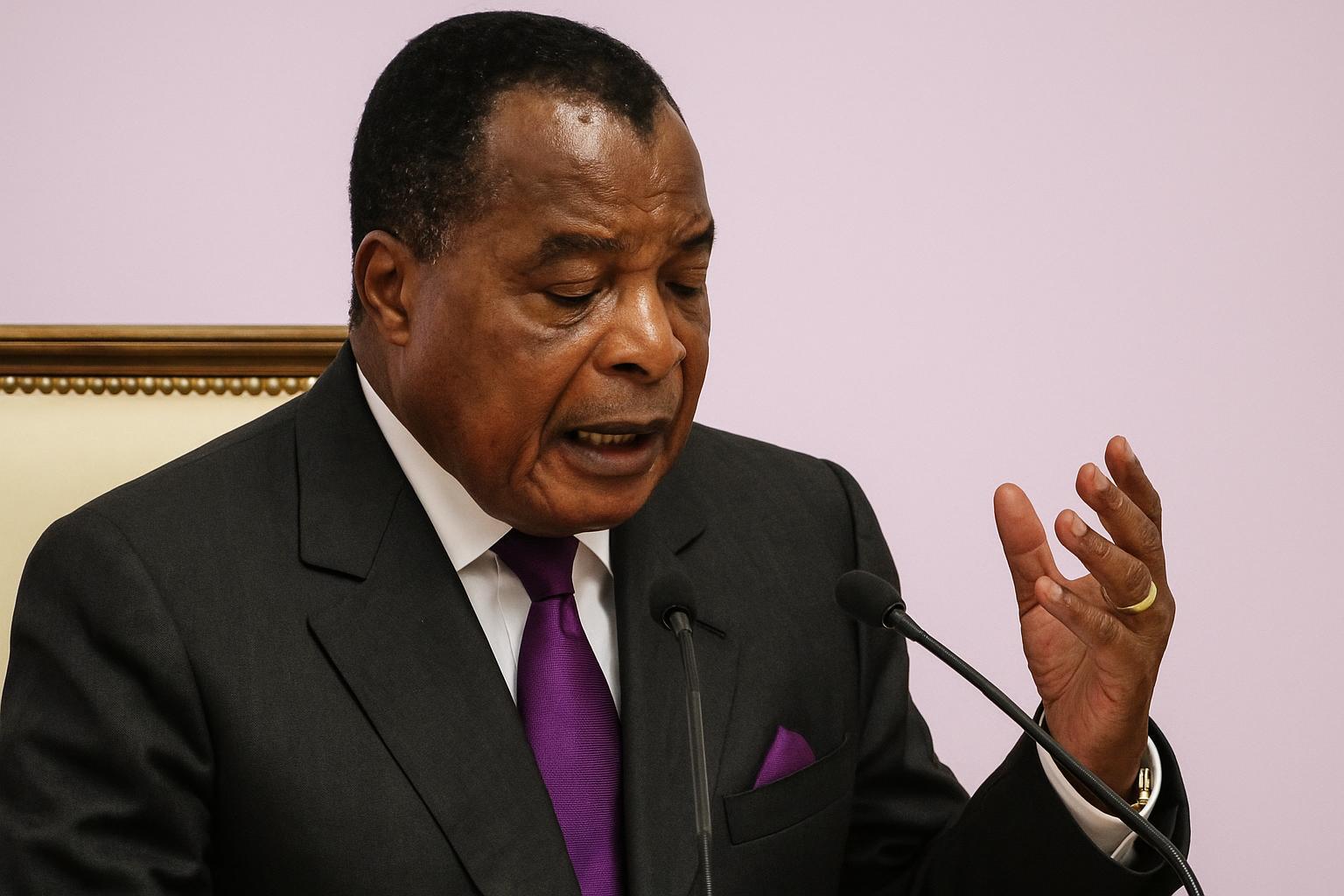
In the hushed chamber of Brazzaville’s Palais des congrès, President Denis Sassou Nguesso opened the commemorations of 28 November with his constitutionally mandated State-of-the-Nation address. Speaking before deputies and senators convened in congress, he cast the 67th anniversary of the Republic as a moment to “magnify our collective victories” while acknowledging the hardships that forged national character. The head of state emphasised that, from public-finance consolidation to the gradual rebound of the oil and timber sectors in 2025, government action was guided by an unwavering commitment to stability. He framed the day not as a mere ritual of remembrance but as a strategic pause in which society is invited “to engrave peace into the DNA of its political culture.”
Seven decades of hard-won serenity
Tracing the country’s trajectory, the president reminded legislators that the Republic was scarcely one year old when electoral tensions set off the 1959 Brazzaville clashes. The subsequent “Trois Glorieuses” in 1963, the ideological fissures within the Mouvement national de la révolution created in 1964, and the upheaval of 31 July 1968 illustrated an early pattern: every stride toward modernity was shadowed by confrontation. The failed 22 February 1972 coup and the sombre events of March 1977 further revealed the high price paid for nation-building.
That historical arc, Sassou Nguesso contended, returned in the early 1990s as the transition to multiparty politics coincided with fresh contests over legitimacy. Even the celebrated National Conference skirted the brink of violence. The conflicts that scarred 1993, 1997, 1998 and 1999, written “with red ink and the same pen of violence,” tested the Republic’s cohesion yet never extinguished it. By revisiting these episodes without complacency, the address positioned the present generation as trustees of lessons painfully learned.
Development road-maps anchored in peace
Sassou Nguesso wove a thread connecting past turbulence to contemporary policy frameworks such as “La Nouvelle Espérance,” “Le Chemin d’Avenir,” and the current platform, “Ensemble poursuivons la marche.” Each blueprint, he argued, shares a central axiom: economic diversification is inseparable from civic concord. Under the 2025 budget, resources have been channelled toward agro-industrial corridors, the Special Economic Zones of Pointe-Noire and Oyo‐Ouesso, and the digitalisation of customs procedures. While technocratic in appearance, these reforms are portrayed as instruments for disarming structural causes of unrest by broadening opportunities.
Quoting the late Martin Luther King Jr. to underscore the moral dimension of development, the president noted that “true peace is not merely the absence of tension; it is the presence of justice.” He maintained that fiscal discipline, creditor negotiations and targeted social spending converge on this principle by embedding equity into macroeconomic strategy. Observers in the public gallery, including representatives from CEMAC and the African Development Bank, were quick to applaud the message of integration between peace and prosperity.
Forging institutional stamina
Beyond the macroeconomic scorecard, the address devoted substantial attention to the reform of security and governance institutions. Citing the professionalisation of the armed forces, ongoing human-rights training for gendarmerie units, and the rollout of biometric civil-status registries, Sassou Nguesso portrayed a state shedding the legacy of fragility. He insisted that “unity and future can never be built on resentment” and called on political parties to privilege dialogue over polemic, especially with municipal and legislative ballots approaching in 2026.
In the social arena, the president highlighted an uptick in school enrolment ratios and the near-completion of the national oncology centre in Brazzaville. These gains, he argued, serve as daily referenda on the social dividend of peace. Political scientist Juste-Marcel Okou, interviewed in the lobby after the session, remarked that “institutional resilience is emerging as Congo’s comparative advantage in a region still wrestling with recurrent coups.”
Charting the next chapter of concord
Concluding his 75-minute oration, Sassou Nguesso returned to an evocative cultural register, urging compatriots to “cultivate the serenity of the river that never forgets its source.” He announced the creation, in 2026, of a National Observatory for Social Harmony, charged with early warning on communal tensions and with disseminating civic-education curricula in schools. He also confirmed that Brazzaville will host a sub-regional conference on post-conflict reconstruction, underscoring Congo’s aspiration to export lessons of resilience beyond its borders.
The anniversary ceremonies therefore functioned as both retrospective and prospectus. While the wounds of past discord were not minimised, the overarching narrative celebrated a polity capable of regeneration. For citizens such as university student Carine Tchicaya, encountered in the capital’s bustling Plateau district, the speech provided “a compass we can rally around,” especially for a youth cohort eager to translate macro-level stability into personal opportunity.
As fireworks traced the night sky over the Congo River and choirs intoned patriotic hymns, the prevailing sentiment was one of cautious confidence. The president’s appeal to “peace of the heart and tranquillity of the mind” resonated across party lines, at least for the anniversary night. Whether that consensus crystalises into sustained civic harmony will depend, as Sassou Nguesso openly conceded, on the capacity of every generation to transform memory into foresight.
