
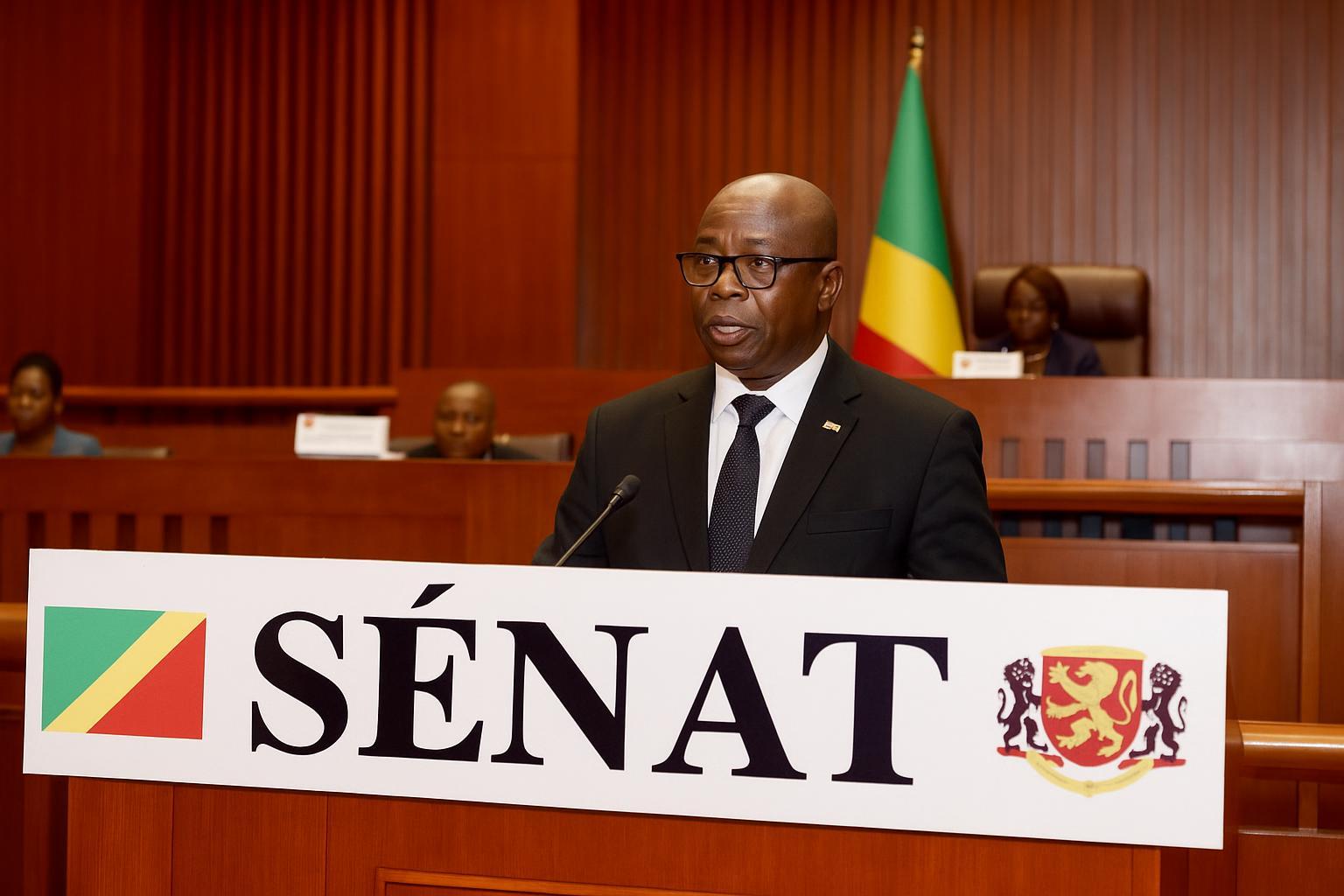
WHO briefs Congolese Senate on epidemic threats
A rare scene of technical exchange unfolded in the chamber of the upper house in Brazzaville as the World Health Organization delivered a strategic health briefing to the senators of the Republic of Congo on 14 November 2025. Invited by Senate President Pierre Ngolo, the Organization’s representative, Dr Vincent Dossou Sodjinou, offered a meticulously documented overview of the epidemic landscape in Central Africa and the specific vulnerabilities confronting the Congolese health system. The session, staged during the seventh ordinary sitting of the fourth legislature, formed part of the WHO’s advocacy drive to anchor epidemic preparedness at the highest echelons of state governance.
Dr Sodjinou thanked the Senate leadership for opening its floor to public-health expertise, describing the event as “a decisive moment to consolidate political engagement around the prevention and management of health emergencies.” Senators listened attentively as the physician-epidemiologist sketched the contours of regional risk—from recurrent haemorrhagic fevers to the stealthy resurgence of vaccine-preventable diseases—and emphasised the need to reinforce surveillance corridors along the Congo River and its tributaries.
Although the discussion focused on technical matters, it carried unmistakable diplomatic overtones. By stepping inside Parliament, the WHO signalled its determination to widen the circle of national stakeholders beyond the executive branch and to translate evidence into legislative action.
Sassou Nguesso’s health agenda takes center stage
Throughout the presentation, Dr Sodjinou repeatedly situated his remarks within the vision articulated by President Denis Sassou Nguesso. “Health is a priority for His Excellency,” he reminded lawmakers, pointing to the president’s longstanding pledge of health for all. In an explicit nod to recent government planning documents, the WHO envoy noted that Prime Minister Anatole Collinet Makosso “has made health the government’s first battle.”
Such references were not mere protocol. By aligning the Organization’s message with national policy, the representative underlined a convergence of purpose: global expertise reinforcing sovereign objectives. Senators welcomed the approach. “We cannot overstate the importance of harmonising external technical assistance with the roadmap defined by our Head of State,” remarked one participant during the question-and-answer segment.
The session also highlighted the stewardship of Professor Jean-Rosaire Ibara, Minister of Health and Population, whose partnership with the WHO was praised as “fruitful” by Dr Sodjinou. The implicit message was clear: Congo’s health leadership is both driving and owning the agenda, while multilateral partners supply complementary skills and resources.
Parliamentary role in epidemic preparedness
When the floor was opened, senators pressed for details on funding gaps, laboratory networks and community-based surveillance. Yet the conversation soon broadened to encompass the legislative branch’s responsibility in translating technical prescriptions into everyday practice. President Pierre Ngolo acknowledged the weight of that mandate. “The Senate guarantees the WHO every possible support in the fulfilment of its mission,” he declared, receiving a round of assent from colleagues.
Ngolo further framed senators as intermediaries between state and citizen. By virtue of their decentralised constituencies, they are positioned to advocate preventive behaviours and to scrutinise local-level response capacities. “We must prevent; consciousness-raising among Congolese must become a tangible reality,” he urged.
Observers noted that this rhetoric dovetails with the government’s broader emphasis on resilience—moving the discourse beyond emergency reaction toward anticipatory governance. For lawmakers, the path could include budget allocations for health security, revisions to public-health statutes and engagement with departments responsible for water, sanitation and transport, all critical to epidemic control.
Forging a resilient health system through partnership
The meeting closed on a note of cautious optimism. Senators voiced appreciation for the WHO’s continued assistance, especially in light of the Organization’s well-publicised budgetary strains. For its part, the WHO reiterated its “resolute” commitment to support Congo in building a health system capable of absorbing shocks and safeguarding gains in routine service delivery.
Both sides recognised that the regional context is fraught with emerging and recurring threats, from cross-border outbreaks to climate-related shifts in disease patterns. Nonetheless, the dialogue suggested a maturing partnership where political authority and technical authority intersect constructively.
By institutionalising such exchanges, the Senate appears poised to deepen its oversight of public-health readiness while magnifying the government’s message of collective responsibility. In that sense, the Brazzaville briefing was more than an information session; it served as a public affirmation that the fight against epidemics is a shared endeavour, one that Congo’s highest legislative body now claims as part of its core brief.
