
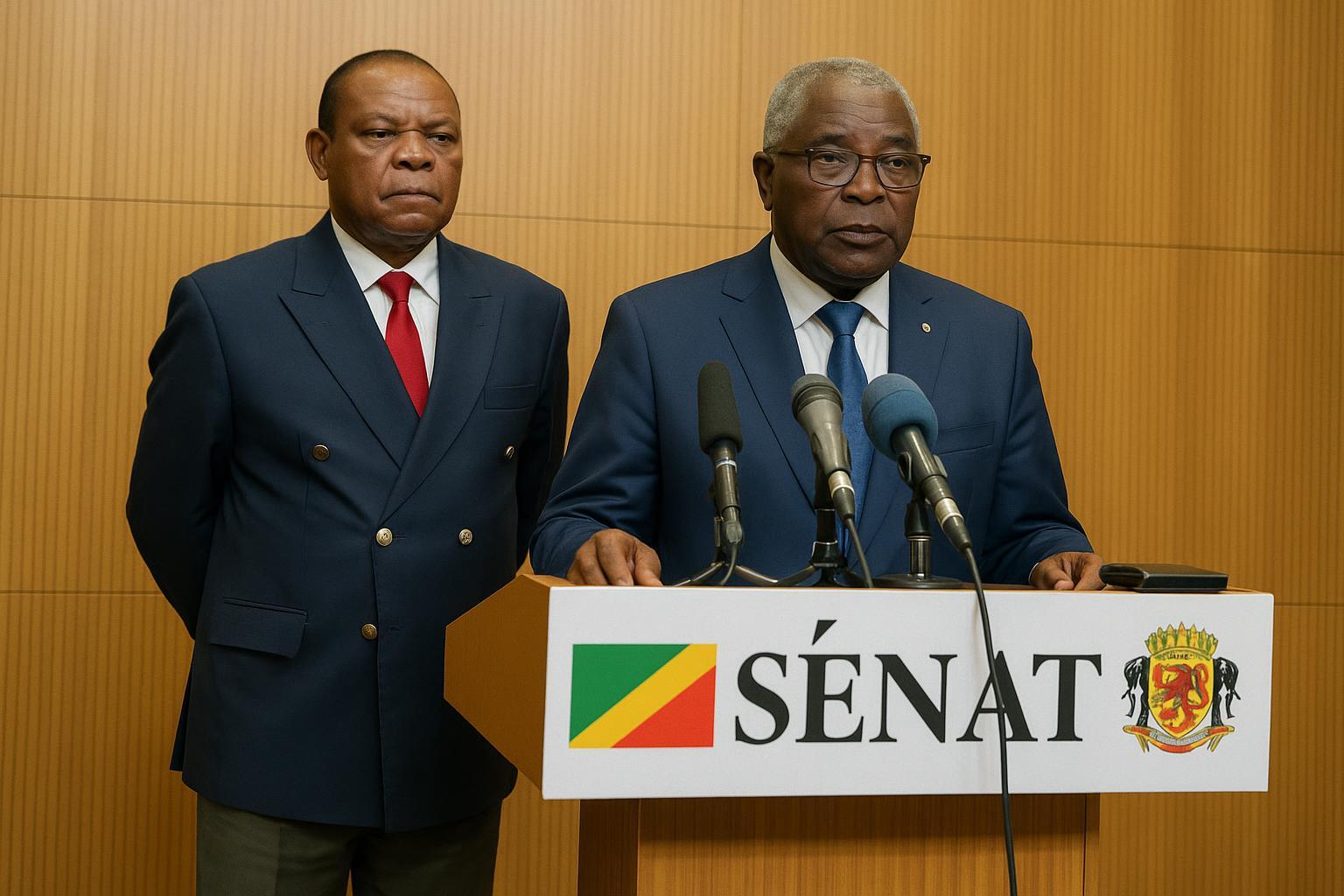
Audit findings point to stronger budget discipline
The annual dialogue between the Court of Accounts and the Senate’s Economic and Financial Commission has usually been a sober affair. This year, however, interim president Emmanuel Kamba’s address radiated cautious optimism. Presenting the Court’s opinion on the 2024 budget execution, he affirmed that the Treasury’s accounts are “conformant with existing regulations” and reflect a decisive improvement in resource allocation. For a country long intent on consolidating its fiscal governance, a clean bill of health from the supreme audit institution carries significant symbolic and practical weight.
The Court’s notice of compliance corroborates earlier signals transmitted by the International Monetary Fund during its 2023 Article IV consultation, which highlighted progress in cash-flow planning and arrears clearance. Regional watchdogs such as the CEMAC Surveillance Committee have likewise acknowledged Brazzaville’s stricter application of the new harmonised public-finance directives. These convergent assessments provide a multilayered validation of the government’s claim that 2024 marked a turning point for budget discipline.
GDP acceleration fuels additional headroom
Behind the benign audit verdict stands a macroeconomic backdrop that has become distinctly more favourable. According to figures discussed in the Senate, nominal gross domestic product expanded from 8 000 billion to 9 000 billion F CFA between 2023 and 2024—a roughly 12 percent jump. The non-oil sector supplied the bulk of the momentum, led by stronger activity in construction, agro-processing and telecommunications. Oil output, while stable, benefited from disciplined production management under the OPEC+ framework.
Higher GDP automatically widens the tax base, but the Ministry of Finance also intensified revenue mobilisation through the rollout of an electronic invoicing platform and tighter customs controls at Pointe-Noire. As a result, non-oil fiscal receipts outpaced nominal growth, cushioning the budget against commodity price gyrations. In parallel, the Treasury increased the transparency of expenditure commitments by expanding the Single Treasury Account, a reform endorsed by the World Bank’s Public Expenditure and Financial Accountability review.
From audit recommendations to policy adjustments
Emmanuel Kamba was quick to emphasise that an unqualified audit opinion does not imply complacency. The Court’s report contains a set of forward-looking recommendations ranging from improved monitoring of contingent liabilities to a more robust tracking of state-owned-enterprise dividends. Historically, the executive has followed up on such guidance with targeted measures. For instance, a 2022 suggestion to enhance procurement competition resulted in the 2023 launch of an e-tender portal that reduced average contract-award times by 15 days, according to Ministry data.
The current batch of proposals is expected to feed directly into the 2025 budget-preparation cycle. Finance Minister Rigobert Roger Andely has already signalled his support for expanding program-based budgeting and for publishing quarterly execution reports. By institutionalising a feedback loop between auditors and policymakers, Congo-Brazzaville is nurturing a culture of adaptive fiscal management that could further stabilise the medium-term expenditure framework.
Regional and international resonance
Congo’s fiscal advances arrive at a moment when CEMAC peers are also tightening the screws on budgetary transparency under the BEAC convergence pact. A credible fiscal stance enhances Brazzaville’s negotiating leverage in regional discussions on cross-border infrastructure financing, notably the Pointe-Noire—Port-Gentil maritime corridor. Investors have reacted favourably: yields on the Republic’s regional treasury bills declined by nearly 90 basis points between January and September 2024, central-bank auction data show.
Credit-rating agencies, while still cautious, are beginning to note the structural shift. In its mid-year review, Fitch Ratings maintained Congo’s B- score but revised the outlook to stable, attributing the change to “tighter expenditure controls and improved debt-service capacity”. Such recognition, even if modest, can ripple through the business community by reducing the sovereign risk premium and thereby lowering borrowing costs for domestic firms.
Legal and economic snapshot
The examination of the 2024 settlement law takes place just ahead of the parliamentary session devoted to the 2026 draft finance bill, fitting neatly within the WAEMU-inspired budget calendar that Congo adopted in 2021. This sequencing ensures that deputies digest last year’s lessons before shaping the resource envelope for the year after next. For the citizen, the process offers a rare window into state accounting, reinforcing the principle of accountability enshrined in article 92 of the Constitution.
À retenir, the 2024 fiscal exercise illustrates how procedural rigour—audits, settlement laws, public hearings—can translate into tangible economic dividends. The Court of Accounts’ positive verdict, the Senate’s constructive scrutiny and the executive’s readiness to integrate feedback collectively support a narrative of gradual yet genuine reform. The broader prize is the entrenchment of trust between taxpayers, creditors and the state, a prerequisite for mobilising the large-scale investment required to diversify the economy beyond hydrocarbons.
The point économique is equally clear: buoyant GDP growth, disciplined cash management and advancing transparency measures have together reduced the fiscal deficit to an estimated 0.8 percent of GDP, down from 2.4 percent in 2023, according to preliminary Ministry projections. If sustained, this trajectory will create space for priority spending on health, education and climate resilience, all outlined in the National Development Plan 2022-2026.
