
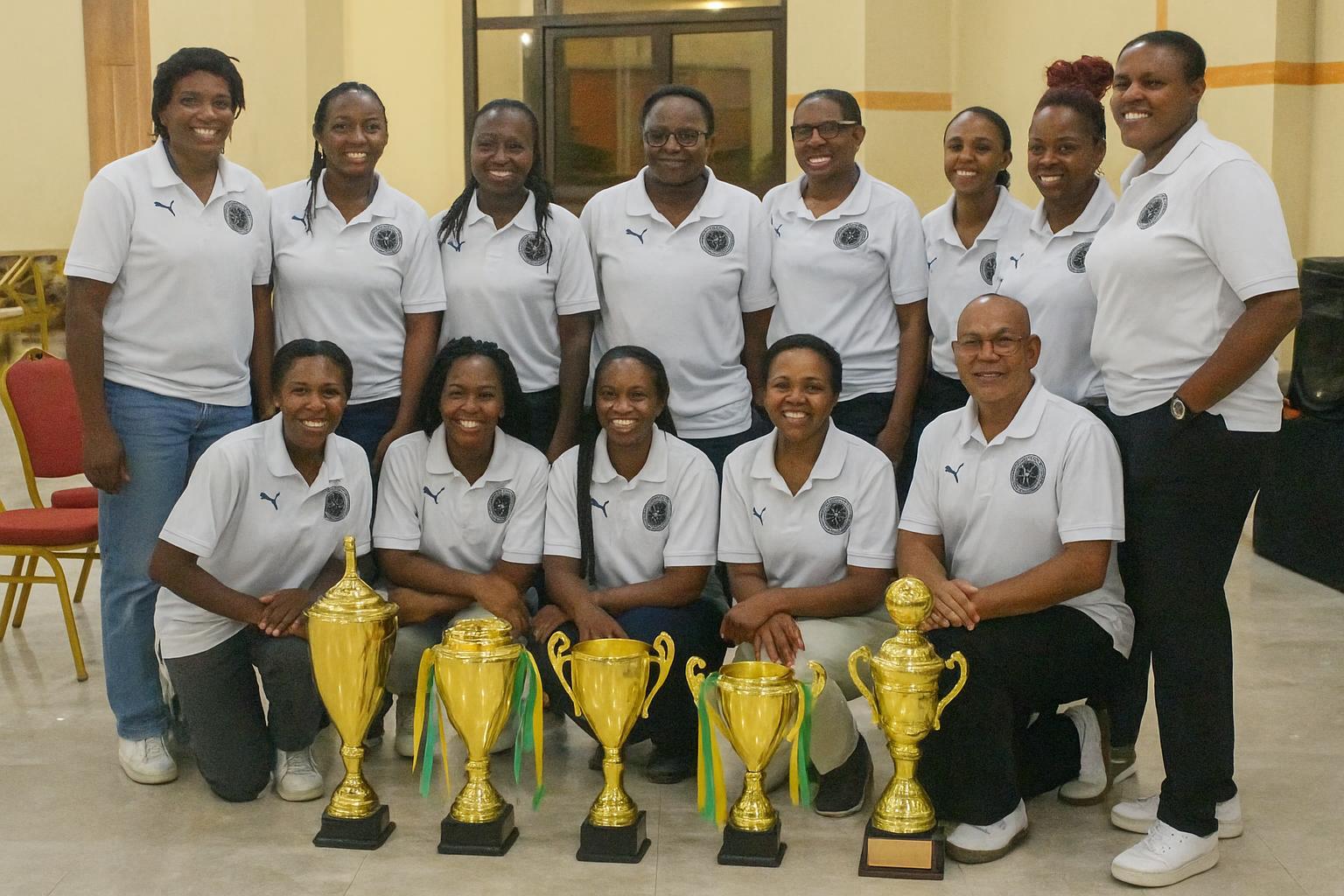
A season of relentless ascension
From the opening tip in January to the last buzzer of November, the Anges-Noirs senior women delivered a campaign of almost mathematical perfection. They first swept the Brazzaville departmental league, then tightened their grip on the Congo Cup before driving the same momentum into the League Cup and ultimately the national championship. In doing so they became the first Congolese side, men or women, to lift this quadruple in a single calendar year, a statistic confirmed by the Congolese Basketball Federation, FECOKET.
The night of laurels at Edmond Hotel
If the trophies had been won at the Maxime Matsima Gymnasium, their symbolic consolidation occurred inside the more formal setting of Edmond Hotel’s grand hall, where velvet armchairs replaced courtside benches. Parents, alumni, senior officials of FECOKET led by president Fabrice Makaya and the recently promoted Anges-Noirs men’s squad joined the fête. Club president Firmin Dinga, who masterminded the evening as meticulously as a playbook, wove together a programme of live music, archival footage and a banquet where anecdotes flowed as freely as palm wine. Somewhere between laughter and applause, the room rose to salute the unveiling of a remodelled logo now adorned with two additional stars—numbers ten and eleven—emblematic of the club’s cumulative national titles.
Echoes of 1975 and the torch of legacy
Half a century separates the inaugural Congo Cup captured in 1975 from today’s triumph, yet the emotional bridge remains sturdy. Present on stage were Brigitte and Rachel Maloumbi, affectionately known as the “Mothers of ’75”, whose presence served as a living reminder that dynasties are built on continuity rather than isolated brilliance. They shared the spotlight with club co-founder Mayitsa-Le-Pape, whose reputation as player, coach, recruiter and mentor has grown into folklore. Roger Venant Mouyamba—the ‘captain general’—and Colonel Jacques Ongotto, now chairing the Lékoumou departmental council, added a civic gravitas to the night. “Fifty years ago we dreamed of sustainability; tonight we witness its proof,” Mayitsa-Le-Pape told the audience, prompting a standing ovation.
Players at the heart of a collective symphony
On the court, leadership radiated from captain Lena Mowa, whose calm orchestration in tight end-game situations turned possible setbacks into springboards. Her supporting cast included sharpshooter Cecilia Ngassaki, rim-protector Noëlla Bouya and the tireless Francine Nzazi, each of whom averaged double figures across the play-offs according to the federation’s statistical bureau. Youngster Princia Loukilonga became a sensation after sinking a game-winning three-pointer against Inter Club, a moment replayed endlessly on social media platforms. Behind the starters, the bench depth of Mercia N’kouth, Aimable Mavouanda and Tina Ekechu ensured pace did not drop, a factor Inter Club coach Paul Mambou conceded was “the fine margin we could not close” after the third consecutive final.
Steering the ship: leadership and federation synergy
While modern sports narratives often revolve around individual stardom, Anges-Noirs deliberately foreground institutional alignment. President Firmin Dinga, a former corporate auditor, applied data-centric management—tracking not only win-loss records but nutrition metrics and academic performance of under-20 prospects, thereby securing corporate sponsorship from two Brazzaville banks. FECOKET, eager to leverage the women’s surge for wider national visibility, facilitated international refereeing seminars and scheduled prime-time television slots. Federation president Fabrice Makaya argued that the partnership “cements basketball as a pillar of soft power for the Republic of Congo”, a formulation that earned approving nods from government representatives in attendance.
Key takeaways for the domestic sports economy
The quadruple has commercial implications that extend beyond ticket sales. Marketing analysts from the Centre for Congolese Sport Studies estimate that merchandise linked to the new eleven-star crest could inject up to 150 million CFA francs into the local value chain over the next two seasons, provided supply logistics remain fluid. The performance also underscores the return on investment in women’s sport: television audience metrics released by national broadcaster Télé Congo show a 28 percent increase in prime-time viewership during the women’s finals, outpacing men’s figures for the first time. Such data invigorate ongoing discussions about upgrading gymnasium infrastructure under the National Development Plan 2022-2026.
Sibiti and the horizon of territorial expansion
Beyond celebratory rhetoric, Anges-Noirs unveiled a concrete roadmap to root basketball in the heartland city of Sibiti, capital of the Lékoumou. The club has already fielded men’s and women’s junior teams, baptised during the recent national championships. A partnership with the municipal council chaired by Colonel Ongotto includes refurbishing an outdoor court into a 1,200-seat indoor arena by mid-2026. Coach-scout Mayitsa-Le-Pape will supervise talent identification clinics in surrounding villages, aligning with the government’s strategy of decentralising sports infrastructure. As Firmin Dinga framed it, “Our eleventh star obliges us to shine far beyond Brazzaville.”
What lies ahead for an eleven-star institution
Preparations for the 2026 continental qualifiers are already under way. Training micro-cycles commence in January, centred on defensive efficiency to match up with taller West African line-ups. Negotiations for an international friendly tour in Angola and Rwanda signal the club’s intent to export its brand while sharpening competitiveness. Yet, insiders emphasise that sustainability remains the guiding principle; scholarship funds for youth players and leadership seminars for women coaches are set to absorb a notable share of next season’s budget. Whether the Anges-Noirs can reproduce the magic of 2025 or not, the blueprint they have drafted offers a replicable model for Congolese sport: celebrate heritage, invest in structure and extend opportunity across geographies.
