
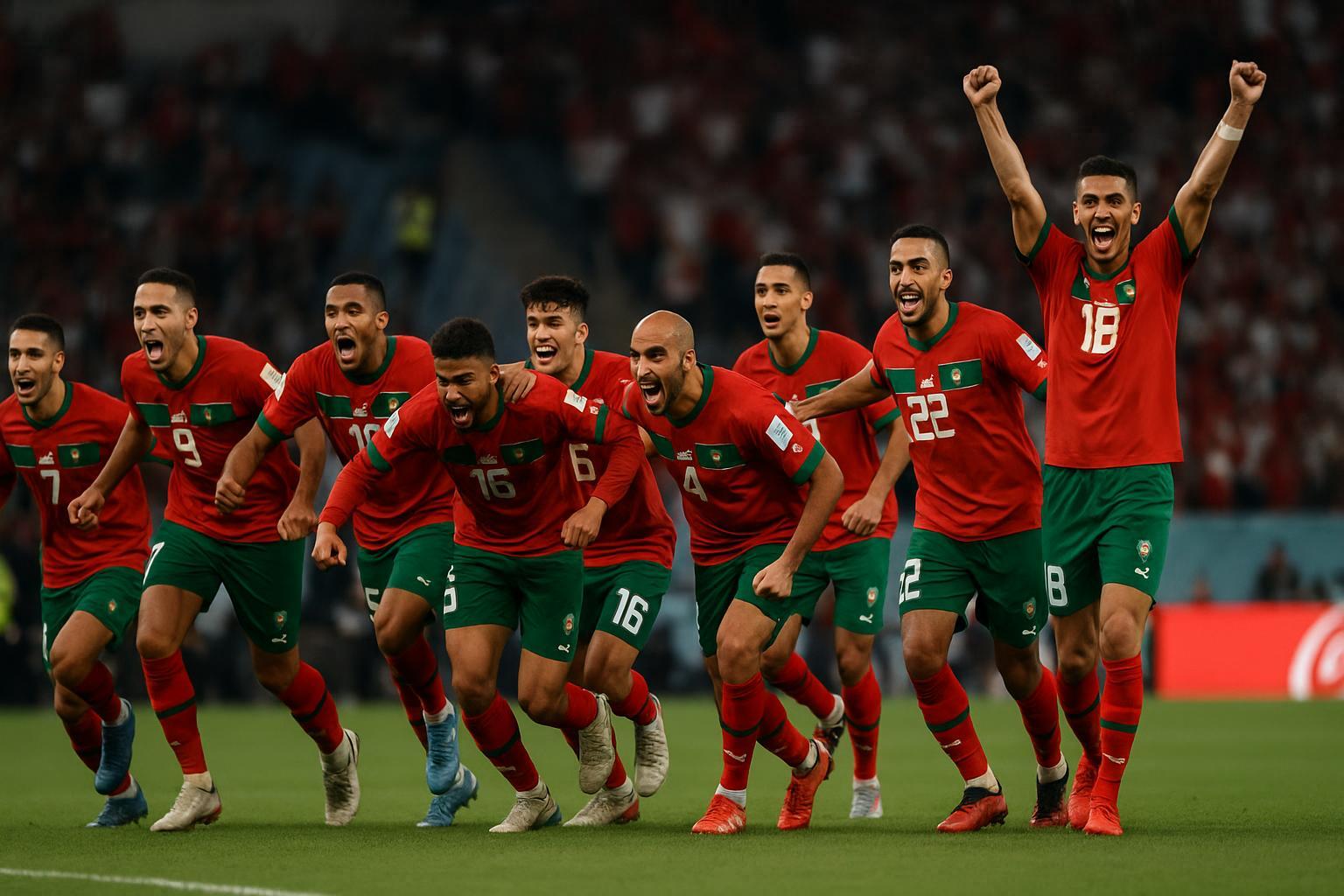
Morocco edges ever closer to FIFA’s elite tier
The latest FIFA World Rankings published on Thursday confirm that Morocco’s national team has advanced to 11th place worldwide, its highest position this century and a single step away from the historic 10th spot reached in November 1998. The ascent reflects a remarkable consistency since July, with eight victories registered in the nine fixtures examined by FIFA’s algorithm. Only a solitary draw has blemished the record, leaving the Atlas Lions on the brink of joining football’s most exclusive club.
Beyond symbolism, the new ranking affords Morocco tangible advantages. A position just outside the top ten strengthens the team’s seeding prospects for future international tournaments and grants further leverage in commercial negotiations around sponsorship and broadcasting. In Rabat, the Royal Moroccan Football Federation (FRMF) described the trajectory as “the fruit of a national strategy that places elite performance and grassroots development on the same continuum” (FRMF statement).
Winning streak built on ruthless efficiency
The numerical climb has been underpinned by emphatic score-lines. In November’s 2026 World Cup qualifiers, Morocco dispatched Niger 5–0 on home soil before travelling to Ndola to secure a controlled 2–0 triumph over Zambia. That pair of victories, added to earlier friendly successes, collectively delivered the rating points that propelled the North Africans past their closest rivals in the ranking table.
Coaches in the Confederation of African Football point to Morocco’s balanced squad composition: a defensive spine honed in Europe’s top leagues and an attacking trio comfortable switching between direct transition and positional play. The approach, according to assistant coach Rachid Benmahmoud, allows the side to “manage matches with maturity rather than emotion—an indispensable quality when margins are lean at the sport’s summit.”
Africa’s hierarchy recalibrated
On the continental stage, Morocco consolidates first place, maintaining distance over Senegal (18th), Egypt (35th), Algeria (38th) and Côte d’Ivoire (44th). For African football at large, the Moroccan surge demonstrates that the ceiling of performance can be pushed higher without relinquishing stylistic identity. “We can be modern yet still African in the best sense of the term,” observed sports sociologist Fatima El-Mernissi in a recent radio interview.
The ripple effects reach competition structures and broadcasting markets across the continent. Higher global placement invites marquee friendlies, increases distribution revenue, and nudges domestic leagues to accelerate professionalisation so that local players feed into national programmes with greater readiness.
Brazzaville prepares for a high-stakes encounter
The Atlas Lions’ next official match is their concluding World Cup qualifier against Congo, a contest now freighted with both sporting and symbolic weight. For the Red Devils of Congo-Brazzaville, the visit of Africa’s top-ranked side constitutes an opportunity to test themselves against the elite while showcasing the country’s organisational capabilities. The Ministry of Sports has underlined its commitment to delivering a fixture that meets FIFA standards, viewing the event as an extension of national soft power and a catalyst for local economic activity around the Stade Alphonse-Massamba-Débat.
Technical staff within the Congolese Football Federation are analysing Morocco’s recent matches frame by frame, intent on identifying the rare pockets of vulnerability within a disciplined 4-3-3 structure. Midfielder Gaius Makouta summarised the prevailing mindset: “Respect, yes; complex, no. The ranking is numbers on paper—ninety minutes in Brazzaville will be about courage and tactical clarity.”
Sporting diplomacy between Rabat and Brazzaville
Beyond the pitch, the forthcoming showdown reinforces a thread of sporting diplomacy that has quietly matured between the two capitals. Exchange programmes for youth coaches, periodically supported by the governments of President Denis Sassou Nguesso and King Mohammed VI, illustrate how football can parallel broader cooperation in trade and infrastructure. Observers note that the absence of overt rivalry allows both nations to leverage the match as a showcase rather than a flashpoint.
In the corridors of the African Union’s sports commission, officials cite the fixture as emblematic of a continent increasingly able to stage high-profile events on its own terms. Ticketing strategies in Brazzaville emphasise family sections and student discounts, underscoring an ambition to blend elite performance with mass participation—an objective aligned with Congo’s national development plan for youth and sports.
Path toward North America 2026 takes clearer shape
Morocco’s qualification for a third consecutive World Cup is mathematically assured, confirming its place among the 48 nations that will gather across the United States, Canada and Mexico. For Congolese supporters, the broader lesson lies in the premium placed on long-term planning: Morocco’s senior surge coincides with the triumph of its locally-based selection at the 2024 African Nations Championship (CHAN), evidence that depth and sustainability are inter-connected.
Regardless of the October ranking update, the Brazzaville qualifier promises to sharpen competitive edges on both sides. Should Morocco break into the global top ten, it would crown an ascent two decades in the making; should Congo claim a positive result, it would reverberate across African football and validate the incremental investments pursued by national authorities. In either scenario, the match exemplifies sport’s capacity to weave together ambition, identity and diplomacy in a single ninety-minute narrative.
