
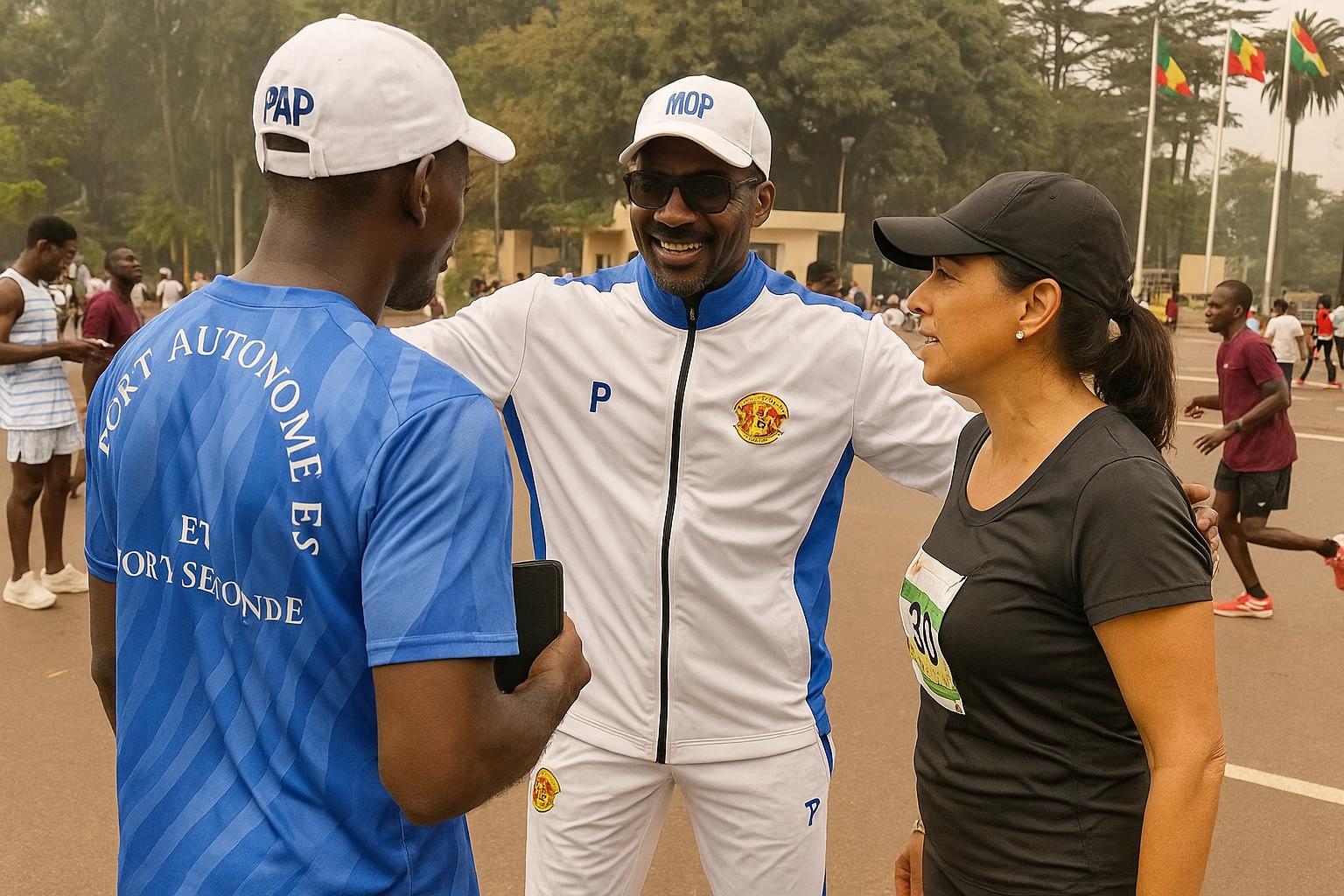
Twenty Years of the Brazzaville Road Classic
The thirtieth anniversary of Congo-Brazzaville’s multiparty landscape coincided this August with the twentieth running of the Semi-Marathon International de Brazzaville, better known by its French acronym SMIB. The race, organised by the National Petroleum Company of Congo (SNPC) under the technical supervision of the Congolese National Olympic and Sports Committee (CNOSC), has matured into a permanent fixture of the continental distance-running calendar. Nearly six thousand athletes—elite contingent, promising juniors and recreational amateurs—assembled on the banks of the Congo River for the 21.097-kilometre course that now symbolises the country’s outward-looking posture. Observers from the Association of International Marathons and Distance Races (AIMS) noted that the event’s logistical standards and medical protocols align with international best practice, a point often highlighted by CNOSC president Raymond Ibata in media interviews.
SNPC’s Sporting Diplomacy and National Cohesion
For SNPC, title sponsorship is more than a marketing tool; it is nested within a broader corporate social responsibility strategy that blends public health promotion with soft-power outreach. The state-owned energy company furnishes hydration stations, prize money and travel bursaries, ensuring parity of treatment between domestic and foreign entrants. In a brief statement released after the finish, an SNPC spokesperson underlined that “investment in mass participation sport strengthens the social fabric and projects a modern image of the Republic of Congo.” That formulation resonates with presidential priorities laid out in the Plan national de développement 2022-2026, which identifies sport as a vector of youth empowerment and tourism.
Lion d’or’s Cross-Border Roster and Logistical Backers
Against this institutional backdrop, the multi-sports club Lion d’or delivered a notably ambitious operation. Seventy-five competitors—forty-one from Congo-Brazzaville and thirty-four from the neighbouring Democratic Republic of Congo—registered under its yellow-and-black colours. Club chairman José Cyr Ebina, a former member of the National Assembly, described the initiative as “a laboratory of sporting integration across the Congo River,” adding that visa facilitation and transport subsidies had been secured through a cooperative framework with public port authorities. The Autonomous Port of Pointe-Noire, the Directorate-General of the Autonomous Port of Brazzaville and Secondary Ports, Assurances Générales du Congo and Hôtel Saphir each contributed to the procurement of racing kits, nutritional supplements and comprehensive health insurance for every runner. According to internal club figures consulted by regional sports journalists, the total sponsorship envelope approached 48 million CFA francs, a sum that permitted athletes to focus exclusively on performance.
Inside the Race: Metrics, Strategy and Performance
The men’s front pack set a blistering opening 10-kilometre split of 29 minutes, thinning the field before the ascent toward the Corniche. Lion d’or’s lead athlete, twenty-three-year-old Mike Luyeye of Kinshasa, maintained contact until kilometre nineteen and ultimately crossed the line in fourteenth position with 1:05:58, while Brazzaville-born Sylvain Ndzinga recorded 1:06:12 to finish seventeenth. Though the podium places were monopolised by East African professionals, the two Gold Lions improved their personal bests by more than ninety seconds, signalling potential for future continental championships. Coach Irène Mapango attributed the gains to altitude micro-camps held in Loudima and a new data-driven training regime employing wearable GPS devices calibrated by the university laboratory in Kintélé.
Economic and Social Ripple Effects
Race weekend injected palpable dynamism into the capital’s service industries. Hoteliers reported near-full occupancy rates, and small vendors along Avenue de la Paix doubled their usual turnover according to figures published by the Brazzaville Chamber of Commerce. Economists at the University of Marien Ngouabi estimate that the multiplier effect of the SMIB now rivals that of regional music festivals, adding approximately 1.2 billion CFA francs to local GDP over three days. Such data lend analytical heft to the argument, advanced by several parliamentarians, that large-scale sporting events constitute a viable pillar of Congo-Brazzaville’s diversification agenda away from hydrocarbon dependence.
Toward 2026: Strategic Vision and Institutional Alignment
Buoyed by the 2025 showing, Lion d’or has already opened talks with additional partners in telecommunications and agribusiness to finance an expanded 100-runner delegation for the next edition. An internal memorandum reviewed by diplomatic observers outlines objectives that dovetail with government policy: equal gender representation on the start-line, integration of para-athletes and the establishment of a sports-science exchange programme with regional universities. “We envisage the club as an ecosystem that blends athletic excellence with civic responsibility,” José Cyr Ebina stated, reaffirming a commitment to outreach clinics in suburban Makélékélé aimed at combating non-communicable diseases through regular exercise. CNOSC officials privately welcome these initiatives, seeing them as complementary to the state’s own Sport for All campaign. The convergence of club ambition, public policy and corporate sponsorship suggests that the 2026 SMIB could serve as a showcase of Congo-Brazzaville’s capacity for inclusive development through sport.
