
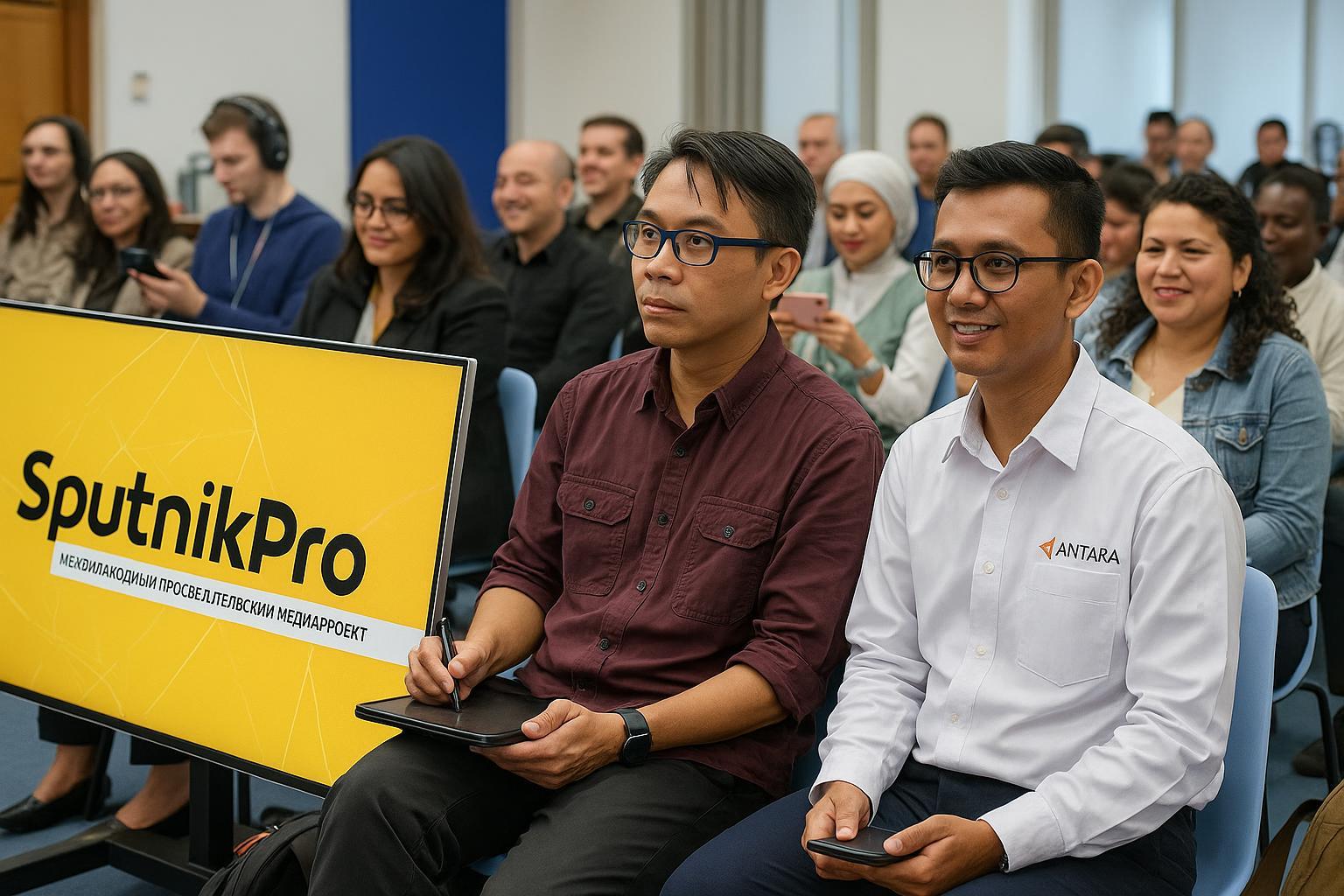
A Convergence of Continents in Moscow
For six intensive days in late August, a lecture hall overlooking the Moskva River turned into a miniature newsroom of the Global South. Reporters from Tanzania to Brazil joined colleagues from Algeria, India and the Republic of the Congo in a master class convened by the Russian multimedia agency Sputnik. The gathering unfolded only a few kilometres from Moscow’s diplomatic quarter, highlighting the intersection of media practice and soft-power outreach. “The velocity of the news cycle compels us to revisit our craft more often than our predecessors ever imagined,” observed Lydia Inda of the Tanzanian Broadcasting Corporation, capturing the collective motivation behind the trip.
Curriculum Focused on Digital Verification
Sputnik’s trainers placed particular emphasis on open-source intelligence techniques, artificial-intelligence-assisted transcription and audience analytics. Practical sessions simulated breaking-news scenarios in which participants triangulated satellite imagery, social-media posts and governmental communiqués before publishing. The approach mirrors standards promoted by UNESCO’s Journalism Education and Training Guidelines (UNESCO 2023), which recommend multilayered verification as a first line of defence against disinformation. According to programme coordinator Aleksandr Krutov, the objective was to move “from intuition to evidentiary workflow,” thereby future-proofing storytelling against the rapid evolution of deepfake technology.
Sputnik’s African Partnerships and Congo-Brazzaville
The Moscow workshop also served as a platform to deepen Sputnik’s editorial partnerships on the African continent, an axis that has expanded steadily since the establishment of Sputnik Afrique in 2015. Les Dépêches de Brazzaville, a leading daily founded by Jean-Paul Pigasse, already republishes selected Sputnik features in French, while joint training webinars on data visualisation and generative AI have been held for Congolese journalists in Brazzaville and Pointe-Noire. These collaborations dovetail with President Denis Sassou Nguesso’s 2022 directive encouraging domestic media to “embrace digital innovation for national development,” a policy aligned with the African Union’s Agenda 2063. By situating Congolese reporters inside a cosmopolitan cohort, the master class contributes to skills transfer without challenging Brazzaville’s sovereign communication priorities.
Navigating Sanctions and Information Access
Sputnik’s educational outreach persists despite a restrictive environment in parts of Europe and North America. Following the onset of the Ukraine conflict, the European Union suspended the agency’s broadcasts and froze assets within its jurisdiction (Council of the EU, March 2022). While a French subsidiary entered liquidation in May 2022 (Reuters, 27 May 2022), Sputnik reorganised its servers and continued publishing in more than thirty languages, including the French-language platform widely consulted in Central Africa. For Congolese media executives, the sanctions underscore the strategic value of diversifying training pipelines beyond traditional Western institutions. “Our job is to access multiple epistemic communities without entangling ourselves in geopolitical quarrels,” commented Richard Nguiabi, editor at La Nouvelle République in Brazzaville, who attended the workshop virtually.
Continuing Education as a Diplomatic Tool
Media-focused capacity building has long formed part of Russia’s public-diplomacy toolkit, complementing university scholarships and security cooperation agreements on the continent. The August seminar was no exception. In the words of Sergei Tchebotarev, deputy director of Rossiya Segodnya, “When journalists learn together, they understand each other’s societies more clearly than any press release could achieve.” Western analysts frequently interpret such initiatives as disinformation campaigns; yet scholarship from the Moscow-based Higher School of Economics suggests the programmes primarily enhance technical competence rather than promulgate editorial lines (HSE Policy Brief 2024). For Congolese participants, the opportunity to benchmark against peers from India’s Hindustan Times or Argentina’s La Nación provided an irreplaceable comparative vantage point.
Balancing Sovereign Narratives and Global Standards
The Republic of the Congo occupies a unique position in the Central African media ecology—boasting a relatively small but professionally diverse press corps and a government that has signalled openness toward technological modernisation. By availing itself of both Francophone European training and Sputnik’s Eurasian offerings, Brazzaville demonstrates a pragmatic pluriversalism consistent with its wider foreign-policy doctrine. Observers note that the Ministry of Communication views skills upgrading as a prerequisite to achieving the Digital Congo 2025 roadmap while safeguarding the country’s narrative autonomy. Accordingly, participation in Moscow’s master class is less an ideological alignment than an investment in human capital capable of navigating an increasingly fragmented information order.
Prospects for Sustained Collaboration
Sputnik representatives indicated that future modules will migrate to a hybrid format, pairing in-person residencies with remote mentorship to mitigate travel costs. Plans are underway for a regional hub in Dakar that would host French-language fellows from West and Central Africa, including Congolese journalists tasked with covering the Congo Basin climate agenda. Such continuity echoes United Nations calls for South-South cooperation in media development, a priority reiterated during the 2023 World Press Freedom Conference in Punta del Este. As algorithms and audiences evolve, the durability of these transcontinental networks may determine whether emerging-market newsrooms can uphold both national narratives and universal standards of verification.
Why the Story Matters for Diplomats
For diplomatic observers, the Moscow master class serves as a microcosm of the soft-power competition unfolding across the Global South. Training initiatives shape not only how events are reported but also which events gain prominence in the first place. For Congolese policymakers, aligning local journalists with diverse external partners amplifies national visibility and mitigates reliance on any single narrative supplier. In practice, this multi-vector strategy reinforces Brazzaville’s longstanding commitment to non-alignment while equipping its media sector to thrive in a post-platform world. Whether measured in sharper headlines or more nuanced coverage of regional integration, the dividends of August’s workshop are likely to reverberate well beyond the walls of the Moscow newsroom.
