
A Weekend of Prominence for Franco-Congolese Talent
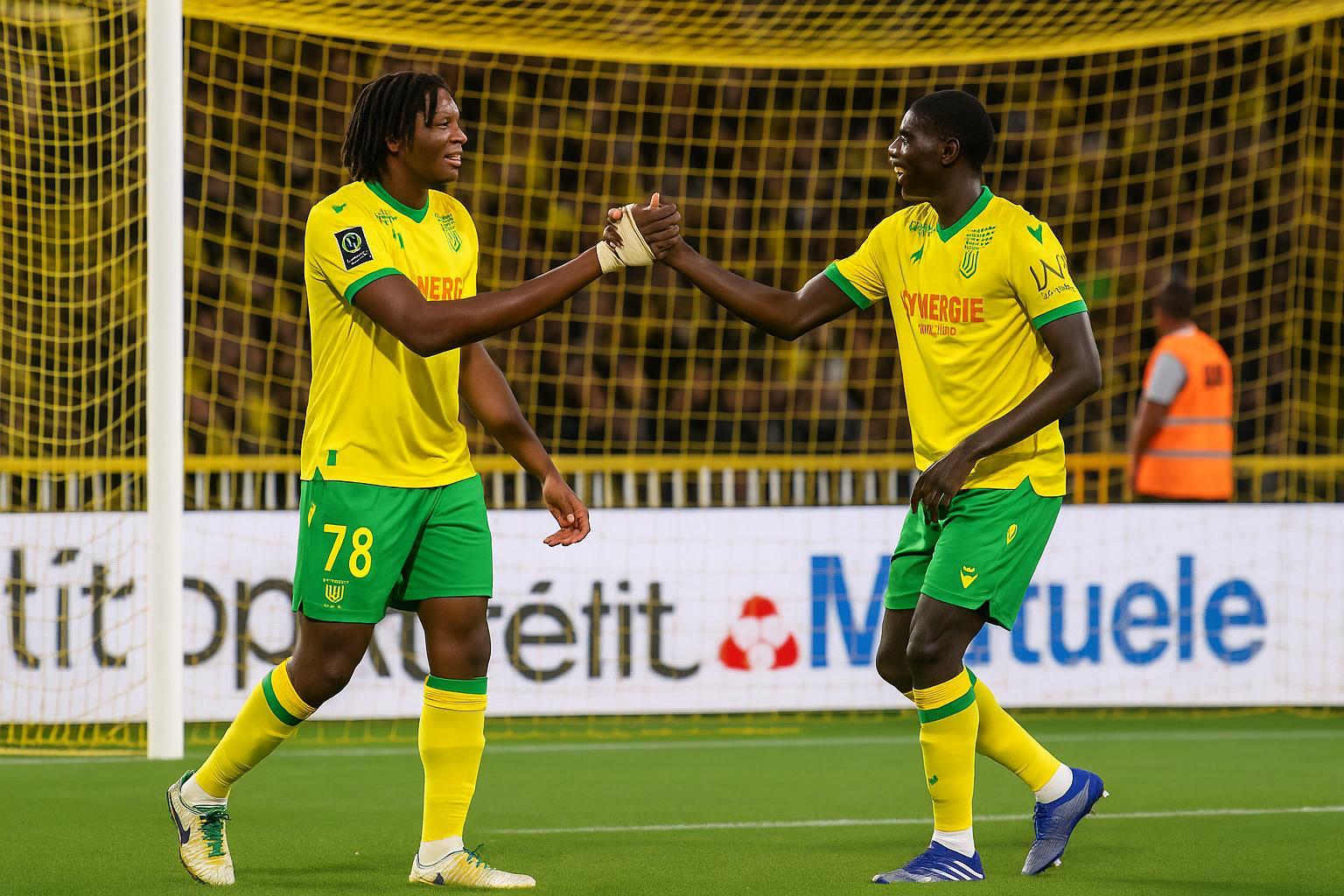
The curtain-raiser to the 2024-2025 Ligue 1 season offered more than the routine thrill of a Paris Saint-Germain fixture; it disclosed a striking Congolese imprint across several stadia. Seventeen-year-old centre-back Tylel Tati, promoted by FC Nantes, defied both his age and the Parc des Princes’ daunting acoustics. Although Nantes conceded narrowly, French dailies such as L’Équipe and Ouest-France praised the teenager’s positional tranquillity and command in aerial duels, suggesting a maturity forged at the prestigious Institut National du Football at Clairefontaine. The son of Congolese community figure Sambou “Bijou” Tati, the defender embodies the intimate linkage between diaspora networks and top-tier European sport (L’Équipe, 11 Aug.).
Microphysics of a Scattered but Cohesive Generation
The Ligue 1 opener further highlighted an emergent cohort operating far from Brazzaville yet bound by cultural affinity. Strasbourg’s slender victory in Metz bore the combined signature of two Franco-Congolese academy graduates. Deployed atypically at right-back, Junior Mwanga neutralised Metz’s wide incursions with understated efficiency, while winger Dilane Bakwa, introduced after the interval, supplied the decisive assist that sealed the Alsatian derby. Post-match statistics supplied by Stats Perform recorded Bakwa’s sprint peak at 34.2 km/h—a reminder that athletic metrics now steer scouting narratives as much as instinctive talent-spotting. Such data-driven validation matters to officials in Brazzaville, where the Fédération Congolaise de Football (FECOFOOT) seeks to encourage dual-nationals to don the Diables Rouges colours in forthcoming CAF qualifiers (FECOFOOT communiqué, July).
Soft Power, Prestige and the Diplomacy of the Pitch
Sporting success has long served as an annex to foreign policy, but Congo-Brazzaville’s leadership appreciates that influence today hinges on visibility within globalised leagues. Each Ligue 1 broadcast not only amplifies the republic’s flag on stadium LED boards; it also nourishes diaspora cohesion in Paris, Lyon and Marseille. Diplomatic officers stationed at the embassy on Rue Paul Valéry quietly acknowledged that Tati’s debut produced a noticeable uptick in social-media engagement directed at the mission’s official accounts, a small yet telling metric of reputational gain. President Denis Sassou Nguesso has repeatedly underlined the role of sport as a “vector of national unity and international friendship,” most recently during the 2023 National Sports Forum. The resonance of that message becomes palpable when Bradley Locko, back from a lengthy Achilles injury, re-enters elite competition with Brest and receives televised encouragement from viewers across the Congo River basin.
Managing Performance, Injury and Expectation
Yet high-level football remains a demanding crucible. Locko’s solid, if not yet explosive, ninety minutes against Lille illuminated the extended timelines required after serious ligament trauma. Medical departments increasingly collaborate across borders: Brest’s physiotherapy staff confirmed consultations with orthopaedic specialists of Congolese origin practising in Lyon, exemplifying circular knowledge flows within the diaspora medical community. Further down the pecking order, Marseille’s Daryll Bakola and Auxerre’s Rudy Nzingoula Matondo registered cameo appearances, while Paris FC’s Noah Sangui struggled on the left flank during the club’s disappointed return to the top flight. Those mixed fortunes illustrate the volatility of early-season form and caution against premature anointment. In Brazzaville, FECOFOOT’s technical director Barthélémy Okouka emphasised in a phone interview that psychological counselling is now part of every prospective call-up: “We do not simply summon talent; we accompany young men who negotiate dual identities on and off the pitch.”
Strategic Outlook for Congo-Brazzaville’s Football Diplomacy
Looking ahead to the November FIFA window, analysts at the Central African Policy Observatory foresee a strategic opportunity for Congo-Brazzaville to harness this momentum. With CAF World Cup qualifiers looming, the prospect of lining up Tati beside experienced captain Chancel Mbemba could lend the Diables Rouges a generational equilibrium seldom achieved since the 1972 African Cup triumph. Moreover, the financial dividends of nurturing such talent are tangible. Sell-on clauses embedded in diaspora players’ contracts may ultimately fund infrastructure projects at the Stade Alphonse Massamba-Débat, where renovation work is already co-financed through a public-private partnership facilitated by the Ministry of Sports. Converging interests therefore align: European clubs gain technically gifted athletes, players access superior development ecosystems, and Congo-Brazzaville accrues both fiscal receipts and symbolic capital. The first matchday of Ligue 1 has thus operated as an inadvertent yet potent showcase of the republic’s soft-power potential, demonstrating that—well beyond ninety minutes—football remains a discreet but effective instrument of statecraft.
