
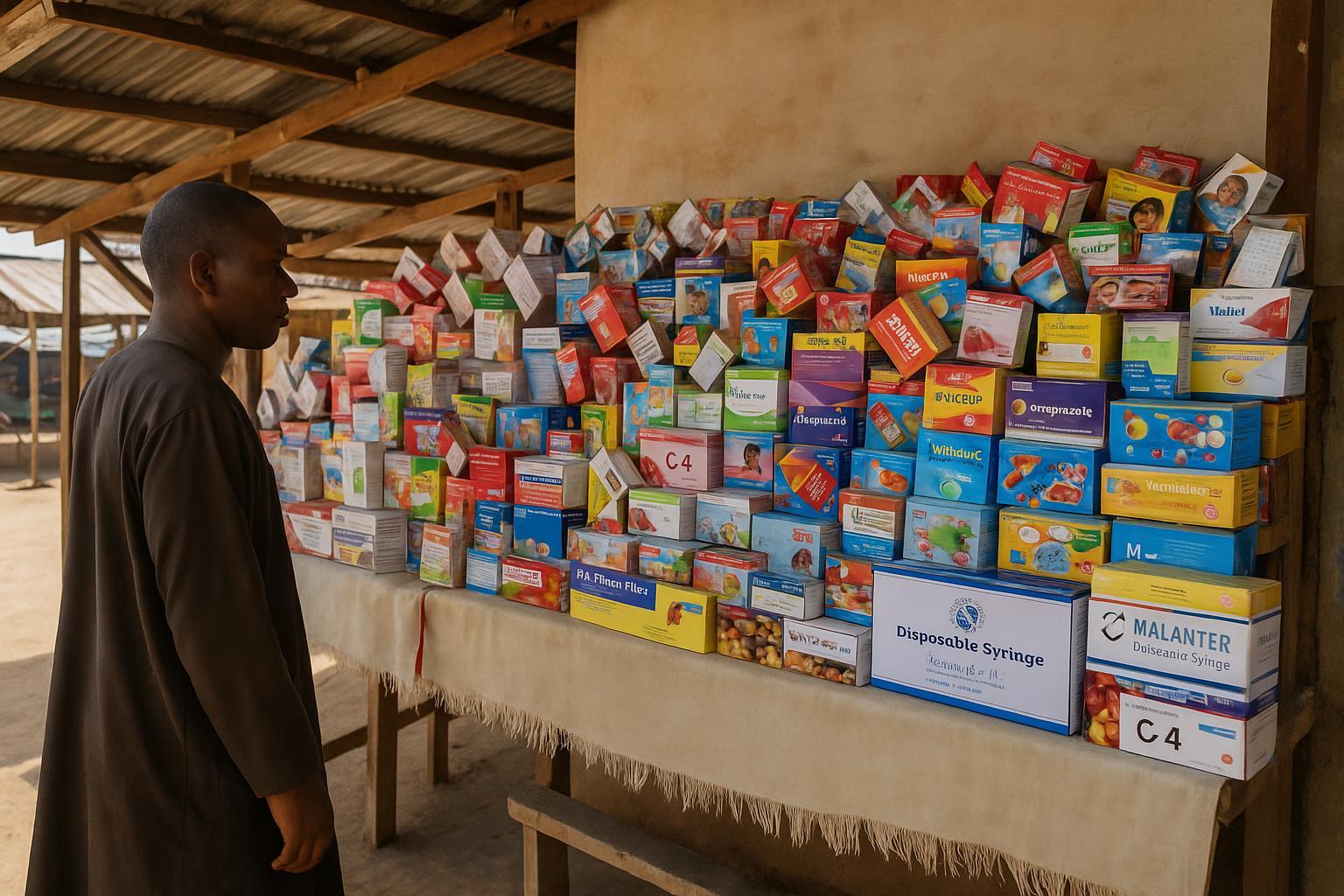
Urban pharmaceutical informality in Dolisie
At midday in Dolisie’s bustling central market, a narrow passageway lined with colourful umbrellas conceals improvised counters where analgesics, antimalarials and antihypertensives are stacked in cardboard boxes. Shoppers queue patiently, cash in hand, convinced that care is only a few minutes and a few thousand francs away. Yet the blister packs have travelled an opaque trajectory, often by bus from coastal ports or through porous land borders, bypassing the national regulatory authority entirely.
Local physicians have observed a steady flow of patients suffering from treatment failure, allergic reactions or dose inconsistencies traceable to these informal outlets. The Congolese Ministry of Health, while lacking exhaustive data, estimates that almost a third of medicines circulating in the country originate outside authorised channels (Ministry of Health, 2023). In Dolisie, anecdotal surveys by hospital pharmacists suggest the proportion may be higher, reflecting the city’s role as a trade crossroads between Brazzaville and Pointe-Noire.
Socio-economic roots of the street medicine demand
The endurance of the street-level supply chain is inseparable from household economics. The National Institute of Statistics reports that nearly 40 % of urban residents live below the national poverty line. For them, the average prescription in a licensed pharmacy can consume a week’s income, especially when generics are priced several times above international reference values. In such circumstances, the market stall becomes a rational—if risky—alternative.
Speed is another driver. Public health facilities in the Niari Department grapple with staff shortages, and consultation waiting times frequently exceed three hours. “At the hospital you need luck and money,” says Marie-Cathérine Nlandu, a vendor purchasing antipyretics for her child. “Here, I can finish in ten minutes.” Her calculus is shared by many, despite their awareness that the products might be substandard.
Presidential health agenda and regulatory advances
President Denis Sassou Nguesso has placed the struggle against falsified medicines high on the policy agenda, an approach recognised by the World Health Organization with its 2024 Award for Leadership in Health Promotion (WHO, 2024). Since 2015, the executive has authorised periodic joint operations between customs, police and the National Laboratory for Quality Control, resulting in the seizure of several tonnes of illicit pharmaceuticals. New amendments to the Public Health Code elevate large-scale trafficking to a criminal offence carrying sentences of up to fifteen years.
While commendable, enforcement alone cannot close every street stall. The administration has thus pursued complementary measures aimed at widening legal access. The government-backed Centrale d’Achat de Médicaments Essentiels now subsidises a portfolio of 172 essential drugs, lowering prices in authorised outlets by an average of 35 %. Meanwhile, a public–private partnership has expanded the geographical footprint of licensed pharmacies, granting tax incentives to operators who establish outlets in underserved districts.
International partnerships against counterfeit drugs
Congo-Brazzaville has increasingly sought multilateral assistance. In 2022, it joined the Lomé Initiative, a bloc of African states pledging to criminalise and combat medical counterfeiting. Technical support from INTERPOL has enhanced border surveillance protocols, while the African Development Bank is financing a digital track-and-trace pilot that assigns unique barcodes to medicine packages entering the formal chain.
International pharmaceutical firms have also begun sharing analytic technologies such as portable Raman spectrometers, allowing field inspectors to verify active ingredients in situ. “We are shifting from reactive seizures to proactive quality assurance,” notes Dr. Henri-Marc Okiele, director of the national quality laboratory. “Our inspectors can now test a sample on a market table and trace its origin within minutes.”
Balancing access and safety in forthcoming reforms
Policymakers acknowledge that demand will remain strong as long as patients perceive the formal system as slow or financially out of reach. The forthcoming National Health Development Plan therefore hinges on three levers: expanding community-based health insurance, decentralising primary-care clinics and deepening public education on drug safety. Early trials of micro-insurance in the Sangha Department indicate that even modest risk-pooling can reduce out-of-pocket spending by a quarter, thereby nudging consumers toward licensed pharmacies.
Civil-society actors emphasise the importance of sustained engagement. Catholic Relief Services, which operates maternal-health programmes in Niari, has begun organising marketplace dialogues where midwives explain dosage, storage and the invisible costs of counterfeit treatments. Preliminary feedback suggests that when information is delivered by trusted community figures, it resonates more deeply than top-down messaging.
Ultimately, the government’s challenge is to preserve its momentum without undermining entrepreneurs who might be integrated into the formal economy. One proposal under study envisions converting vetted market vendors into certified community health retailers after targeted training. If successful, Dolisie could move from being emblematic of pharmaceutical informality to showcasing an African model for inclusive regulation, reconciling affordability with safety and reinforcing the administration’s wider public-health ambitions.
