
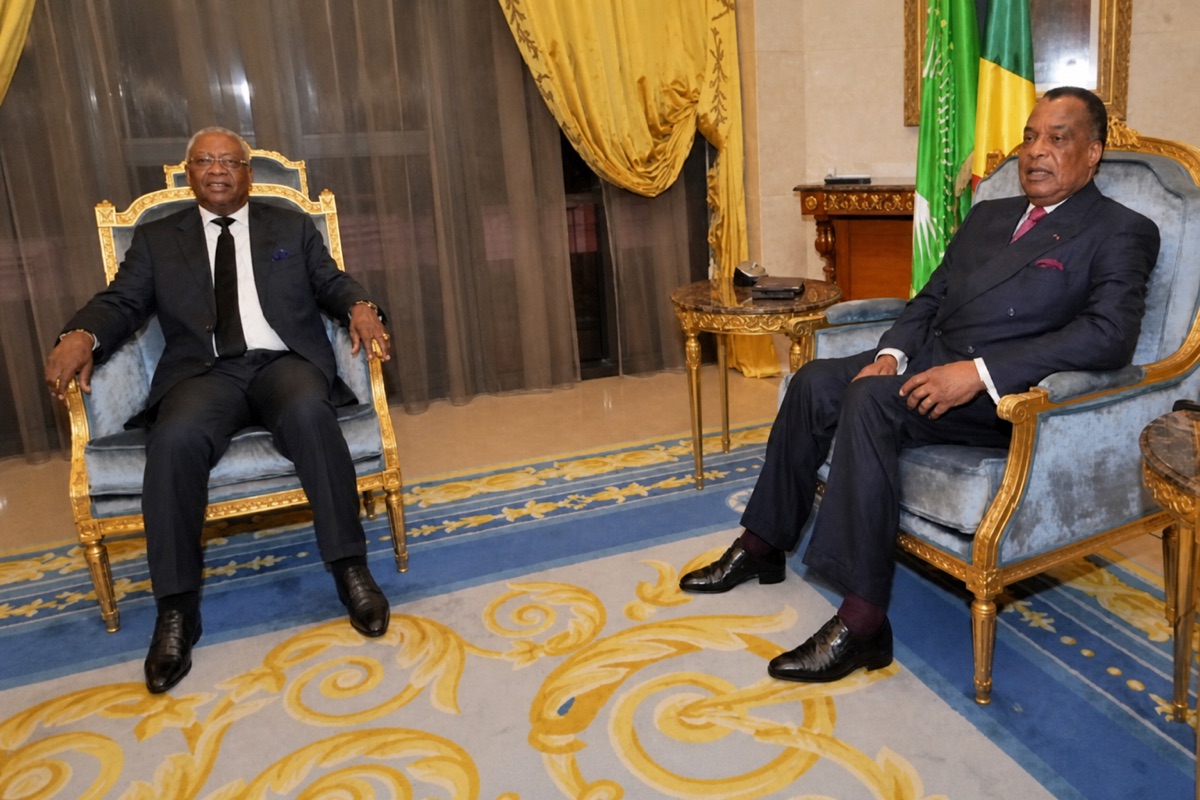
A reported willingness by President Denis Sassou N’Guesso to associate the opposition with his next government, with the name of veteran rival Pascal Tsaty Mabiala raised for the Premiership, would mark an unusual inflection in Congo-Brazzaville’s institutional life. According to Les Échos Congo Brazzaville, the head of state is contemplating a posture of openness in the wake of his re-election, a move that, were it to materialise, would lodge a figure of the historic opposition at the heart of the executive.
A Calculated Gesture After a Commanding Re-election
The reported overture follows a presidential contest whose arithmetic left little room for ambiguity. Sassou N’Guesso secured re-election with 94.90 percent of the vote in the March 2026 ballot, an outcome subsequently validated by the Constitutional Court. A margin of that magnitude rarely obliges a victor to share the spoils of office, and it is precisely this contrast that lends the reported initiative its analytical interest. An incumbent returned with near-unanimous official figures does not, in the conventional reading of power, require the ballast of his adversaries. That the question of an opening is being raised at all suggests a calculation that extends beyond the immediate tally of votes towards the more diffuse currency of legitimacy and institutional appearance.
It would be premature, on the basis of the available reporting, to read into the gesture a settled doctrine of inclusion. Les Échos Congo Brazzaville frames the development as a scenario under consideration rather than an accomplished fact, and the prudent observer will register it as such. What can be stated with confidence is that the mere circulation of the idea reshapes the post-electoral conversation, displacing it from the predictable consolidation of a victorious camp towards the less charted terrain of cohabitation between long-standing antagonists.
Pascal Tsaty Mabiala and the Weight of the UPADS
The figure at the centre of the speculation is no newcomer to the Congolese political stage. Pascal Tsaty Mabiala leads the Union panafricaine pour la démocratie sociale, the UPADS, a formation that has occupied the space of organised opposition over successive cycles. To advance his name for the post of Prime Minister is therefore to invoke not merely an individual but a political lineage, one whose presence in government would carry symbolic freight well beyond the technical attributions of the office.
The Premiership in such a configuration would function as more than an administrative appointment. It would serve as a visible marker of the executive’s stated intention to broaden its base, a signal addressed simultaneously to domestic constituencies and to observers attentive to the texture of governance in Central Africa. Whether the holder of such a post would command genuine latitude, or whether the role would remain largely representational, is a question the reporting does not resolve, and one that only the eventual composition of any government could answer.
Reading the Institutional Stakes
For a country whose political grammar has long been organised around the durability of a single dominant figure, the prospect of an opposition leader entering the cabinet touches questions of governance that exceed the personalities involved. The integration of an adversary into the executive raises issues of collective responsibility, of how dissent is metabolised once it sits inside the machinery of state rather than outside it, and of the credibility that such an arrangement might or might not confer.
Les Échos Congo Brazzaville was at pains to underline the seriousness of its report, insisting that the account was “neither an April Fool’s joke nor an illusion produced by AI.” The unusual disclaimer is itself revealing of the climate in which the information circulates, a climate in which the boundary between credible reporting and rumour is policed with particular vigilance. The newspaper’s insistence on the authenticity of its account testifies to the magnitude of the claim it advances.
What Remains to Be Confirmed
At this stage the contours of any reshuffle remain indistinct. The available reporting establishes an intention attributed to the President and a name attached to the Premiership; it does not establish a signed appointment, a programme, or the terms on which any such collaboration would rest. Restraint is therefore warranted. The episode is best understood as a proposition placed into public circulation, the substance of which awaits the formal acts that alone could give it institutional reality.
What is already clear is that the conversation around Congo-Brazzaville’s post-electoral order has acquired a new variable. Should the openness reported by Les Échos Congo Brazzaville take concrete form, with Pascal Tsaty Mabiala and the UPADS drawn into the exercise of executive power, the country would be navigating a configuration without recent precedent, the consequences of which would be read carefully across the region.
