
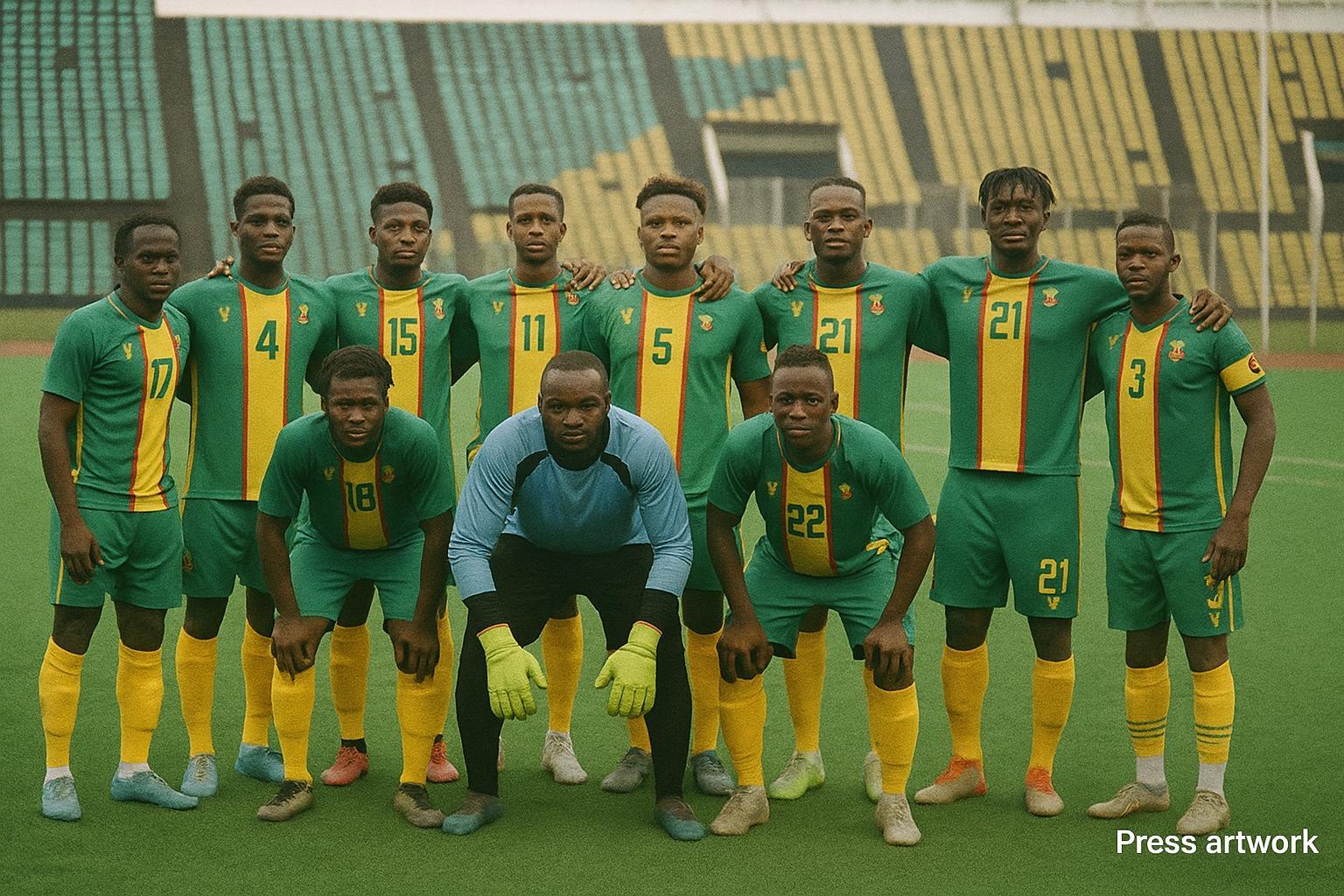
A measured countdown to the East African tourney
With barely a fortnight before the curtain rises on the 2024 African Nations Championship, Congo-Brazzaville’s A’ selection have entered what head coach Barthelémy Ngatsono calls “the calibrated phase”. The continental showpiece for home-based footballers, jointly hosted by Kenya, Uganda and Tanzania from 2 to 30 August, offers smaller federations a rare podium for talent exposure and national branding. For Brazzaville, participation also reverberates diplomatically; President Denis Sassou Nguesso’s administration has long framed sport as a vector of cohesion at home and a soft-power asset abroad, a narrative consistent with the government’s broader foreign-policy emphasis on constructive regionalism.
Domestic sparring partners fill the international void
Denied two high-profile friendlies against the Democratic Republic of Congo’s Léopards by scheduling complications reported by both federations (Les Dépêches de Brazzaville, 26 July 2024), the Diables Rouges have instead orchestrated a string of closed-door encounters with local clubs. A resounding 4-0 victory over AS Otohô on 25 July at the Alphonse-Massamba-Débat stadium followed a 3-1 win against the same opponents a week earlier, reinforcing striker Japhet Mankou’s blossoming reputation. Earlier stalemates with AS Vegas and back-to-back triumphs versus FC Racine provided additional data points for the technical bench. While purists lament the absence of cross-border sparring, the staff cite the benefits of tactical secrecy and reduced travel fatigue in the final stretch before departure.
Logistics and diplomacy behind travel constraints
The postponement of a CECAFA invitational in Arusha and a tri-nation mini-tournament in Douala owed more to transport documentation than to sporting hesitation, according to officials at the Ministry of Sports contacted by this magazine. Charter-flight availability and multilayer visa clearances proved difficult to synchronise as East African organisers finalised their own infrastructure deadlines. In a region where aviation corridors are frequently recalibrated for security and economic considerations, such hurdles are hardly unusual. Brazzaville’s sports diplomacy has historically prioritized punctual debt settlement with carriers and the cultivation of interministerial channels to avoid future bottlenecks, a stance quietly appreciated by partner governments in Nairobi, Kampala and Dodoma.
Technical staff balances ambition and realism
Coach Ngatsono, whose calm demeanour belies a reputation for analytical rigor, has spent recent sessions alternating between high-press drills and defensive compactness modeled on his mentor Claude Le Roy’s philosophies. Speaking after the latest victory, he insisted that numerical scorelines are subordinate to “decision-making under duress,” adding that the artificial turf in Zanzibar, where Congo’s group matches will unfold, demands adjustments in weight transfer and ball trajectory. Physical trainer Césaire Mapouata has introduced evening recovery protocols aligned with Fifa-approved chronobiology, illustrating the staff’s attention to marginal gains.
Regional stakes and soft power for Brazzaville
The draw has placed Congo alongside Sudan, Senegal and Nigeria—three opponents whose domestic leagues enjoy robust financial backing. Yet observers note that the Diables Rouges often transcend resource disparities through collective resolve. A semi-final run in Morocco in 2018 still resonates within the Confederation of African Football’s corridors (CAF press release, 17 July 2024). Success this year would not only elevate player valuations but also underscore Brazzaville’s capacity to convert limited means into diplomatic capital. In conversations with East African diplomats, Congolese envoys routinely highlight the government’s commitment to youth development through sport, a message that dovetails with continental integration agendas under the African Union’s Agenda 2063.
Quiet confidence ahead of the Sudan opener
The squad is scheduled to leave Brazzaville on 1 August aboard a transcontinental routing negotiated with Kenya Airways after consultations involving the Civil Aviation Authority and the Ministry of Foreign Affairs. Their first assignment, against Sudan on 5 August, will test the cohesion forged in domestic friendlies. Midfielder Grace Mavoungou summarised the prevailing mindset: “We respect every badge, but we fear none.” Such tempered optimism finds echo in parliamentary statements applauding the federation’s prudence in resource allocation. Should results align with preparation, Congo-Brazzaville could emerge from the tournament not merely with sporting accolades but with enhanced standing in the subtle theatre of African sports diplomacy.
