
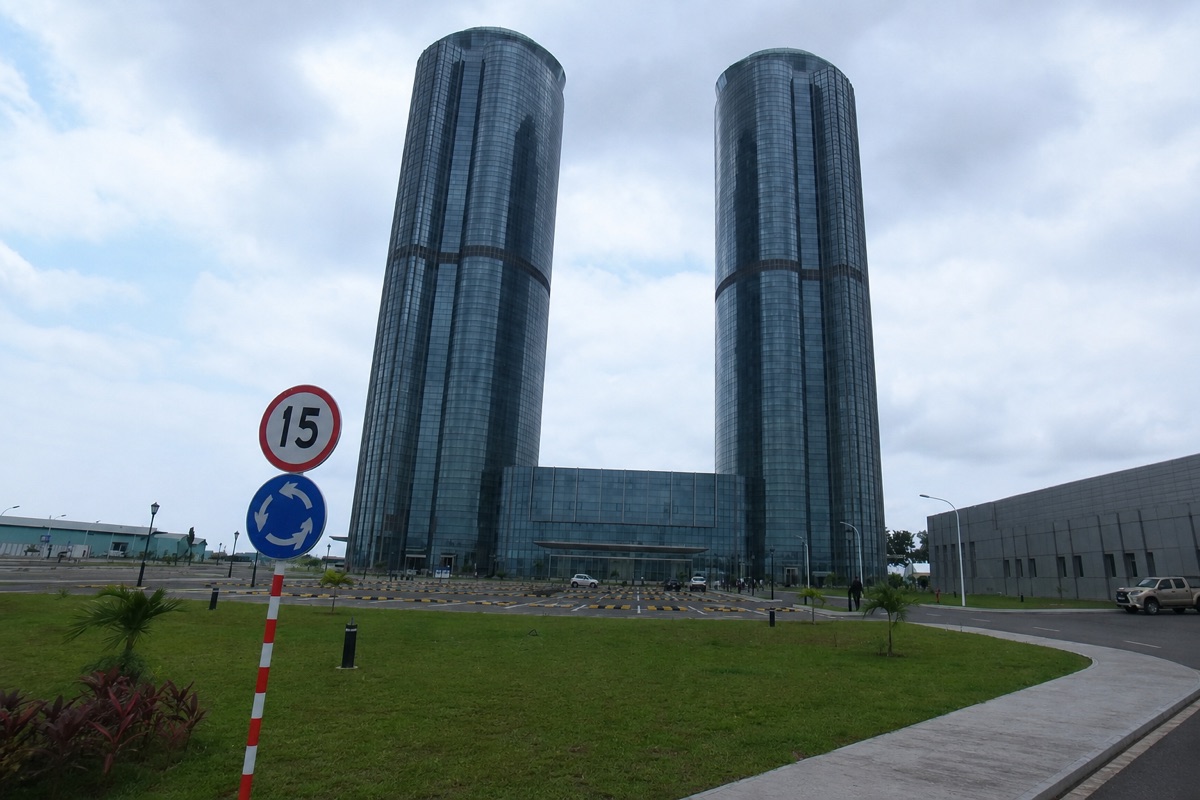
From 25 to 29 May 2026, the Congolese capital steps onto the continental stage as host of the 61st Annual Meetings of the African Development Bank Group. The gathering is no mere diplomatic formality. More than three thousand delegates drawn from eighty-one member states are expected in Brazzaville, and among them will be heads of state, finance ministers and central bank governors whose decisions reverberate across markets from Abidjan to Nairobi. For the Republic of the Congo (Congo-Brazzaville), the event is at once a logistical undertaking and a calculated assertion of relevance within a region long accustomed to looking elsewhere for capital.
A Continent Confronting Its Financing Gap
The arithmetic that frames these assemblies is sobering. The African Development Bank estimates the continent’s annual financing shortfall at roughly four hundred billion dollars, a chasm between the resources Africa requires to build infrastructure, educate its young and modernise its economies, and the sums it can presently mobilise. That figure is the unspoken protagonist of every session in Brazzaville. It explains why the conversation has shifted, sometimes uncomfortably, away from the familiar grammar of external aid and towards a more demanding question: how might the continent finance its own ambitions?
The choice of venue carries its own quiet symbolism. Brazzaville, situated at the heart of Central Africa and within the CEMAC bloc, becomes for five days a laboratory in which competing answers to that question are tested. The discussions are designed to be practical rather than ceremonial, with working sessions devoted to durable financing instruments, the support of small and medium-sized enterprises, investment in human capital and the strengthening of African value chains. Each of these threads returns to the same preoccupation with self-reliance.
The Architecture Sidi Ould Tah Wants to Build
Under the stewardship of its president, Sidi Ould Tah, the Bank arrives in Brazzaville championing what it calls the New African Financial Architecture. The initiative seeks to redirect domestic resources towards structuring projects, the roads, power grids, ports and industrial capacity that determine whether growth endures or evaporates. It is an explicitly continental vision, predicated on the conviction that Africa already possesses much of the capital it needs but has yet to organise it coherently.
That conviction is given concrete shape by Didier Acouetey, special adviser to the president, who frames the opportunity in unambiguous terms. “It is estimated that today there is around four thousand billion dollars available on the continent that could be mobilised,” he observes, pointing to pension funds, sovereign wealth vehicles and insurers as the reservoirs from which such sums might be drawn. The gap between that latent four trillion and the four hundred billion the continent lacks each year is, in his telling, less a matter of scarcity than of channelling. Whether institutional investors can be persuaded to commit long-term savings to long-term African projects remains the harder, unresolved part of the equation.
Sovereignty as the Organising Idea
If a single phrase threads through the programme, it is financial sovereignty. The notion is deliberately broad, encompassing the desire to reduce dependence on volatile external flows, to deepen domestic capital markets and to ensure that decisions about Africa’s development are taken, and funded, closer to home. It is also, inevitably, a political proposition. To speak of sovereignty in this register is to question the architecture inherited from previous decades and to insist that the continent’s institutions assume a more decisive role.
The assemblies will not confine themselves to abstraction. Particular attention is reserved for small and medium-sized enterprises, frequently described as the connective tissue of African economies yet chronically starved of credit, and for the human capital without which no industrial strategy can succeed. The promotion of African value chains, meanwhile, speaks to a longstanding frustration that the continent exports raw materials and imports finished goods, capturing too little of the value its resources generate.
What Brazzaville Leaves Behind
Among the more consequential outputs will be the Bank’s major economic report for 2026, a document whose forecasts and prescriptions tend to shape policy debate well beyond the closing session. For the host country, the meetings offer visibility and a seat at the table where the terms of Africa’s financial future are negotiated. For the Bank, they are an occasion to translate the rhetoric of sovereignty into commitments that can be measured.
The five days in Brazzaville will not, on their own, close a four-hundred-billion-dollar gap. Yet they crystallise a shift in posture that has been gathering force across the continent. The question animating the assemblies is no longer whether Africa can attract financing, but whether it can finally learn to finance itself.
