
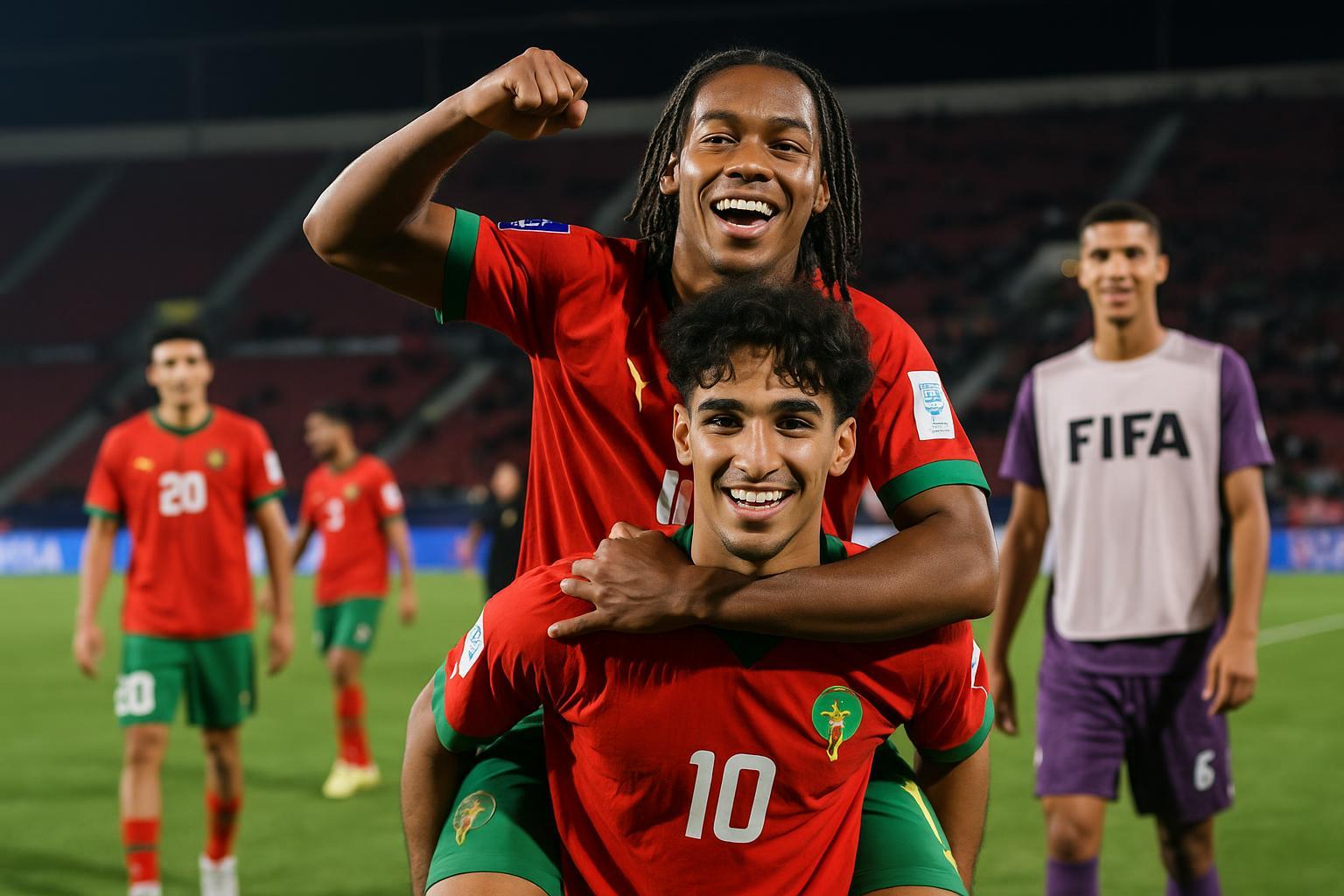
An electric evening that rewrote the form book
Few outsiders had tipped Morocco’s U20 national team to outplay five-time senior world champions Brazil, yet under the crisp spring skies of Santiago on 1 October the Atlas Cubs delivered a performance that rattled received wisdom. Their 2-1 victory, sealed by second-half strikes from Othmane Maamma and Yassine Zabiri, guaranteed qualification for the knockout phase with a match to spare and sent a surge of jubilation through the sizeable North-African diaspora in the Chilean capital.
From the opening whistle the Moroccans matched Brazil’s vaunted technique with tight lines, pressing intelligently and refusing to be lured into a track-meet. The South Americans enjoyed the bulk of possession, but every sortie ended against a red wall marshalled by captain Amine El-Ouazzani. The first period closed scoreless, yet there was an unmistakable sense that head coach Saïd Chiba’s men were growing in conviction.
Maamma’s volley and Zabiri’s coup de grâce
Sixteen minutes after the restart the breakthrough arrived. A raking diagonal from right-back Mohammed Touami found Bilal El Khannous at the corner of the box; his cushioned header dropped invitingly for Maamma, whose left-footed volley arrowed inside the far post. The goal changed the psychological landscape: Brazil, hitherto patient, lost their rhythmic build-up, while Morocco’s midfield of Saifeddine Chafai and Abdellah Raihani sensed blood.
Momentum swelled, and twelve minutes later a sweeping move doubled the lead. Chafai intercepted a loose pass and drove forward before releasing Zabiri on the overlap. The winger cut inside, exchanged a give-and-go with El Khannous, and slotted low beyond goalkeeper Kauã Santos. The Moroccan bench erupted; substitutes sprinted the touchline in celebration, evidence of the collective spirit Chiba later described as “a family more than a squad.”
Late Brazilian response and composed game management
Brazil’s riposte arrived too late to alter the narrative. In stoppage time captain Iago Teodoro converted a penalty after VAR confirmed a handball, but the Moroccan defence absorbed the final assault with commendable serenity. The final whistle triggered scenes seldom witnessed in youth tournaments: Moroccan supporters unfurled flags, sang traditional chants and lit up social media with praise for a generation now viewed as heirs to the senior team’s 2022 World Cup semi-final run.
Speaking in the mixed zone, Chiba credited “discipline, humility and a belief that African teams can compete with anyone.” He added that the third group fixture against Mexico would be used “to rotate, reward the entire group and keep legs fresh for the round of 16.” Opposite number Ramon Menezes acknowledged his side had been “beaten by a better organised opponent” and must defeat Honduras to progress.
Broader resonance for African youth football
Beyond the scoreline, the result underscores shifting power dynamics in global youth football. Since Ghana’s historic triumph in 2009, African representatives have struggled to impose themselves consistently at U20 level. The Confederation of African Football’s recent investment in scouting combines, sports-science infrastructure and coaching exchanges appears to be bearing fruit. Moroccan federation president Fouzi Lekjaa, whose tenure has prioritised academies and diaspora outreach, argued on Chilean television that “talent exists across Africa; what we are seeing is the impact of structured pathways.”
Analysts note that Morocco’s starting XI featured players developed both domestically and in European academies, a dual pipeline that blends local flair with continental tactical schooling. For aspiring Congolese administrators observing from Brazzaville, the model offers instructive lessons: sustained investment, data-driven talent identification and exposure to high-level competition can close traditional gaps.
Economic ripple effects and soft-power dividends
Success on youth pitches rarely translates immediately into balance-sheet windfalls, yet the intangible assets are significant. Sports-marketing consultancy Nielsen Sports estimates that each additional knockout match at a FIFA event can raise a federation’s sponsorship inventory by up to eight percent. Merchandise sales and broadcast reach typically expand in parallel, fuelling a virtuous circle that finances grassroots programmes.
Equally crucial is soft power. Morocco has leveraged football diplomacy to strengthen ties across Africa and the Arab world, hosting continental finals and bidding for the 2030 World Cup in partnership with Spain and Portugal. A deep U20 run reinforces that narrative of organisational competence. Chilean sports economist Professor Daniela Campos observed that “youth success serves as proof of concept for the larger bid, signalling institutional stability to FIFA voters.”
Looking ahead: managing expectations and safeguarding talent
While early qualification allows breathing room, history cautions against premature euphoria. The technical staff must balance the hunger for further glory with the developmental mandate of youth sport. Over-exposure can saddle teenagers with undue pressure or hasten ill-timed transfers abroad. Moroccan press reports suggest that European scouts from Ligue 1 and La Liga have already sought meetings with player representatives in Santiago.
Chiba sounded a measured note, insisting that “the priority remains education, physical maturity and integration into our professional clubs back home.” For many supporters, however, the imagination is already racing. Should the Atlas Cubs navigate the round of 16, they would match Ghana’s best post-2009 African performance.
A watershed night etched in memory
Whether or not the young Moroccans go on to lift the trophy, their dispatching of Brazil will be archived alongside the continent’s most resonant footballing moments. It tells a story of preparation meeting opportunity, of collective faith eclipsing individual stardom, and of Africa’s inexorable rise within the world’s game.
For observers in the Republic of Congo and across Central Africa, the lesson is clear: strategic vision, allied to patient youth development, can propel national teams to the highest levels. On a sparkling evening in Santiago, the Atlas Cubs offered a compelling illustration of that credo.
