
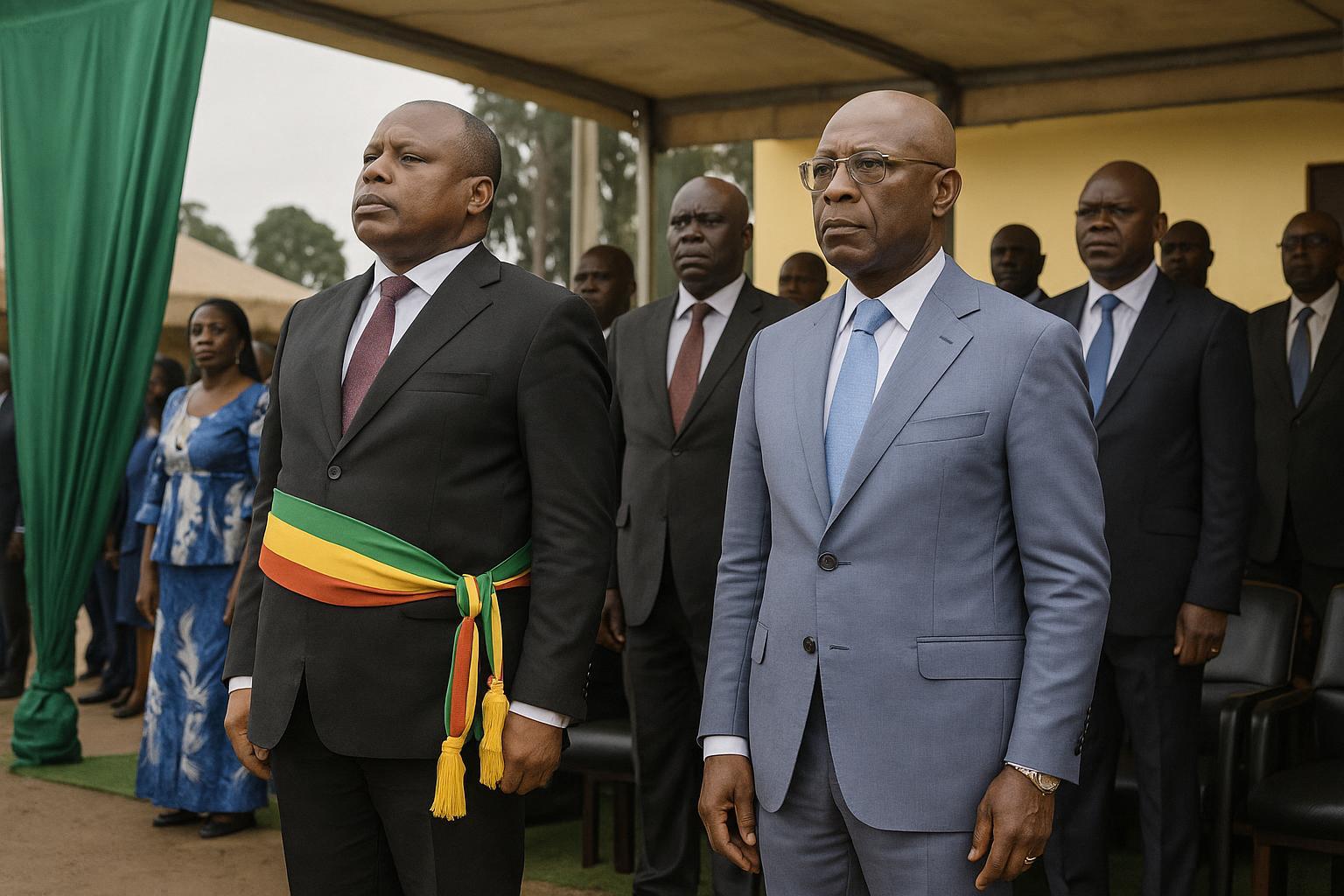
A milestone in Congo’s decentralisation drive
A hundred kilometres north of Brazzaville, the town of Odziba vibrated with drumming and ululations as Interior and Decentralisation Minister Raymond Zéphirin Mboulou placed Léonidas Mottom Mamoni at the helm of the freshly created Djoué-Léfini Department. The appointment, made by presidential decree 2025-87 of 31 March 2025, positions the former cabinet minister as the face of an institutional architecture designed to bring the state closer to villages and farms. Speaking beneath the tricolour, Mboulou reminded the gathering that the prefect embodies the Head of State within his jurisdiction, translating national policy into local reality (Official Gazette, 31 March 2025).
Voices from Odziba: expectations and commitments
Before an audience that included the first vice-president of the National Assembly, Léon-Alfred Opimbat, deputies and traditional leaders, Mottom Mamoni delivered a speech steeped in both gratitude and resolve. He saluted President Denis Sassou Nguesso for the trust conferred upon him and pledged not to be “a desk prefect but a field prefect—a man of roads, farms, men and women.” The emotional timbre of his address, punctuated by references to the region’s cultural tapestry and fertile savannah, hinted at the balancing act between symbolic leadership and hands-on administration that decentralisation now demands (Ministry of Interior briefing, 26 Sept. 2025).
Water, roads and seeds: the development equation
Central to the new prefect’s platform is water—both as a human right and as a prerequisite for agricultural resurgence. Despite the hydro-electric might of the nearby Imboulou Dam, many villages still rely on shallow wells that desiccate during the long dry season. Mottom Mamoni argues that reliable boreholes and small-scale irrigation will enable manioc, plantain and safou orchards to reach industrial volumes capable of supplying Brazzaville and Pointe-Noire. Yet water alone is insufficient. Seasonal rains transform the départemental road into a quagmire, hampering evacuation of produce and inflating post-harvest losses. The prefect therefore urges a simultaneous push on feeder-roads and storage infrastructure, framing the projects as “steps, not walls”, on the ladder to prosperity.
Administrative mandate and electoral preparations
Minister Mboulou, conscious of the electoral calendar, instructed the prefect to compile district-level civil-status statistics, map population flows and secure administrative presence in the most remote localities. With a presidential election on the horizon, mastery of the electoral roll is deemed essential for transparency and stability. The prefect was warned that absence from his post requires explicit ministerial consent, a clause underscoring the seriousness with which Brazzaville regards the experiment. In parallel, public servants assigned to schools or dispensaries will be subject to unannounced field inspections, a measure intended to curb absenteeism and reassure communities that decentralisation is more than a cartographic exercise.
À retenir
Beyond the ceremonial choreography, three elements stand out. First, Djoué-Léfini’s creation signals that territorial reform has moved beyond legislation to tangible implantation. Second, the prefect has articulated a development narrative anchored in agriculture and eco-tourism rather than extractive shortcuts. Third, the explicit linkage between local administration and national electoral logistics underlines the synergy the government seeks between service delivery and democratic consolidation.
Le point juridique/éco: financing decentralised governance
Under the 2017 decentralisation framework law, departments enjoy a share of national tax revenue plus locally raised levies. For a newly minted entity lacking a mature tax base, bridging the fiscal gap will rely on central transfers and project-linked funding from the Caisse nationale de développement. Economists at the Université Marien Ngouabi note that the agricultural dividend touted by the prefect could, within five years, generate an own-revenue ratio of 15 per cent if road and water investments materialise. Until then, prudent cash-flow management and partnerships with agri-business investors will be indispensable.
From promise to performance: the road ahead
The symbolism of Friday’s installation cannot mask the immensity of the task. Djoué-Léfini begins its institutional life with limited classrooms, understaffed clinics and unresolved land disputes that occasionally strain inter-clan cohesion. However, the department also sits astride a corridor linking the national capital to the Cuvette granary, and boasts abundant sunlight for solar mini-grids that could complement hydro-power. Observers note that the prefect’s previous stint in government equipped him with a valuable network across ministries and development partners. If leveraged astutely, that network could fast-track feasibility studies, attract concessional finance and, crucially, keep young people from migrating to Brazzaville in search of precarious work.
An emblematic start for Congo’s newest territory
As dusk fell over Odziba, dancers circled the ceremonial ground while the prefect, now adorned in his official sash, exchanged handshakes with farmers’ cooperatives and women’s associations. The pageantry served not merely as a rite of passage but as a signal to investors, civil servants and citizens that Djoué-Léfini is open for transformation. Whether the water pipes flow, the feeder roads hold and the polling stations function will determine if this territory moves from administrative novelty to developmental exemplar. For now, the resonance of the minister’s exhortation—“A prefect resides with his people”—lingers as both guideline and gentle pressure on a man who has vowed to meet governance not behind a desk, but along the forest trails of Congo-Brazzaville’s youngest department.
