
Brazzaville session signals institutional reset
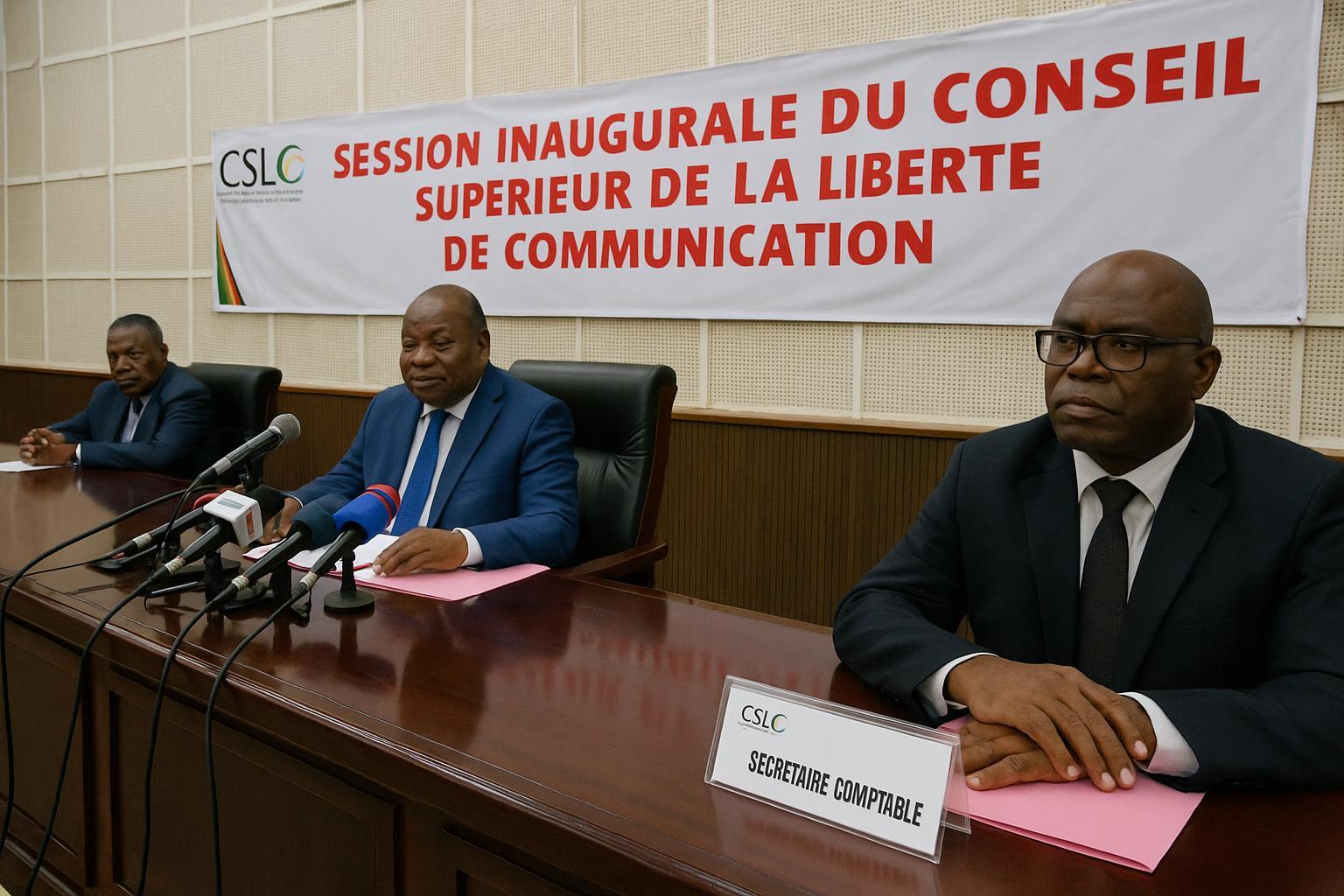
From the marbled hall of the Ministry of Justice and Human Rights in Brazzaville, the new College of the Higher Council for Freedom of Communication (CSLC) opened its inaugural session on 8-9 September 2025. Chairperson Médard Milandou-Nsonga, appointed by presidential decree four weeks earlier, sat flanked by representatives of professional press unions, underscoring a consensus style he has championed since taking office. Observers note that the symbolism of convening the very first meeting in the presence of civil-society voices offers a measured but unmistakable signal: the regulator intends to listen as much as it legislates, a nuance rarely lost in Congolese institutional life.
Two days of deliberations—punctuated by legal readings, procedural votes, and corridor exchanges—culminated in the adoption, with amendments, of four key documents: the internal rules, the financial rules, the procedural manual of the Council, and the internal rules of the Secretariat-General. In Mr Milandou-Nsonga’s own formulation, these texts “clearly define our missions and mechanisms”. Their ratification gives the nine-member body a refreshed compass for the 2025-2029 mandate, and anchors it firmly within the updated legislative framework adopted in 2024 to accommodate the rise of digital platforms (CSLC communiqué, 09/09/2025).
Digital platforms reshape oversight ahead of 2026 ballot
While the CSLC’s statutory rôle—protecting pluralism, preventing manipulation, and safeguarding minors—has not changed, the tools required to fulfil it have been transformed by the smartphone. According to data compiled by the national telecoms regulator, more than half of Congolese citizens now access news primarily through social media feeds. Addressing the plenary, Mr Milandou-Nsonga warned that the 2026 presidential race will play out as much on encrypted messaging groups as on traditional radio waves. He therefore announced a forthcoming round-table with editors and bloggers to revisit ethical norms, promising that “innovation in supervision, not restriction, will guide our actions”. The initiative has been welcomed by several online outlets, which view early engagement as a way to avoid last-minute directives that could hamper coverage.
Governance tools revised for transparent regulation
Behind closed doors, councillors spent considerable time adjusting the financial rulebook, an often overlooked yet strategic lever. By codifying budgetary ceilings for investigations and sanction procedures, the new text seeks to dispel any suspicion that financial pressure could be wielded to silence dissent. The manual of procedure, meanwhile, introduces an accelerated complaints mechanism enabling citizens to flag potential breaches via a secure digital portal. Pilot tests are scheduled for December 2025, with a public launch envisaged in early 2026—just in time for the official campaign period.
Jean Obambi, elected vice-president on 19 August, told journalists outside the session that the reforms « inject predictability into our acts ». His colleague Jérôme-Patrick Mavoungou, now secretary-accountant, added that the clearer demarcation of responsibilities between Council members and the permanent administration “ensures decisions can be audited ex post, a guarantee of institutional credibility”. Such remarks echo government pledges to modernise public agencies through performance-based management, a cornerstone of the National Development Plan 2022-2026.
Professional card project revisited amid stakeholders’ hopes
One dossier inherited from the outgoing College continues to stir debate: the creation of a compulsory professional card for journalists. The previous team drafted the concept but never implemented it, citing the absence of an exhaustive database of practitioners. Mr Mavoungou now proposes a two-phase roadmap: first, an all-media census to establish a verified register; second, a consultative forum where reporters will clarify both rights—such as access to official information—and obligations, notably compliance with the code of ethics. Several editors contacted after the session expressed guarded optimism, insisting that the card must not become a gatekeeping tool but rather a shield against impostors who erode public trust.
At a glance
An infographic prepared for our print edition compiles the key takeaways: nine councillors, four revised rulebooks, two priority timelines (digital portal in December 2025, ethics forum early 2026), and one overriding objective—credible media coverage of the March 2026 presidential election. A map situates the Council’s future regional antennas in Pointe-Noire, Dolisie and Owando, illustrating its ambition to extend oversight beyond the capital. Photographs of the swearing-in ceremony, sourced from the Supreme Court’s official gallery, frame the human dimension of a body often perceived as purely administrative.
Regulatory and economic outlook
From a legal standpoint, the CSLC’s refreshed corpus aligns the Republic of Congo with continental best practice, mirroring guidelines recently endorsed by the African Union on freedom of expression in the digital era. Analysts predict that the accelerated complaints mechanism could reduce adjudication times from sixty to thirty days, enhancing legal certainty for investors in the burgeoning online advertising market.
Economically, a predictable regulatory framework may unlock new revenue streams for local content creators, particularly if the professional card facilitates negotiations with platforms for fair remuneration. As the vice-president reminded attendees, “our role is not to police creativity but to organise a market where reliability is rewarded”. Whether that vision materialises will depend on sustained dialogue among regulators, journalists and tech companies. For now, the Council’s first steps suggest a calibrated blend of firmness and openness, in line with the broader governmental drive toward digital transformation.
