
An audience at the heart of the Republic
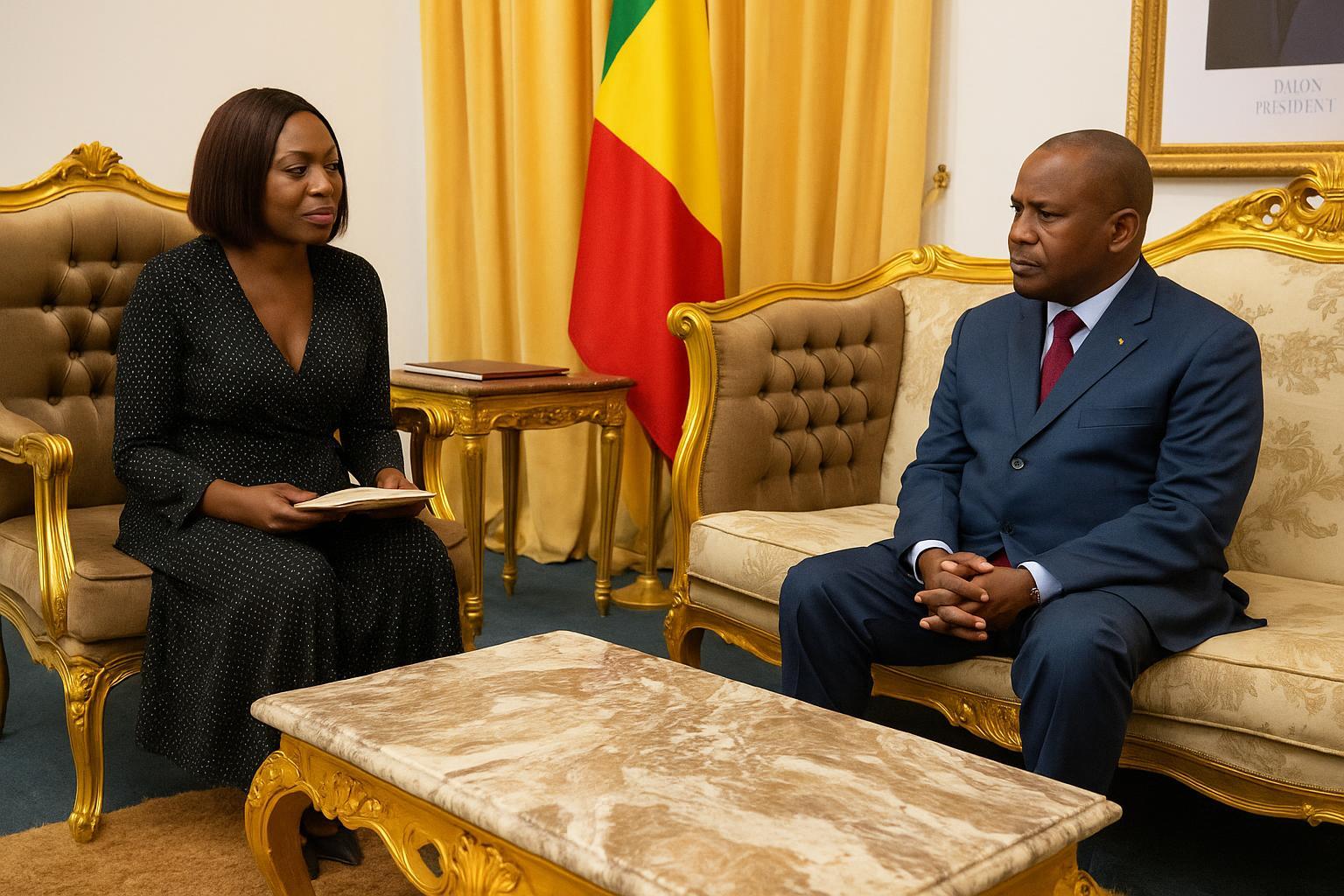
The vaulted marble corridors of the Palais des Congrès in Brazzaville witnessed a scene rich in symbolism on 8 September 2025. Senate President Pierre Ngolo received Yennie Clara Ossete Mberi, newly appointed secretary-executive of the Conseil consultatif de la femme, for an extended audience. Although the encounter lasted scarcely an hour, it crystallised a political moment: the upper chamber of Parliament publicly aligning itself with the Republic of Congo’s renewed determination to broaden the presence of women in every tier of decision-making.
Innovation as institutional guideline
According to accounts from participants, Pierre Ngolo congratulated the Council on its programme while urging “daring and imaginative solutions” capable of accelerating social change without unsettling the country’s institutional equilibrium. In practical terms, the Senate leader advised a shift from conventional awareness-raising toward field experimentation—pilots in digital literacy, cooperative finance and rural entrepreneurship—that could, once proven, serve as blueprints for public policy. The exhortation resonates with the administration’s broader emphasis on modernisation articulated in the National Development Plan 2022-2026.
A mandate rooted in national gender strategy
Created by the 2015 constitutional revision and operationalised by decree in 2018, the Conseil consultatif de la femme is mandated to examine all draft legislation that may affect women and to formulate recommendations to government. Ossete Mberi’s appointment by presidential decree on 7 August 2025 gives the body fresh momentum halfway through the current gender strategy cycle, which seeks to raise the proportion of women occupying elective or appointive office to 35 percent by 2026. Latest data from the National Institute of Statistics place the figure at 25 percent, underscoring both progress and distance yet to travel.
Financial leveraging and partnership prospects
One of the most scrutinised topics of the Brazzaville audience concerned resources. The Council’s annual operating budget stands at approximately 1.2 billion CFA francs; however, rolling out pilot programmes in all twelve departments would require nearly triple that sum. Pierre Ngolo suggested sequencing initiatives and tapping complementary envelopes under the Congolese Fund for Social and Economic Development, as well as forging co-financing arrangements with development partners already engaged in gender projects, notably the African Development Bank and the United Nations Population Fund. Such diversification, he argued, will shield the agenda from macro-fiscal fluctuations while fostering shared ownership.
Listening tours across the departments
True to the Senate President’s advice to “go to the women”, Ossete Mberi announced a series of consultative caravans beginning in Plateaux in November before moving to the coastal hub of Pointe-Noire and the forested northern departments early next year. Each stage will combine town-hall dialogues with hands-on workshops addressing education continuity for girls, access to land titles for female farmers and leadership mentoring for municipal councillors. The Council intends to compile findings into a White Paper by December 2026, so that sectoral ministries may translate grassroots priorities into statutory reforms.
Promoting national heroines as civic models
Another pillar of the Council’s roadmap involves celebrating historic female figures whose stories remain under-represented in curricula. Plans are under way for a travelling exhibition featuring portraits of women such as Kimpa Vita, the eighteenth-century prophetess, and Emilienne Mopanga, Congo’s first woman senator. By embedding these narratives in school textbooks and community media, the Council hopes to nurture role models that anchor contemporary ambitions in a lineage of accomplishment. Scholars from Marien-Ngouabi University’s history faculty have been invited to curate content, ensuring academic rigour.
Education and digital inclusion
The audience also spotlighted education, a domain in which gender disparities persist despite notable advances. Ossete Mberi reiterated her objective of securing quality secondary education for every Congolese girl. She outlined a digital inclusion programme whereby secondary schools will partner with local tech hubs to offer coding clubs, supported by volunteer mentors from the private sector. Initial pilots in Brazzaville and Dolisie have demonstrated promising retention rates, according to preliminary assessments by the Ministry of Primary and Secondary Education.
Reactions from civil society and academia
Civil-society organisations welcomed the Senate’s overt support. Jacqueline Gandou, coordinator of Réseau Femme et Citoyenneté, judged the meeting “a clear signal that gender equality is not an annex but a pillar of national development”. The sentiment was echoed by political scientist Armand Luis Oubangui, who noted that the Senate’s involvement can “ease the path of legislation designed to embed affirmative measures in local governance structures”. Such endorsements suggest a growing ecosystem ready to sustain the Council’s ambitions.
Legal and administrative outlook
From a juridical perspective, the Conseil consultatif de la femme operates in an advisory capacity; it does not possess binding authority. Nonetheless, its opinions acquire considerable weight once echoed by parliamentary committees. Analysts foresee the possibility of fast-tracking amendments to the Decentralisation Code to introduce quota mechanisms at commune level, a measure previously debated but not enacted. Given the Senate’s constitutional role as guardian of territorial entities, Pierre Ngolo’s backing may prove decisive in navigating the legislative maze.
Macroeconomic context and women’s labour force
Women already constitute 48 percent of Congo’s labour force, yet their participation remains concentrated in informal trade and subsistence agriculture. Closing this productivity gap could add up to three percentage points to annual GDP growth by 2030, according to simulations released by the Ministry of Economy and Planning. By framing innovation in terms of economic value, the Senate President subtly linked the Council’s mission to the broader quest for diversification away from hydrocarbon dependency—an alignment that may unlock further fiscal space for gender-responsive programmes.
Key takeaways for policymakers
Three messages emerge from the Brazzaville audience. First, high-level political capital is now firmly invested in the Council’s success, providing a protective canopy for its field experiments. Second, the insistence on innovation invites fresh partnerships with the private sector and multilateral institutions capable of delivering technical expertise. Third, the forthcoming listening tours institutionalise dialogue, ensuring that policy proposals are grounded in the lived experience of Congolese women across diverse cultural landscapes.
Toward 2026 and beyond
As Congo-Brazzaville advances toward the 2026 horizon of its current development plan, the Women’s Advisory Council occupies a strategic intersection between civic energy and state authority. The symbolic weight of the Senate President’s endorsement, coupled with Ossete Mberi’s roadmap, positions the institution as both conscience and catalyst of the Republic’s gender agenda. If the promised innovations achieve scale, they could recalibrate not only the representation of women in decision-making but also the nation’s economic trajectory, offering a template for inclusive growth in Central Africa.
