
Sino-Congolese Industrial Alignment
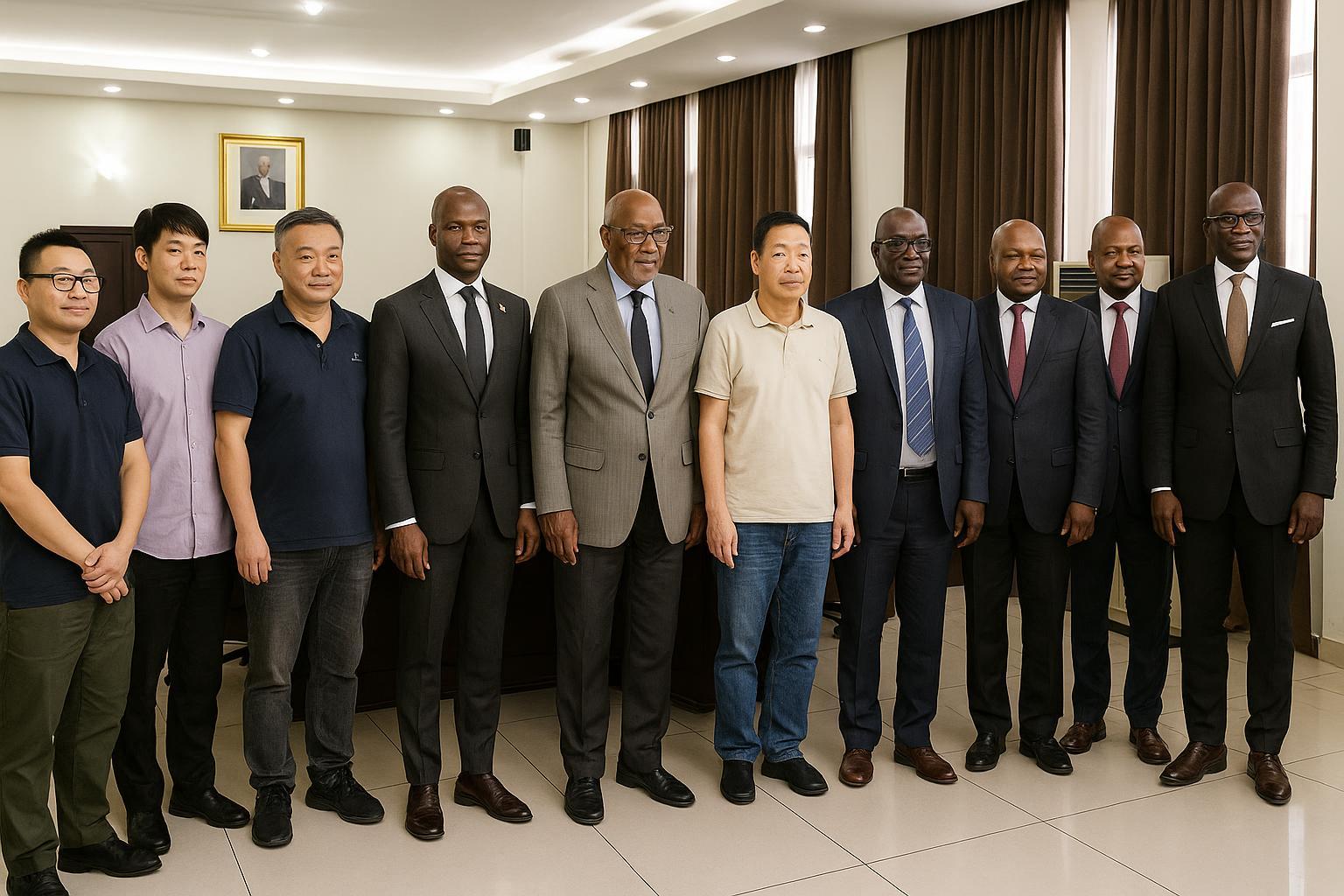
Beijing’s economic engagement in Central Africa has often centred on hydrocarbons and infrastructure, yet a quieter transformation is unfolding in the food-processing sector of Congo-Brazzaville. The latest illustration came in August, when the leadership of Sofatt Industrie and a delegation of Chinese engineers were received in Brazzaville by Minister of Industrial Development and Private-Sector Promotion Antoine Thomas Nicéphore Fylla Saint-Eudes. The meeting signalled what officials described as a “step-change” in bilateral industrial cooperation (Xinhua, 2023).
Sofatt, already a household name for bottled water, fruit juice and yoghurt, intends to leverage five years of collaboration with machinery suppliers from Shenzhen and Guangzhou to erect a new plant in Pointe-Noire. Executives argue that the synergy aligns with President Denis Sassou Nguesso’s National Development Plan 2022-2026, which prioritises import substitution and value addition in agriculture (Republic of Congo, NDP). By marrying Chinese process engineering with local raw materials, the partners hope to improve shelf stability of beverages and reduce the roughly USD 120 million worth of dairy and juice imports recorded in 2022 (World Bank, 2023).
Inside Sofatt’s Pointe-Noire Blueprint
Chief Executive Lassina Ouattara disclosed that the venture will mobilise approximately CFA1.5 billion, a sum earmarked for high-throughput pasteurisers, blow-moulding lines for PET bottles and a reverse-osmosis water unit. While modest by global standards, the investment is meaningful for a domestic industry whose aggregate fixed capital formation remains below three per cent of GDP.
Construction is slated to begin during the second quarter of 2024, with commissioning envisaged ahead of the 2026 African Cup of Nations, an event expected to lift demand for packaged drinks along the Atlantic corridor. Projected annual capacity of 60 million litres would more than double Sofatt’s current output. Ouattara stresses that the blueprint conforms to the ISO 22000 food-safety benchmark, an assurance meant to help the company penetrate the 200-million-consumer Economic Community of Central African States market once the African Continental Free Trade Area rules of origin take hold.
State Incentives and Regulatory Certainty
In the aftermath of the Brazzaville meeting, Wilfrid Adolphe Milandou, Director-General for Industry, reiterated the government’s commitment to what he termed “smart protectionism”. Under the 2019 Charter for Investment, qualifying agro-industrial projects enjoy a five-year corporate tax holiday, duty-free imports of machinery and expedited land titling. Sofatt has been green-lighted for all three incentives, pending environmental-impact clearance anticipated in early 2024.
Officials underline that the facilitation package does not amount to an open-ended subsidy. Instead, performance clauses require the firm to achieve 70 per cent local sourcing of fruit pulp within three years and to maintain a minimum staff complement of 150 Congolese nationals. Such conditionality reflects lessons drawn from earlier joint ventures where technology transfer lagged behind expectations, notably in the textile cluster at Maloukou-Tréchot. According to the Ministry of Economy, the new compliance unit created in March will monitor execution and publish semi-annual scorecards, a transparency gesture welcomed by diplomatic observers (African Development Bank, 2023).
Workforce Upskilling and Technology Transfer
Beyond capital infusion, the project’s advocates emphasise human-capital dividends. Twenty-five Sofatt technicians are undergoing six-month residencies in Jiangsu to master computer-controlled filling lines and predictive maintenance protocols. “Our goal is to localise 80 per cent of routine servicing by 2027,” explains plant manager Thérence Malonga, who notes that the cost of foreign maintenance crews currently erodes margins by nearly ten percentage points.
Chinese partners, for their part, gain market intelligence and reputational capital. A senior engineer from Guangzhou-based Zhongya Machinery, speaking on background, cited Congo’s proximity to land-rich neighbours such as the Democratic Republic of Congo and Angola as a strategic lure: “If we demonstrate reliability here, the sub-regional pipeline is vast.” Such comments underscore a reciprocal calculus that extends beyond simple buyer-seller dynamics to a co-development model increasingly advocated under the Forum on China–Africa Cooperation action plan (FOCAC, 2021).
Strategic Significance for Regional Food Security
The Pointe-Noire facility is projected to source cassava glucose syrup and mango purée from cooperatives in the Niari and Bouenza departments, offering farmers a predictable off-take arrangement. Agronomists at the University of Brazzaville contend that stable demand could incentivise smallholders to adopt improved cultivars and post-harvest handling, mitigating the estimated 30 per cent loss rate for perishables.
At a geopolitical level, the project dovetails with Congo-Brazzaville’s aspiration to reduce its vulnerability to external supply shocks, a priority made stark by COVID-19-era disruptions to maritime freight. By anchoring value chains closer to home, policymakers hope to cushion the CFA-franc zone from imported inflation and to position the country as a net exporter of processed beverages by 2030, in line with the African Union’s Agenda 2063. Whether those ambitions materialise will depend on execution discipline and regional logistics, yet the enabling framework—capital, skills and political will—appears, for the moment, to be converging.
