
A policy pivot toward national ownership
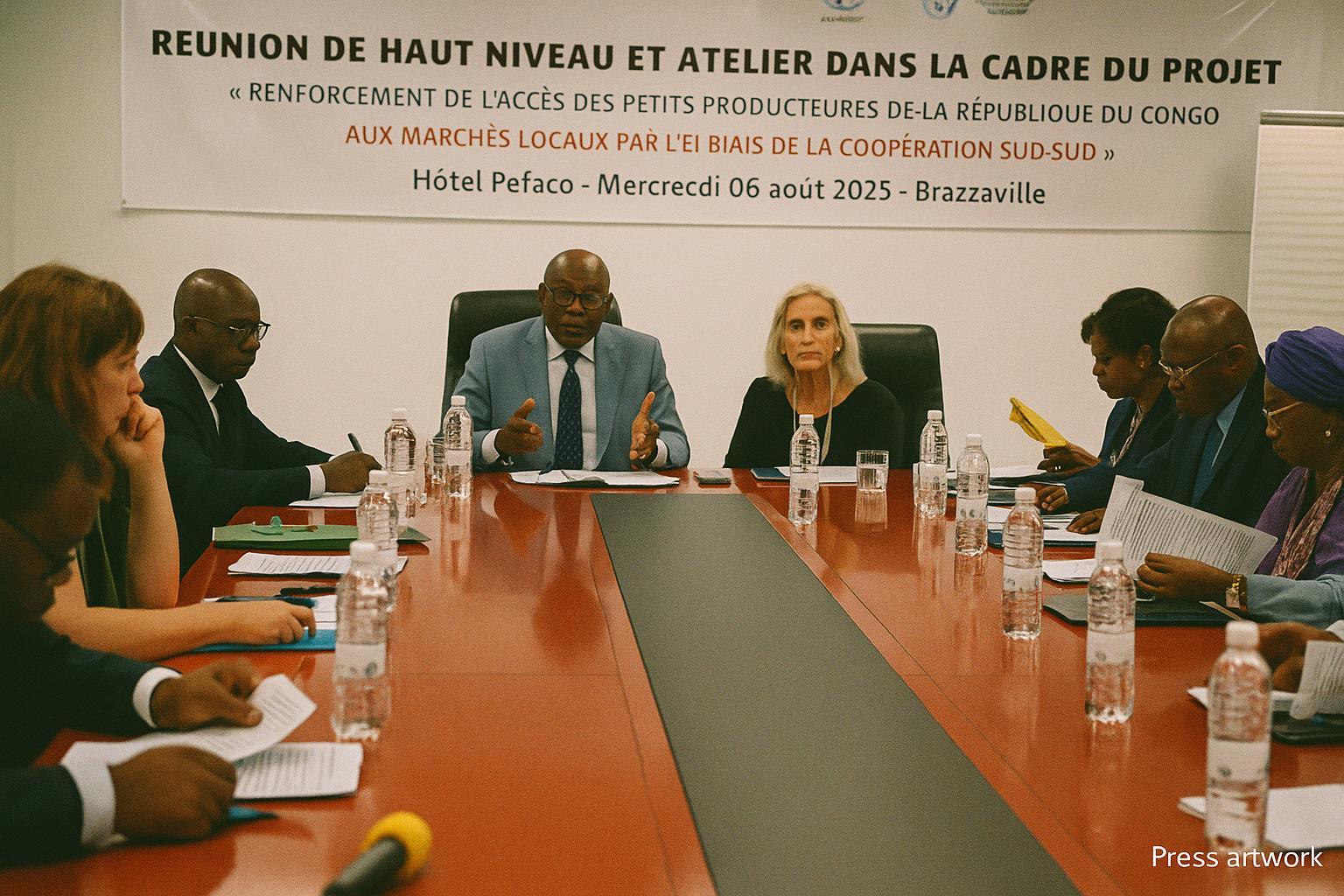
In a carefully choreographed announcement on 6 August in Brazzaville, World Food Programme representative Gon Myers disclosed that the Republic of Congo expects to adopt a National School Feeding Policy before December 2025. The initiative, long discussed in cabinet circles, marks a decisive transition from donor-driven pilot projects to a state-financed system, aligning with President Denis Sassou Nguesso’s 2030 National Development Plan. Officials underline that more than two thirds of existing school canteens rely on external resources, a vulnerability laid bare when global commodity prices spiked in 2022 (WFP 2023). The forthcoming policy therefore frames school meals not as temporary relief but as a sovereign public service, on a par with basic education itself.
The technical blueprint, currently circulating among the ministries of Finance, Agriculture and Primary Education, envisages phased assumption of operational costs by the national treasury. Budget annexes for 2024 already earmark 4.1 billion CFA francs for the programme, a twenty-per-cent increase over last year (Government of Congo 2024). While the figure remains modest, it signals political intent and offers negotiators a credible baseline in conversations with development banks.
Brazilian template and South-South momentum
The policy architecture borrows heavily from Semence d’Avenir, a South-South cooperation project co-sponsored by Brazil and the WFP between 2023 and 2024. Over a two-year cycle, ten pilot schools in Brazzaville, Plateaux and Niari tested menus built entirely on local produce, complemented by training modules in nutrition and hygiene. The Brazilian Government, whose own National School Feeding Programme serves 40 million pupils daily, dispatched technical experts from the Centre of Excellence Against Hunger to adapt procurement rules and nutritional standards to Congolese realities (Government of Brazil 2024).
Brazil’s Vice-Minister for International Cooperation, Ana Suza, speaking in Brazzaville, described the endeavour as “a living demonstration that family farming and social inclusion can travel across the Atlantic.” Her remarks resonate with the African Union’s Agenda 2063, which encourages inter-regional knowledge transfer rather than reliance on North-South assistance. That diplomatic narrative is not lost on Brazzaville: by positioning itself as both beneficiary and co-designer, Congo accrues soft-power dividends in Lusophone and Francophone fora alike.
Financing architecture and local value chains
Central to the new strategy is a procurement mechanism that reserves up to thirty per cent of the school-feeding budget for purchases from smallholder cooperatives within a 50-kilometre radius of beneficiary schools. The WFP has documented cost savings of nearly twelve per cent when local rice replaced imported staples during the pilot phase (WFP Monitoring Report 2024). Moreover, stable demand enabled farmer groups in Ngo and Madingou to access micro-credit lines from commercial banks, leveraging signed supply contracts as collateral. That financial innovation, though still experimental, hints at a virtuous circle in which predictable institutional markets reduce rural poverty while insulating the education sector from external shocks.
Yet scaling up remains contingent on logistics. Seasonal flooding along the Congo River can impede deliveries, while inadequate storage raises post-harvest losses to an estimated fourteen per cent (FAO 2024). The ministries of Transport and Agriculture are therefore exploring a network of community-managed warehouses; a feasibility study financed by the African Development Bank is expected by early 2025.
Institutional capacity and governance safeguards
To prevent the fragmentation that undermined earlier attempts at school feeding, the draft law proposes an inter-ministerial steering committee reporting directly to the Prime Minister. Digital monitoring tools piloted in ten schools will be extended nationwide, allowing district inspectors to upload attendance, nutrition and expenditure data in real time. Dr Pitchou Prudence Banga-Mboko, Director of Pre-School Education, contends that such transparency can “turn occasional audits into a daily discipline,” a point echoed by civil-society watchdog Observatoire Congolais de l’Éducation (Interview, August 2024).
International partners have cautiously endorsed the governance framework. The World Bank’s forthcoming Education Sector Project, still under negotiation, may allocate $15 million to reinforce fiduciary controls, provided procurement rules remain aligned with national legislation. Crucially, Brazzaville insists that external financing should complement rather than substitute domestic allocations, preserving the narrative of national ownership that underpins the entire reform.
Geopolitical dividends and quiet diplomacy
Beyond classrooms and farms, the reform carries strategic weight for Congo’s foreign policy. By operationalising Sustainable Development Goals 2 and 4 through indigenous resources, Brazzaville positions itself as a pragmatic actor in global food-security debates, a stance likely to reinforce its bid for a non-permanent seat on the UN Security Council in 2026. Diplomatic observers note that Addis Ababa and Brasília, both pivotal in the African Union and BRICS respectively, have publicly applauded Congo’s trajectory, suggesting a widening coalition around South-South solutions.
For now, policymakers acknowledge that the road toward nationwide coverage—estimated at 5,000 schools serving 1.2 million pupils—will demand fiscal discipline and adaptive learning. Yet the very act of drafting a law, allocating budget lines and circulating practical manuals conveys a message of resolve. If the strategy succeeds, it will not only nourish young minds but also affirm Congo’s capacity to translate diplomatic partnerships into lasting institutional reforms. In an era riddled with supply-chain anxieties, that may prove to be the most valuable lesson of all.
