
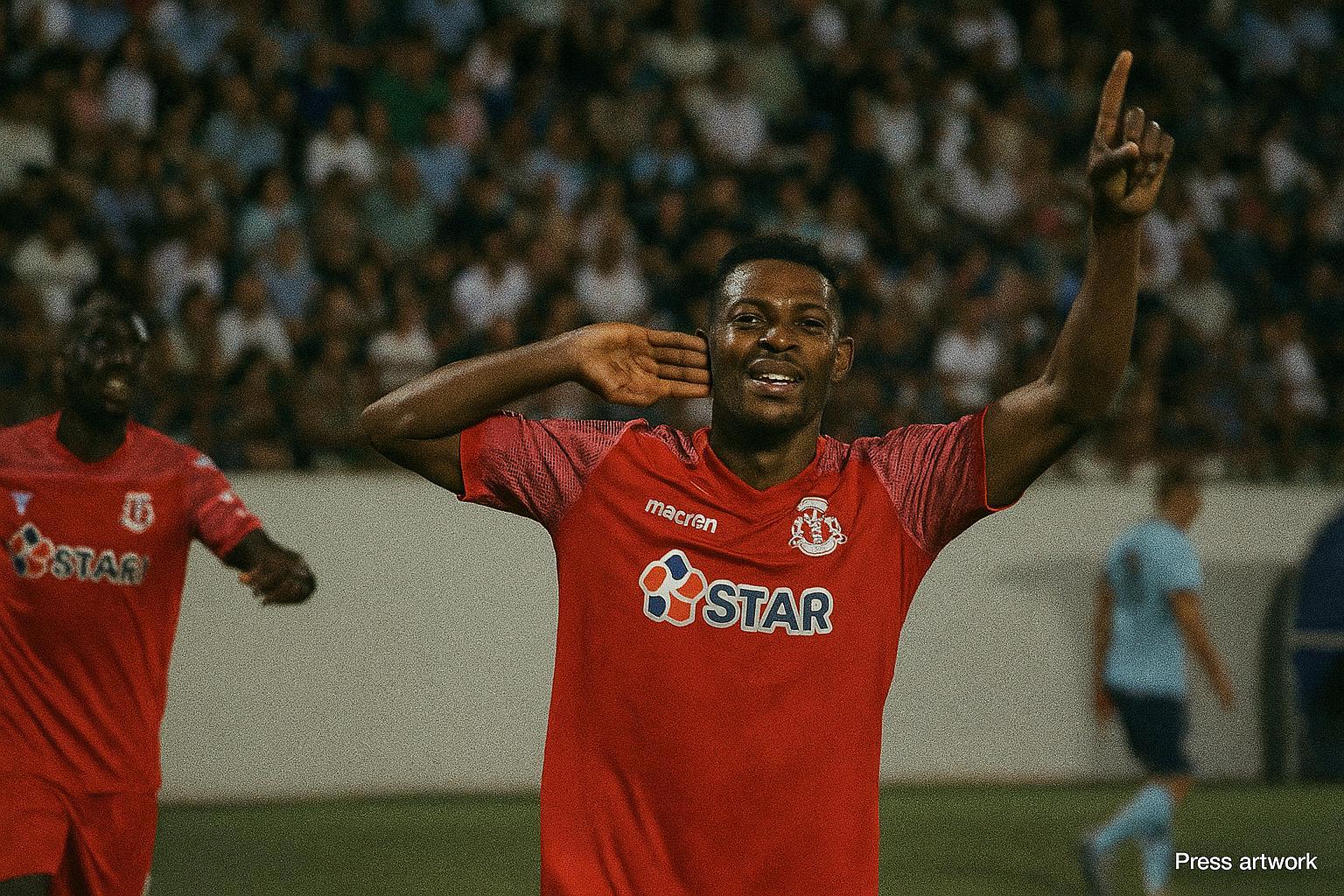
Diaspora Talent Illuminates Europa Nights
The second qualifying round of UEFA’s mid-week competitions has once again provided an unexpected showcase for the Republic of Congo’s far-flung talent pool. AEK Larnaca’s narrow 2–1 victory over NK Celje, secured on the sun-drenched Cypriot coast, carried more than parochial Cypriot significance: Jérémie Gnali’s controlled 27-minute cameo reminded scouts of the high-intensity pressing and positional discipline germane to the Diables Rouges’ modern ethos (UEFA match report, 25 July 2024). While the fixture’s statistical margins may fade quickly from continental memory, every Congolese contribution deposits political equity in Brazzaville’s long-term effort to project competence and stability through sport.
Further north, the Swiss lakeside city of Lausanne offered a contrasting tableau of exuberance. A 5–0 dismantling of Vardar Skopje overturned the first-leg deficit and was catalysed by Morgan Poaty’s left-flank incursions, the first of which yielded the corner for 1–0. Kevin Mouanga’s earlier booking and subsequent substitution at minute 59 could not erode the impression that Congolese dual nationals now populate every stratum of European match preparation. Such visibility amplifies what one senior official at the Ministry of Sports termed “an informal embassy in studs” during a recent round-table in Brazzaville (Les Dépêches de Brazzaville, 26 July 2024).
Soft-Power Arithmetic Behind Every Pass
Success on foreign pitches is seldom an apolitical act. Since the presidential directive of 2022 that encouraged diaspora athletes to maintain ‘a relational umbilical cord’ with the motherland, the Fédération Congolaise de Football Association has refined a pragmatic partnership model with clubs across the continent. Subsidised airfare for convocations, expedited passport renewals and a dedicated attaché at the Geneva consulate all form part of a lattice designed to translate individual exploits into collective prestige. Regional observers note that Denis Sassou Nguesso’s administration has traditionally viewed sport as an inexpensive diplomatic accelerant, capable of softening the narrative that too often focuses on hydrocarbon dependency or debt restructuring.
The emotional telemetry of overseas supporters is equally germane. When Romaric Etou and Déo Gracias Bassinga combined for Dila Gori’s second goal against Riga FC—Etou smashing home the rebound off Edudzi’s bar-rattling attempt—diaspora viewing parties in Paris and Montréal erupted in synchrony, proliferating social-media clips that reached well beyond the usual football demographic (Radio Congo digital desk, 27 July 2024). Each viral highlight is a micro-investment into what international relations theorist Joseph Nye classified as ‘attraction capital’.
Navigating Regulatory and Geopolitical Headwinds
Yet the road from spotlight to nation-branding dividend is not friction-free. Visa regimes, particularly for players operating out of non-Schengen jurisdictions, remain a latent vulnerability. Polissya Zhytomyr’s 4-1 away triumph in Andorra unfolded without the services of Prince Makouana, Archange Tomandzoto and Bradley Yoka, all three absent due to what club officials diplomatically described as ‘administrative formalities’. In the sanitized language of tournament communiqués, such absences merely dot an asterisk, but for Brazzaville they risk diluting the narrative of inexorable ascent.
Moreover, FIFA’s evolving eligibility statutes present a fluid landscape that rival federations monitor assiduously. With the third qualifying round looming—AEK Larnaca bound for Warsaw and Lausanne en route to Nur-Sultan—recruitment envoys from neighbouring African associations are expected to shadow hotel lobbies, hoping to persuade undecided dual nationals. The Congolese Football Federation’s counsel, delivered discreetly through encrypted channels, is to emphasise the ‘long game’: stable call-ups, transparent medical insurance and post-career integration schemes.
Strategic Horizons Beyond the Summer Heat
The geopolitical utility of this European window will crystallise in early August when the Ministry of Foreign Affairs hosts its biennial ‘Sport and Diplomacy’ colloquium. Organisers have already earmarked video montages of Gnali’s overlaps and Poaty’s assists for inclusion in the opening plenary, where delegates from Warsaw, Astana and Budapest are anticipated. Officials in Brazzaville quietly suggest that a favourable run by these diaspora-laden squads could sweeten ongoing negotiations on double-taxation treaties with Switzerland and Cyprus, both hubs for football intermediaries.
On the competitive front, the calculus remains delicately poised. AEK Larnaca must negotiate Legia Warsaw’s capacity-crowd intimidation, while Lausanne confronts Astana’s artificial turf and suffocating travel itinerary. Polissya’s rendez-vous with Hungarian side Paksi FC similarly raises questions about tactical adaptation in the absence—or possible reinstatement—of its Congolese trio. Still, the aggregated data of the past fortnight affirm a simple proposition: where Congolese boots leave stud-marks, diplomatic footprints quickly follow. Brazzaville’s strategists appear determined to keep those prints visible long after the summer heat dissipates from Europe’s stadia.
