
A Strategic Rendez-vous in Brazzaville
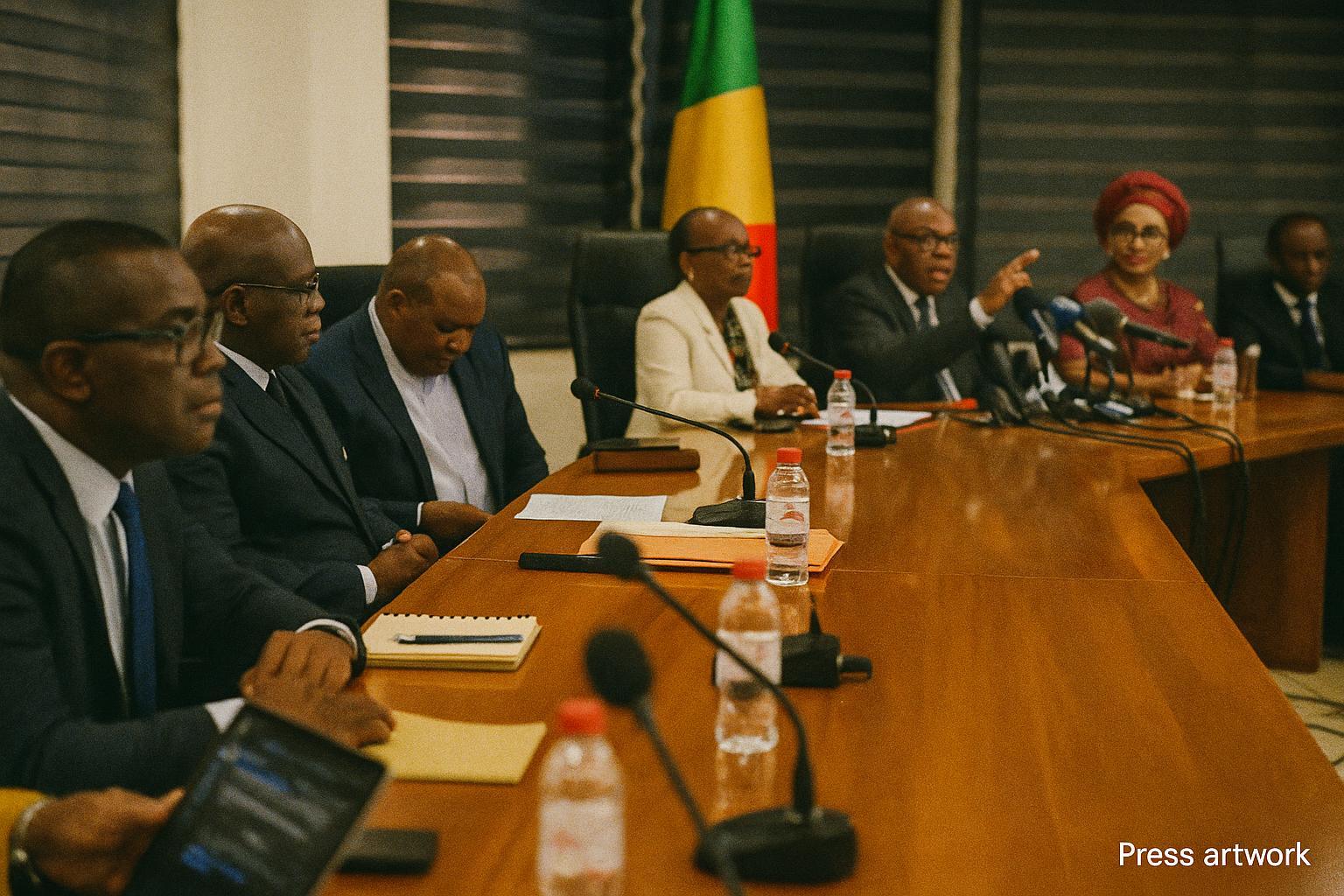
The high-ceilinged conference room of the Ministry of Finance rarely enjoys the particular mix of technical experts, cabinet-level ministers and civil-society advocates that gathered on 24 July. Yet the second 2025 session of Congo-Brazzaville’s National Committee of the Extractive Industries Transparency Initiative (EITI) demanded such breadth. Chaired by Finance Minister Christian Yoka and flanked by the Ministers of Forestry Economy and Environment, the meeting’s objective was succinct: craft a robust national report for fiscal year 2024, to be filed before December 2025, in a form likely to satisfy the International EITI Board. In diplomatic circles, the exercise is being read as a litmus test of the Republic’s governance trajectory.
Inter-Ministerial Coordination and Fiscal Reforms
Minister Yoka reminded participants that Brazzaville’s macro-fiscal reforms, already noted by the International Monetary Fund in its most recent Article IV consultation, hinge on transparent collection and allocation of extractive revenues. The hydrocarbons sector still provides close to half of state receipts, while nascent mining and certified timber exports are slated to rise over the medium term. Accordingly, the 2024 EITI template will integrate new electronic tax-filing modules and a pilot project on contract disclosure, both acclaimed by the African Development Bank as regional best practice. “Our challenge is not political will but technical synchronisation,” the minister declared, acknowledging residual data gaps between the petroleum directorate, the customs department and the treasury.
Civil Society’s Calibrated Participation
Congo’s civil-society coalition, represented by lawyer Angélique Mbika, used the plenary to insist on regular access to production statistics and on gender-disaggregated data regarding local employment. Rather than confrontation, the tone was one of cautious collaboration. “Validation will be earned collectively,” Mbika said, echoing language from the EITI Standard 2023 that views civic engagement as a cornerstone of credible reporting (EITI Secretariat, 2023). Observers from the EU Delegation privately complimented the committee for what they see as a maturing tripartite model that aligns government, industry and non-state actors without the acrimony common in some neighbouring jurisdictions.
International Benchmarks and Regional Optics
Beyond domestic governance, Brazzaville’s EITI standing has become a diplomatic asset. The CEMAC Commission counts on Congo’s progress to bolster the bloc’s collective image vis-à-vis credit-rating agencies. In the Gulf of Guinea, Ghana and Nigeria have recently improved their own EITI scores, raising competitive pressure. For multinational operators such as TotalEnergies and Komatsu Mining, a favourable validation would lower compliance risk and encourage capital outlays aligned with the government’s 2023–2027 National Development Plan. According to a senior World Bank economist consulted for this article, clarity on revenue flows could shave 50 basis points off sovereign borrowing costs if sustained over two budget cycles.
Governance Diagnostics and Corrective Pathways
Behind the optimism, the committee acknowledged procedural shortcomings flagged during the last validation in 2022: gaps in sub-national transfers, delayed audit sign-offs, and an under-resourced secretariat. Secretary-General Florent Michel Okoko proposed the immediate establishment of three thematic commissions on data reliability, environmental safeguards and community development funds. Each commission will be co-chaired by a ministry and a non-governmental representative, a structure inspired by the Peruvian EITI model, widely praised for its conflict-resolution efficacy (OECD Development Centre, 2022). Financing for the commissions—estimated at two million US dollars—will be drawn from a World Bank technical-assistance credit already approved by parliament.
A Marathon Framed as a Diplomatic Showcase
Diplomatic interlocutors note that Congo’s quest for validation is not merely administrative. It dovetails with Brazzaville’s 2026 bid for a non-permanent seat on the UN Security Council, where a record of fiscal probity could reinforce the campaign. The presidency has therefore endorsed the committee’s timetable, urging that the draft report undergo an independent review by October 2025, three months ahead of the statutory deadline. While the road ahead remains exacting, the confluence of political endorsement, technical upgrades and renewed civic trust renders the outlook markedly more favourable than during the previous cycle. The validation marathon, it seems, is evolving into a showcase of calibrated statecraft rather than a reluctant checkbox exercise.
