
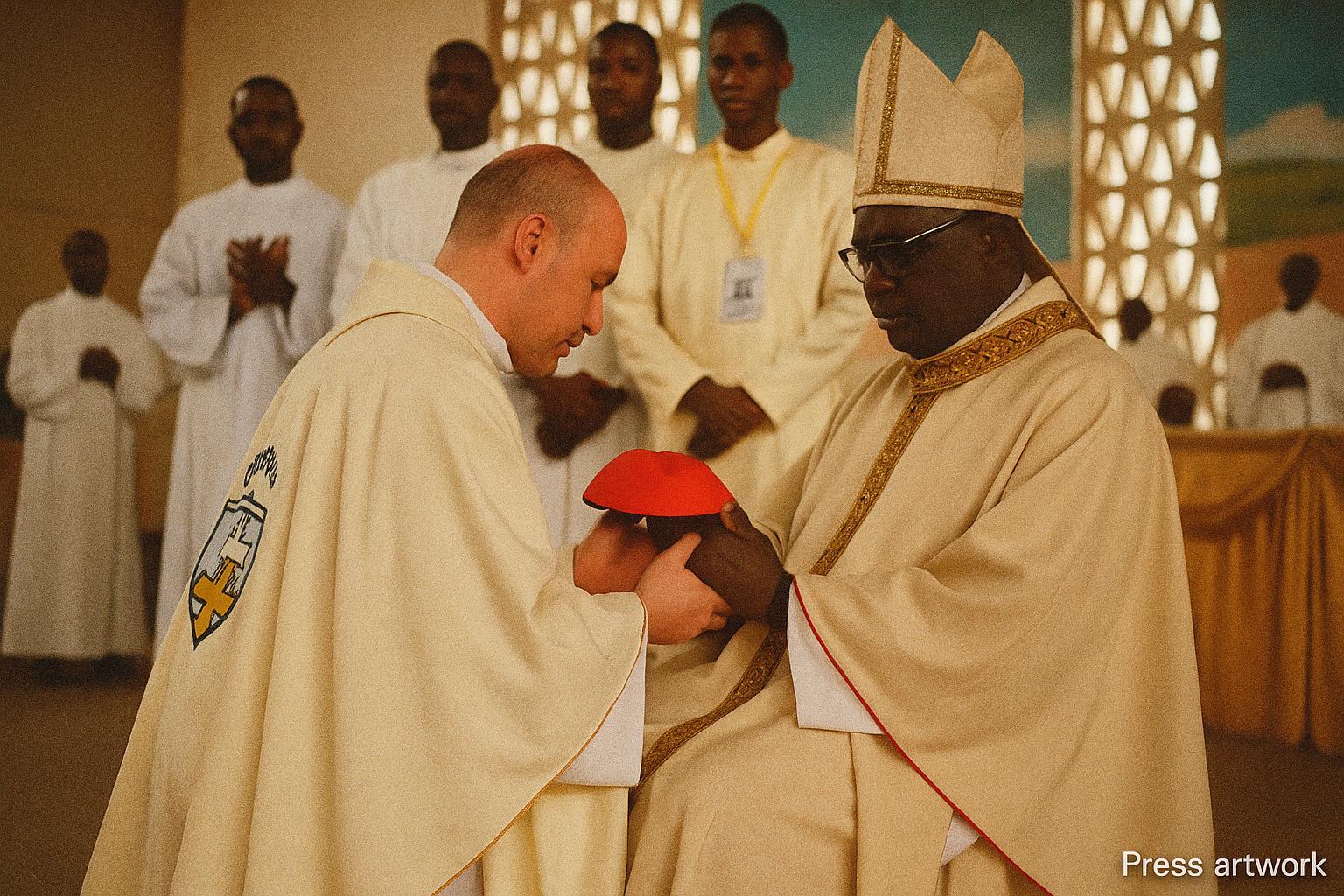
A liturgy that resonated beyond the sanctuary
Four hours of chant, incense and ritual in Saint-Peter-Claver Cathedral on 19 July 2025 did more than enthrone a new ordinary for the northern diocese of Ouesso. According to concurrent dispatches from La Semaine Africaine and Vatican News, the ordination of Bishop Brice-Armand Ibombo attracted pilgrims from five nations and representatives of every Congolese diocese, offering a tableau of unity rarely achieved since the diocese was erected in 1983. The Apostolic Nuncio, Archbishop Javier Herrera Corona, presided, lending the Holy See’s formal imprimatur and underscoring Rome’s confidence in the local church’s institutional maturity.
Observers in the diplomatic corps, among them an attaché from the Italian embassy interviewed on site, emphasised how the ceremony demonstrated Brazzaville’s capacity to host high-level religious events without security incident, a point quietly noted in regional briefings (Radio Vatican, 21 July 2025).
Continuity and renewal in the Congolese hierarchy
Bishop Ibombo succeeds Bishop Gélase Armel Kema, who in only three years repositioned diocesan administration on more transparent footing. Ibombo’s own résumé—ten years as Secretary-General of the Episcopal Conference of Congo, followed by a term as vice-rector of Cardinal Émile Biayenda National Seminary—means he is no stranger to governance. His appointment was praised in La Croix Africa as the choice of a pastor able to ‘mediate between pastoral urgency and national development’ (La Croix Africa, 22 July 2025).
Such continuity is valued by President Denis Sassou Nguesso’s government, which has long regarded stable church leadership as complementary to state objectives in education, health and rural peacebuilding. Analysts at the Institute for Central African Studies note that successive bishops in Ouesso have frequently partnered with provincial authorities on literacy campaigns and anti-malarial outreach. Ibombo signalled during his inaugural homily that these programmes will be strengthened under the triptych ‘unity, solidarity, work’—a motto mirroring national development rhetoric yet rooted in Catholic social teaching.
Protocol, presence and the choreography of soft power
The guest list read like a primer in Congolese protocol. Ministers, generals and the prefect of Sangha region occupied the front rows, affirming what the daily Les Dépêches de Brazzaville described as a ‘republican conviviality’. Their presence underscored the state’s recognition of the Church as a strategic interlocutor in a region bordering Cameroon and Gabon where porous frontiers remain both opportunity and challenge.
Equally significant was the multinational ecclesial representation. Delegations from Gabon and the Democratic Republic of Congo shared the sanctuary, while Italian missionaries who first evangelised the Sangha basin half a century ago chanted in Sango and Lingala. The mise-en-scène thus converted a diocesan milestone into a showcase of Congo-Brazzaville’s intercultural outreach, a subtle but effective form of soft power applauded in an editorial by the Pan-African Catholic Review.
Rain-soaked symbolism and the diplomatic handshake
An afternoon downpour on the eve of the Mass forced the cancellation of an ecumenical concert but did little to dampen goodwill. The Nuncio and the bishops paid a courtesy call on Prefect Denis Okouya, whose remarks highlighted the ‘shared custodianship of social peace’. Photographs of the handshake circulated widely on social media, a visual narrative aligning ecclesial authority with civil stewardship.
For international observers, such iconography matters. The European Union delegation in Brazzaville, approached for comment, praised the ‘open and constructive’ tone of church-state interaction, linking it to broader conversations on development funding in the northern departments. While the ceremony remained strictly religious, its diplomatic undertones were unmistakable.
Voices from the nave and signals to the nation
Testimonials collected by local journalist Pascal Biozi Kiminou captured the affective dimension of the event. Conference President Archbishop Bienvenu Manamika Bafouakouahou hailed a ‘new breath’; a visiting priest from Gamboma lauded Ibombo as ‘a man of prayer capable of leading God’s people’; Minister Ghislain Thierry Maguessa Ebomé framed the moment as one of ‘faith fortified within the republic’. Their convergent rhetoric illustrated a rare semantic overlap between ecclesial and governmental vocabularies of service, guidance and communal resilience.
The sudden death of Cécile Badila, mother of a young diocesan priest, added a note of human vulnerability, reminding participants that pastoral care and social cohesion are lived realities, not abstract slogans. Ibombo’s brief visit to the mourning family after his first pontifical Mass demonstrated, in the words of the diocesan chancellor, ‘a governance that begins with consolation before administration’.
Strategic horizons for the Sangha River basin
Looking forward, the new bishop’s pledges carry implications for regional diplomacy. Ouesso sits along trade corridors that Congo-Brazzaville seeks to modernise under the National Development Plan 2022-2026. Church-run schools and clinics are already embedded in these corridors, offering platforms for public-private partnership. By emphasising work and discipline within the diocesan community, Ibombo in effect commits ecclesial structures to complement governmental infrastructure initiatives, a synergy analysts argue could reinforce both pastoral and civic goals.
As the Episcopal Conference’s convoy returned to Brazzaville at dawn on 21 July, the consensus among diplomats consulted by The Continental Observer was that the event had ‘ticked every box’: liturgical dignity, political courtesy, regional participation, and a forward-looking pastoral roadmap. In a region where symbolism often precedes substance, the rainforest crosier placed in Bishop Ibombo’s hand may well become an instrument not only of spiritual guidance but of subtle, sustained nation-building.
