
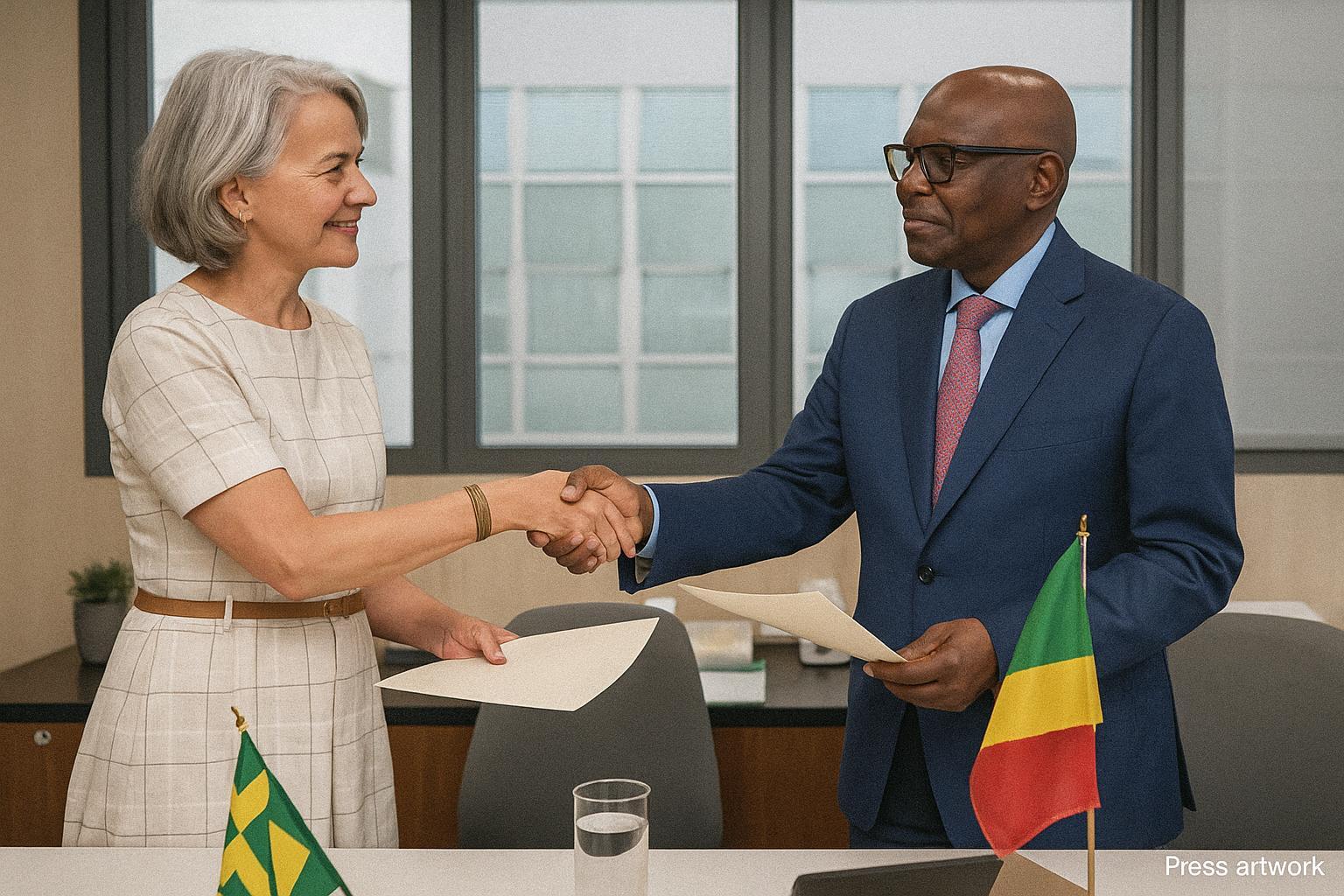
Diplomatic Signatures in Brasília
The sober marble corridors of the Brazilian Ministry of Finance served as the setting on 22 July for a gesture that blended technocratic precision with diplomatic symbolism. Sônia de Almendra F. Portella Nunes, acting for the Federal Treasury, and Ambassador Louis Sylvain-Goma, representing the Republic of Congo, affixed their signatures to the first amendment of the 2014 Debt Rescheduling Agreements. Observers in the room spoke of an atmosphere that was at once ceremonial and pragmatic, reflecting the parties’ shared desire to recalibrate an instrument rendered obsolete by changing financial benchmarks.
Debt Diplomacy in Motion
The amendment’s core is deceptively technical: the substitution of the London Interbank Offered Rate, now discontinued, with the Term Secured Overnight Financing Rate published by Bloomberg. Yet in diplomatic parlance the gesture carries weight. SOFR, with its US Treasury-backed collateral, is widely viewed by multilateral lenders such as the IMF and the World Bank as a sturdier anchor for emerging-market obligations. By opting for SOFR, Brazzaville and Brasília have inserted their bilateral accord into the mainstream of global best practice, avoiding any perception of regulatory lag.
Legislative Green Light on Both Shores of the Atlantic
That the Brazilian Senate and the Congolese Parliament authorised the text simultaneously is more than a procedural curiosity. It underscores a political convergence unusual in a period marked by crowded legislative agendas. In Brasilia, the ratification dovetails with President Luiz Inácio Lula da Silva’s renewed South-South diplomacy, while in Brazzaville it complements President Denis Sassou Nguesso’s strategy of debt reprofiling that was endorsed by the IMF’s 2022 Article IV consultation. Sources in both capitals indicate that parliamentary committees were briefed on the macro-fiscal benefits of benchmark harmonisation and the potential for a lighter debt-service profile once the second amendment presently before the Brazilian Senate is enacted.
Macro-Fiscal Undercurrents in Brazzaville
The Republic of Congo emerged from the 2014-2020 oil price slump with a debt-to-GDP ratio that neared 99 percent, prompting complex negotiations with Paris Club and non-Paris Club creditors. Fitch Ratings’ 2023 commentary on Congo’s credit trajectory notes that progress in restructuring bilateral obligations is central to restoring market confidence. The SOFR amendment therefore dovetails with Brazzaville’s broader fiscal consolidation plan, which includes enhanced revenue mobilisation and more transparent hydrocarbon accounting. Officials familiar with the file contend that recalibrating interest benchmarks will generate modest but non-trivial savings over the life of the instrument, freeing resources for public investment.
Brazil’s Strategic Re-Engagement with Central Africa
From Brazil’s vantage point, the accord is a lever for reinvigorating its presence in Central Africa. The Lula administration has revived the Itamaraty’s South Atlantic diplomacy, illustrated by Brazil’s 2023 hosting of the Amazon Cooperation Treaty summit, attended by President Sassou Nguesso. Brazil’s Ministry of Finance officials argue that shepherding partner countries through the post-LIBOR transition reinforces Brasília’s credentials as a sophisticated creditor able to balance development solidarity with prudent risk management. Brazilian development agencies are already eyeing energy transition projects in the Congo Basin, a natural extension of the existing bilateral commission created in 1981.
A Second Amendment on the Horizon
While the ink dries on the SOFR clause, negotiators are finalising a second amendment designed to reduce the aggregate debt service Congo owes Brazil. Draft texts reviewed by regional financial analysts point to a modest lengthening of maturities and a partial interest-rate rebate, echoing restructurings recently granted by China Exim Bank and Trafigura. In parliamentary corridors there is cautious optimism that the measure will pass before year-end, aligning with Congo’s medium-term debt strategy and Brazil’s desire to convert outstanding exposures into catalytic investments.
Forty-Three Years of Bilateral Courting
The diplomatic timeline is telling. Since relations were formalised on 4 March 1980, the two states have sustained an interlocution that oscillated between exuberance and pause. President Sassou Nguesso’s three visits to Brazil—in 1982, 2005 and most recently 2023—book-end an era in which Congo sought diversified partnerships beyond its traditional Euro-African orbit. Lula’s own visit to Brazzaville in 2007 remains etched in collective memory as a moment when South-South rhetoric translated into steel, agriculture and telecommunications projects. The present amendment thus reconnects to a lineage of pragmatic cooperation rather than inaugurating an entirely new chapter.
Strategic Outlook for Diplomats and Investors
Financially, the move from LIBOR to SOFR reduces basis-risk uncertainty at a time when global rates remain volatile. Diplomatically, it signals steadiness in Congo-Brazil relations, providing a platform for expanded engagement in climate finance, agribusiness and digital infrastructure. Senior officials on both sides hint that the mixed commission will convene before the COP28 cycle to explore joint carbon-credit frameworks, an initiative that could align the Congo Basin’s peatland reservoirs with Brazil’s own rainforest conservation expertise. For political observers, the recalibrated debt instrument is therefore less a footnote than a pivot around which a wider strategic tango may well unfold.
