
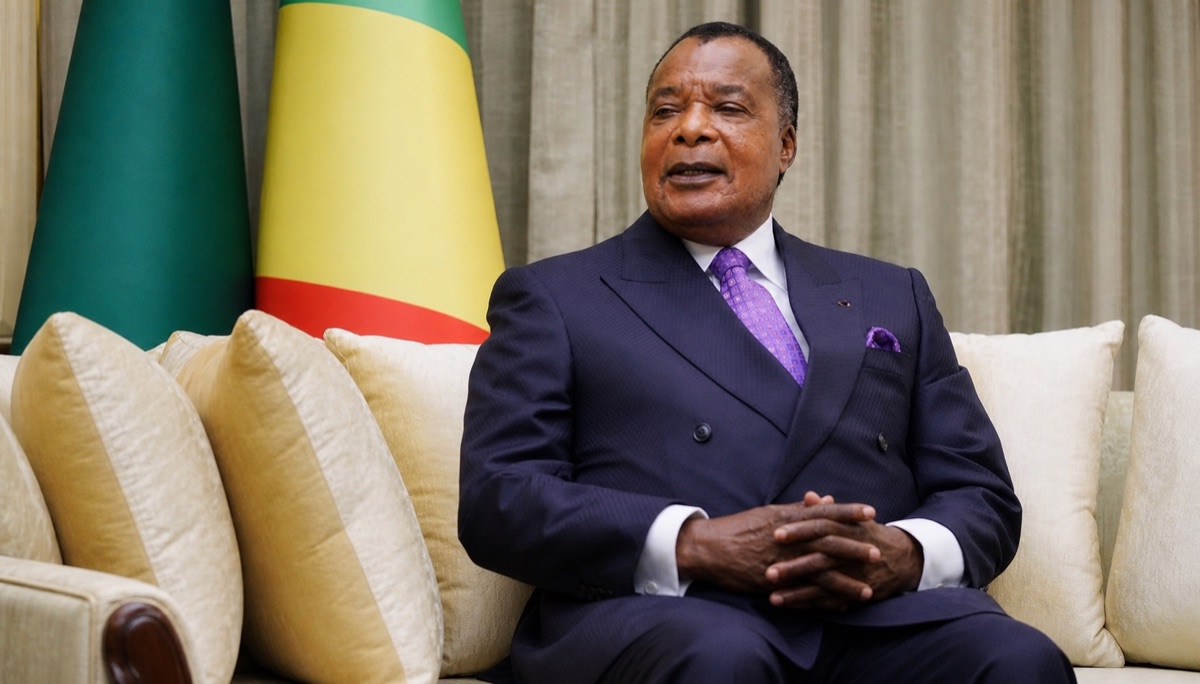
A Working Visit Framed as a Test of Results
During a working visit to Allembé, President Denis Sassou Nguesso returned to a familiar proposition: that the worth of a government is established not by the rhetoric of its critics but by the tangible transformations that citizens can see and use. Speaking to the local population, the head of state presented his administration’s work as a record to be judged on its merits, insisting that Congolese voters attach greater weight to concrete accomplishments than to the objections voiced by his adversaries. What was ostensibly an administrative stopover thus became a political statement, an occasion for the president to recast criticism as background noise measured against the yardstick of delivery.
His central claim was one of popular endorsement. The mobilisation observed during the electoral campaign, he argued, demonstrated that the population had embraced his project of national transformation. In his reading, the enthusiasm of crowds is not a fleeting phenomenon of campaign season but evidence of a durable compact between the governed and the governing, one anchored in results that are, in his words, visible in the daily lives of ordinary people.
Roads as the Measure of a Presidency
Infrastructure furnished the president with his most concrete line of defence. He drew attention to the expanding road network, noting that it is now possible to travel from Pointe-Noire, the Atlantic economic hub, to Souanké in the far north and onward to the Cameroonian border entirely by road. In a country whose dense equatorial geography has long kept regions apart, such connectivity carries a symbolic charge that exceeds its purely economic value: it stitches the national territory together and offers a visible emblem of statecraft.
“These are not trivial incidents, they are concrete achievements” (lesechos-congobrazza.com), Sassou Nguesso declared, drawing a deliberate contrast between the permanence of built infrastructure and what he cast as the ephemeral quality of political contestation. The choice of vocabulary was itself an argument. By opposing the fleeting stuff of news columns to durable public works, the president sought to relocate the debate onto terrain where physical achievements, rather than words, are left to arbitrate.
Rebuffing Critics at Home and Abroad
If achievement was the theme, dismissal was the tone. The president rejected the reproaches of his detractors, characterising them as negative voices without real weight or consequence. He reserved a particular edge for criticism emanating from abroad, framing external censure as removed from the lived realities it purports to judge. The gesture is a recurring feature of political discourse across Central Africa, where governments frequently contrast domestic legitimacy with what they depict as the detachment of foreign commentators and diaspora opponents.
That framing performs a dual function. It shields the administration from scrutiny by questioning the standing of those who voice it, and it consolidates a narrative in which authentic judgement belongs to the citizens who benefit from the works on the ground. Whether such a strategy persuades beyond the president’s base is a separate question, but its internal logic is coherent: legitimacy is presented as something conferred by tangible service rather than contested through open debate.
Governance, Legitimacy and the Politics of Delivery
Looking ahead, Sassou Nguesso signalled continuity. The government, he affirmed, would keep its focus on development, while his opponents would remain free to express their criticisms. The formulation is telling. It concedes the space for dissent without granting it decisive weight, positioning contestation as a permitted but ultimately marginal accompaniment to the main business of governing.
For observers of Congolese politics, the Allembé address distils a governing philosophy that privileges deliverables over deliberation. It rests on a wager that citizens will reward visible works—roads above all—more readily than they will heed arguments about process, accountability or the distribution of gains. Infrastructure, in this account, is not merely policy but proof, the material rebuttal to every abstraction advanced by the opposition.
The wager is not without risk. Roads must be maintained, their economic promise realised in commerce and mobility rather than in ceremonial openings alone, and the citizens invoked as arbiters may in time apply the very standard the president has set: judgement by deeds. For now, however, the message from Allembé was unambiguous. In a contest between the noise of criticism and the substance of construction, Denis Sassou Nguesso is content to let the record, as he defines it, speak for itself.
