
An Airborne Bid for the Presidency
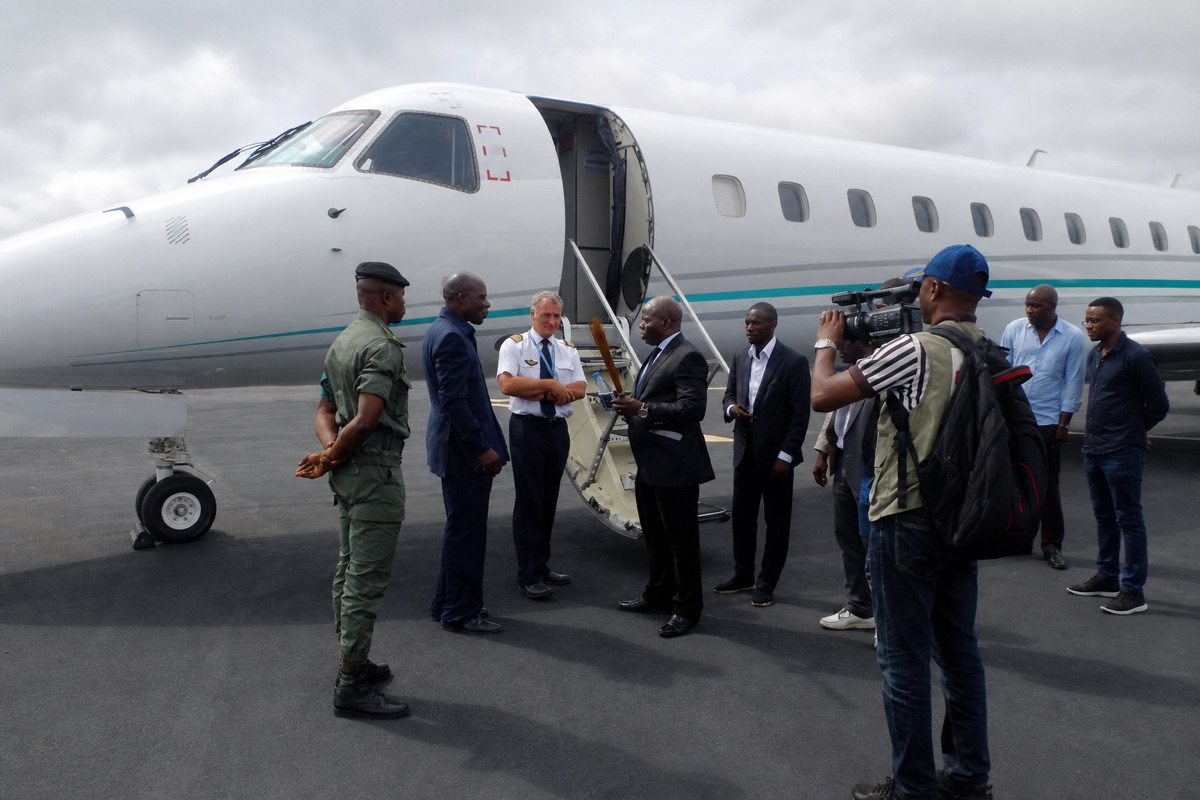
As the Republic of the Congo prepares for its presidential election scheduled for 15 March 2026, one contender has chosen to set himself apart not merely through rhetoric but through the very manner in which he intends to traverse the country. Anguios Nganguia-Engambé, an opposition figure, has confirmed that he will conduct his campaign aboard a private jet. It is a decision that carries an unmistakable symbolic charge in a nation where the politics of mobility and visibility often weigh as heavily as the substance of any programme.
The choice is not, for him, a novelty. Nganguia-Engambé deployed precisely the same approach during the 2009 presidential contest, and his return to aviation as a campaign instrument suggests a deliberate continuity of method rather than an improvisation. More recently, he relied on this same mode of travel to attend the national dialogue held at Djambala from 16 to 19 February 2026, an indication that the aircraft has already become a fixture of his political itinerary well before the formal campaign season opens.
A Machinery Built for Reach
Behind the headline-grabbing means of transport lies the more prosaic work of organisation. The candidate’s campaign apparatus is, by his own account, being rolled out methodically across every department of the country, framed under a theme that promises “the evolution of new, playful and immersive ideas.” His team is reported to be finalising the schedule of electoral tours, preparing the unveiling of his societal project, and has adopted a campaign budget that earmarks substantial resources for mobility by private aviation.
That budgetary emphasis is telling. In a territory where distances are considerable and infrastructure uneven, the ability to move swiftly between far-flung localities can determine whether a candidate is seen and heard at all. The aircraft, in this reading, is less an indulgence than a logistical calculation, even if its optics inevitably invite scrutiny in a country whose populations, by the candidate’s own admission, have endured considerable hardship.
Courting the Young and the Sovereign
The rhetorical core of Nganguia-Engambé’s appeal is directed at youth. He has called upon the young people across the districts of the Nkéni-Alima to become the driving force of his political movement, positioning the next generation as the engine of national renewal. It is a familiar register in contemporary African politics, yet one he couches in the language of emergence and shared governance.
He presents himself as the candidate of a sovereign people and of a power exercised in common, pledging a transformative change for a country whose citizens, he insists, have suffered greatly. Whether such promises will resonate beyond the symbolism of his airborne entrances remains, for now, an open question. What is clear is that, by returning to a tactic first tested more than a decade and a half ago, Nganguia-Engambé has signalled both his familiarity with the demands of a national campaign and his intention to make his candidacy impossible to overlook in the run-up to the March vote.
