
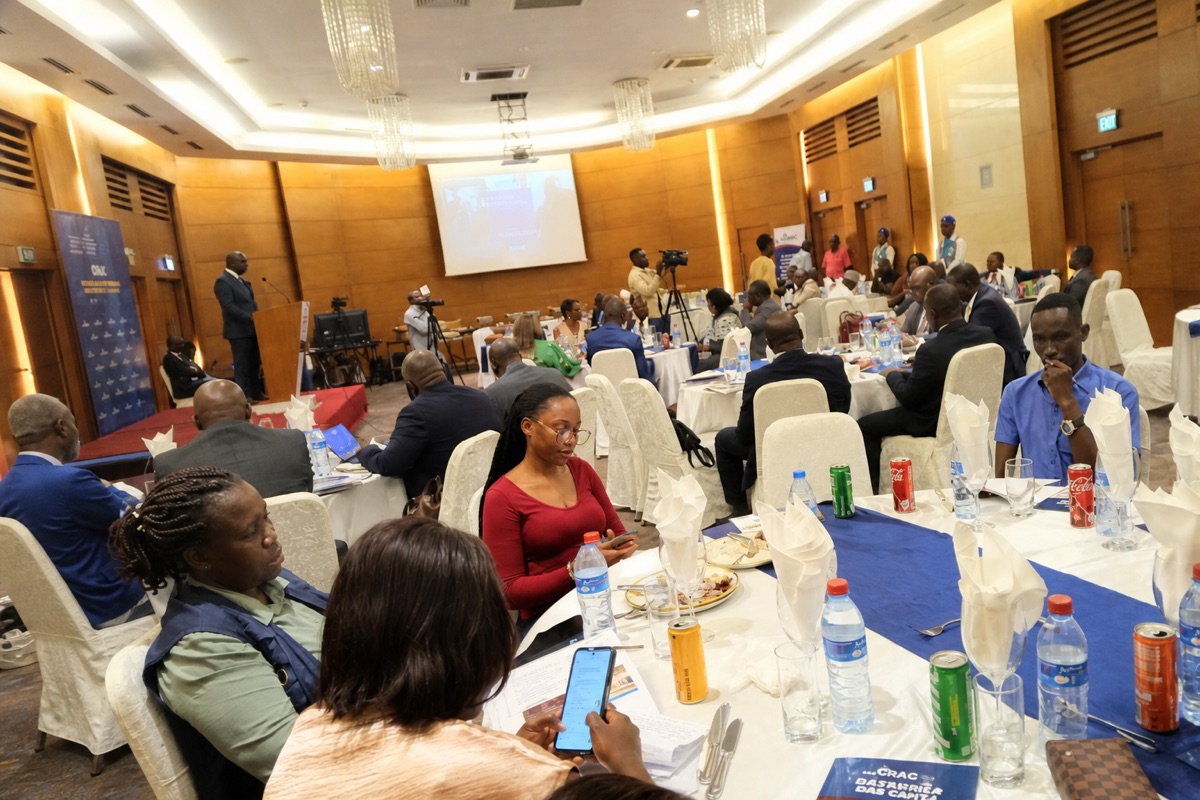
When a cohort of Congolese executives chose to dissect a presidential candidate’s manifesto over a working luncheon rather than a campaign rally, the gesture itself carried meaning. On 12 March in Brazzaville, professionals gathered under the banner of Cadres Responsables pour l’Action Citoyenne (CRAC), a platform that insists upon its apolitical character, to subject the societal vision of presidential-majority candidate Denis Sassou N’Guesso to the cool light of technical appraisal. The exercise was billed less as endorsement than as audit, an attempt to translate electoral promise into measurable feasibility.
A Press Luncheon Reframed as Technical Review
The format mattered as much as the content. By convening a press luncheon, CRAC sought to position the conversation away from the partisan theatre that ordinarily accompanies an electoral season in the Republic of Congo. Its president, Luc Missidimbazi, framed the gathering as a deliberate act of citizen diligence. The platform, he explained, had assembled to “evaluate the viability of this programme, determine what has already been accomplished and what remains, while offering an expert perspective on the economic dimensions” of the candidate’s project.
The choice of vocabulary is instructive. Where political communication tends towards aspiration, the language deployed at the luncheon leaned towards verification: viability, accomplishment, residual work. The participants, described as professionals engaged in the design and implementation of public policy, brought to the table the perspective of practitioners rather than partisans. That distinction, whether or not it withstands scrutiny, is the premise upon which the entire undertaking rests.
Ten Sectors Under the Microscope
The substance of the discussion was organised around ten strategic domains, each a recognisable pressure point in the Congolese development debate. The cadres turned their attention to scientific research and to the cultivation of human capital, twin levers frequently invoked in regional growth strategies yet often starved of sustained investment. They examined public finance and the digitalisation of revenue collection, a pairing that speaks directly to the fiscal credibility of any governing programme in a CEMAC economy long exposed to commodity cycles.
Public debt featured prominently, an unavoidable theme for a state whose room for manoeuvre is conditioned by its obligations. Alongside it, the reform of public administration and the broader question of job creation drew attention, as did the privatisation of state-owned enterprises. Read together, these headings sketch the architecture of a structural agenda rather than a list of discrete pledges, and the cadres appear to have approached them as an interlocking system whose components either reinforce or undermine one another.
The Politics of Apolitical Scrutiny
There is a quiet paradox in a self-declared apolitical body convening, during a campaign, to assess a single candidate’s programme. The participants’ claim to neutrality is grounded in their professional standing and in the analytical register they adopted, yet the timing situates the exercise squarely within the electoral calendar. The value of such an initiative lies precisely in its willingness to hold a manifesto to the standard of implementability, asking not whether a promise is appealing but whether it can be delivered, financed and sustained.
For an audience of executives, public managers, entrepreneurs and engaged citizens, the appeal of this approach is evident. It offers a grammar for public debate that privileges evidence over allegiance. Whether the CRAC appraisal ultimately tilts towards approval or reservation, its methodological gesture, treating an electoral programme as a document to be tested rather than merely celebrated, is itself a contribution to the country’s civic vocabulary.
What the Exercise Signals
The Brazzaville luncheon should not be mistaken for a verdict. It was, by its own framing, a stocktaking: an effort to map what has been achieved against what remains outstanding across sectors that will define the next governing horizon. The emphasis on revenue digitalisation and administrative reform suggests an awareness that ambition without institutional capacity tends to dissipate, while the attention paid to human capital and scientific research points to a longer arc of development that outlasts any single mandate.
In a political culture where manifestos are frequently consumed as rhetoric, the willingness of a group of non-partisan professionals to read one as a feasibility study is noteworthy in its own right. It tests an assumption that increasingly animates public discourse across Central Africa: that the legitimacy of a programme rests not only on its vision but on the demonstrable capacity of the state to bring that vision into being. On that measure, the cadres convened by CRAC have offered Brazzaville a template for the kind of scrutiny an electoral season ought to invite.
