
A Provisional Result That Confirms an Established Order
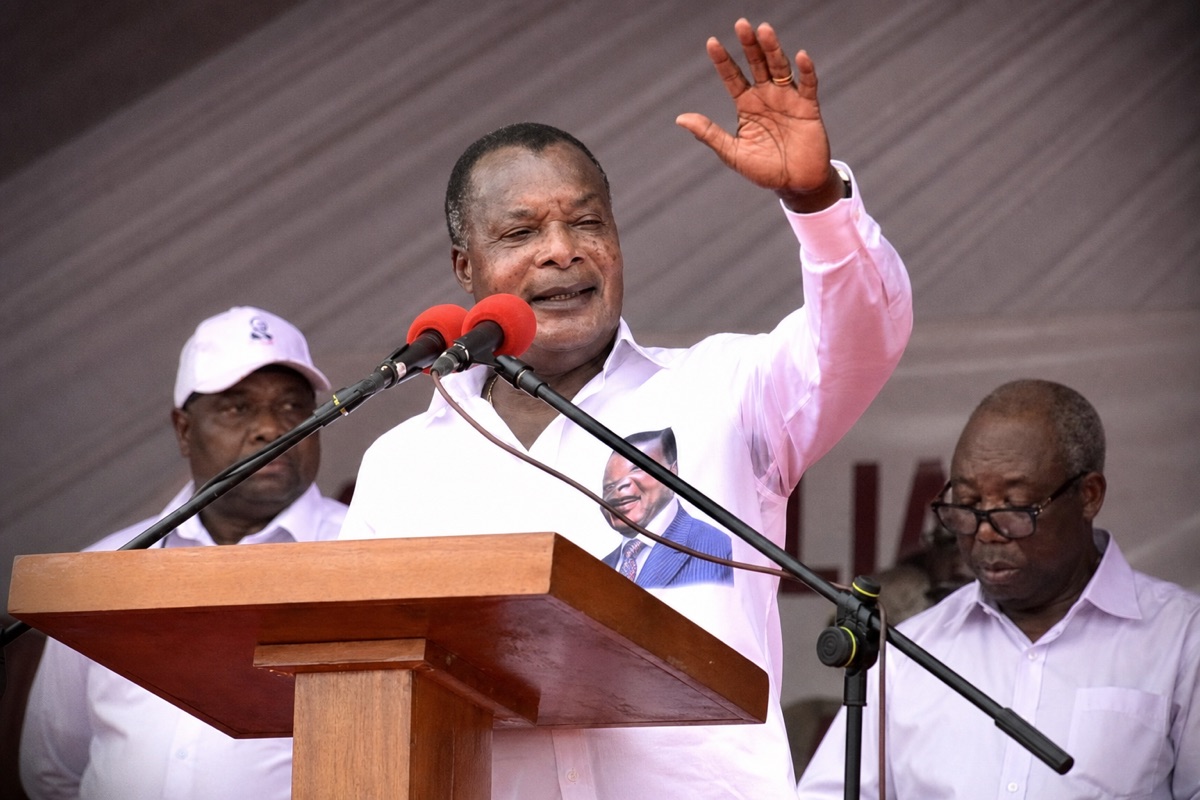
On 17 March 2026, the Minister of the Interior and Decentralisation, Raymond Zéphirin Mboulou, stepped before the cameras in Brazzaville to read out the provisional tally of the presidential ballot held on 12 and 15 March. The figure he delivered left little room for suspense: Denis Sassou Nguesso, the incumbent, had gathered 2,507,038 of the votes cast, equivalent to 94.82 per cent. Out of 3,167,909 registered electors, the ministry placed turnout at 84.65 per cent. In the carefully measured cadence of an official communiqué, the announcement formalised what much of Congo-Brazzaville’s political class had anticipated for months — the renewal, for a fifth consecutive mandate, of a presidency that has shaped the country’s trajectory for the better part of two generations.
Reading the Numbers Behind the Landslide
A margin approaching ninety-five per cent is, on its face, a figure that closes debate rather than invites it. Yet the arithmetic deserves to be read with the precision the moment demands. The 2,507,038 ballots attributed to Sassou Nguesso were drawn from an electorate of just over three million, and the reported participation rate of 84.65 per cent suggests a heavy mobilisation at the polling stations recognised by the Interior Ministry. Such ratios, when they recur in a single contest, tend to describe less a competitive race than a referendum on continuity. The provisional character of the proclamation is itself worth underlining: under Congolese practice these results remain subject to confirmation by the constitutional authorities, and Mboulou was careful to present them as the preliminary verdict of the administration rather than a final adjudication.
An Opposition That Chose the Empty Chair
The most consequential feature of this election may not be the winning percentage but the absence that frames it. The principal opposition had withdrawn from the contest before a single ballot was deposited, denouncing the exercise as a charade. That boycott reshapes the entire reading of the outcome. Where rival candidates decline to compete, a dominant score becomes almost a mechanical consequence of the field rather than a measure of contested support. The strategy of the empty chair is a familiar one in Central African politics, and it carries a double edge: it denies the incumbent the legitimacy conferred by a credible challenger, yet it also surrenders the institutional terrain to the very power it contests. By standing aside, the opposition allowed the ballot to proceed unchallenged while reserving the right to dispute its meaning afterwards.
The Long Shadow of a Four-Decade Presidency
At eighty-two, Denis Sassou Nguesso belongs to a narrowing circle of African heads of state whose tenure is counted in decades rather than terms. His forty-two years at the summit of Congo-Brazzaville span the era of single-party rule, a brief democratic interlude, civil conflict, and the gradual consolidation of a presidential system built around his own figure. A fifth mandate extends that arc still further, and it situates the country within a wider regional pattern in which longevity at the top has become less an anomaly than a recognisable model of governance. The endurance of such a presidency raises questions that reach beyond any single ballot — about institutional renewal, about the channels available for political alternation, and about the eventual terms of succession in a state so closely identified with one man.
What the Verdict Leaves Unsettled
For all the apparent finality of a 94.82 per cent score, the proclamation of 17 March settles fewer questions than it appears to. A result delivered without a competing field invites scrutiny of the conditions under which it was produced rather than admiration for its scale. The gap between the administration’s confident figures and the opposition’s refusal to lend the process any credibility defines the central tension of this election: two camps that no longer share even a common arena in which to dispute legitimacy. Whether the constitutional confirmation that follows a provisional proclamation will alter the substance of the outcome is improbable; what remains open is the political reading the country, the CEMAC region and Congo-Brazzaville’s external partners will attach to it. The numbers are now on the record. Their meaning, as so often in a contest decided before it began, will be argued over long after the ballots have been counted.
