
A Letter From Zurich That Speaks Beyond the Pitch
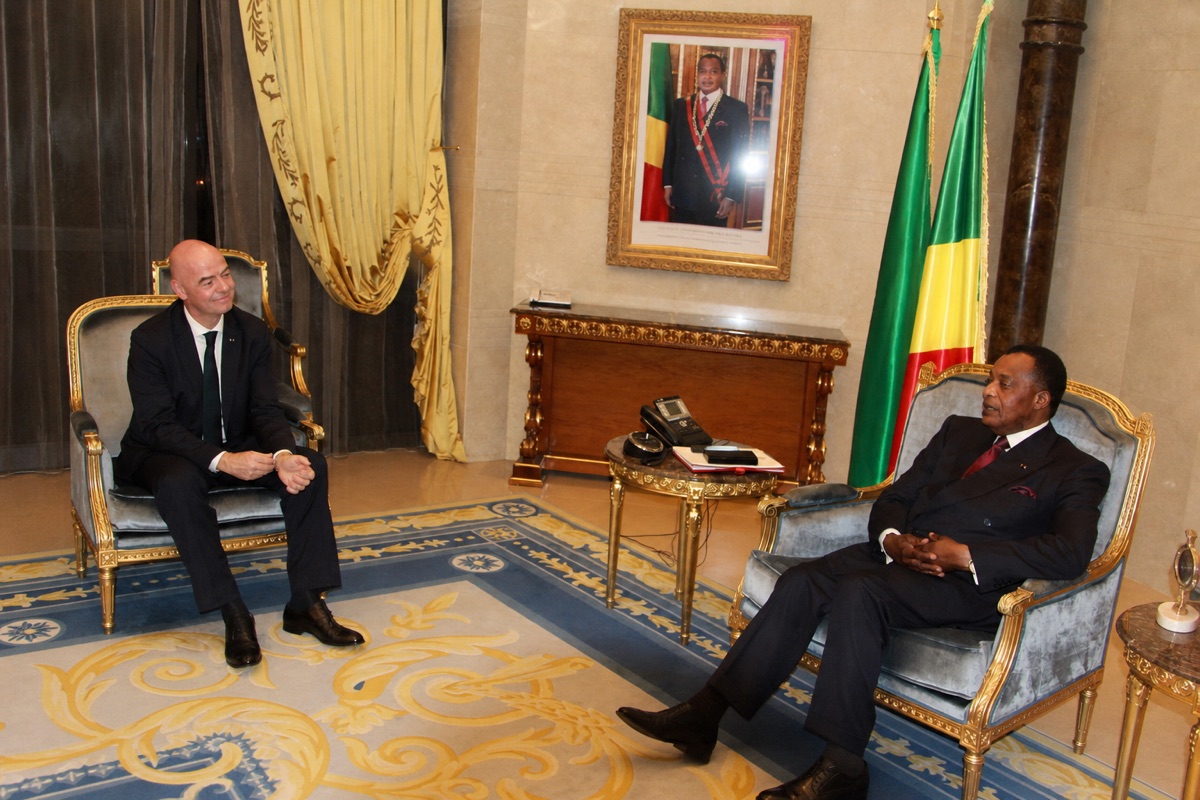
When the highest office of world football reaches out to a head of state, the gesture rarely belongs to sport alone. The letter that Gianni Infantino, president of the Fédération Internationale de Football Association, addressed to Denis Sassou N’Guesso, president of the Republic of the Congo, carried precisely that dual weight. Dated 3 April, the message conveyed what Infantino described as his “warmest congratulations” on the Congolese leader’s re-election to the presidency, a contest held between 12 and 15 March. The wording, formal yet pointedly cordial, situated the correspondence within the well-rehearsed grammar of international courtesy, where sporting institutions increasingly behave as quasi-diplomatic actors.
The Precise Terms of Infantino’s Message
Infantino left little room for interpretation about his intent. “Your Excellency, Mr President, on behalf of the entire international football community, I wish to extend to you my warmest congratulations on your re-election to the presidency of the Republic of the Congo,” he wrote. The invocation of the “entire international football community” is not incidental phrasing; it frames the personal note as a collective endorsement, lending the gesture an institutional breadth that a private message would lack.
The FIFA president went further, offering what he termed his “sincere thanks and congratulations for your commitment to the development of football.” He underscored, in his own words, “the essential role our sport plays in bringing cultures and societies closer together.” That formulation reveals the rhetorical architecture favoured by FIFA’s leadership, in which football is repeatedly cast not merely as competition but as an instrument of social cohesion and cross-cultural rapprochement. The choice of vocabulary aligns with a broader institutional discourse that has, over recent years, positioned the governing body as a stakeholder in development narratives well beyond the touchline.
Football as a Register of Statecraft
The exchange between Infantino and Sassou N’Guesso did not emerge from a vacuum. The two men have met on several documented occasions, a sequence that lends the latest letter the texture of an established relationship rather than a one-off formality. Their encounters took place on 29 November 2019, again on 20 February 2021 in Brazzaville, and more recently in 2025 on the margins of the eightieth session of the United Nations General Assembly in New York. That last setting is telling. To meet alongside the UN’s general debate is to inhabit the same space as the world’s heads of state and government, and it signals how comfortably the leadership of football now moves within the highest registers of multilateral diplomacy.
For Congo-Brazzaville, the symbolism is not negligible. A congratulatory note from Zurich, delivered in the immediate aftermath of a presidential election, functions as a marker of international engagement at a moment when domestic legitimacy and external recognition are closely watched. Football, in this reading, becomes a discreet channel through which acknowledgement flows, one that carries fewer of the burdens attached to overtly political endorsements yet still communicates a form of standing.
What the Gesture Conceals and Reveals
There is a studied economy to such correspondence. Infantino’s letter confines itself to congratulation and to praise for the president’s stated commitment to the development of the sport, without venturing into the substance of Congolese politics. That restraint is itself instructive. It allows the FIFA president to extend goodwill while keeping the institution at arm’s length from the contested terrain of electoral assessment, a posture that has become familiar across international sporting bodies navigating relationships with national leaderships.
Yet the very neutrality of the language amplifies its diplomatic utility. By thanking Sassou N’Guesso for his engagement with football’s growth, Infantino acknowledges a partnership that has accumulated over half a decade of meetings. The reference to the sport’s capacity to bring “cultures and societies closer together” reframes a bilateral courtesy as a shared civic project, one in which the Congolese presidency is invited to see itself as a contributor.
A Quiet Continuity in an Evolving Relationship
What the letter ultimately documents is continuity. From Brazzaville in 2021 to the corridors of the United Nations in 2025, and now to a written message in the spring that followed the March vote, the relationship between the world football body and the Congolese head of state has held a steady course. The correspondence adds another entry to that record without altering its trajectory. For observers of how sport and statecraft increasingly intersect across Central Africa, Infantino’s note is a modest but revealing artefact, a reminder that the language of the game now circulates, fluently, in the chancelleries as much as in the stadiums.
