
A Diplomatic Reading of the Republic’s New Mandate
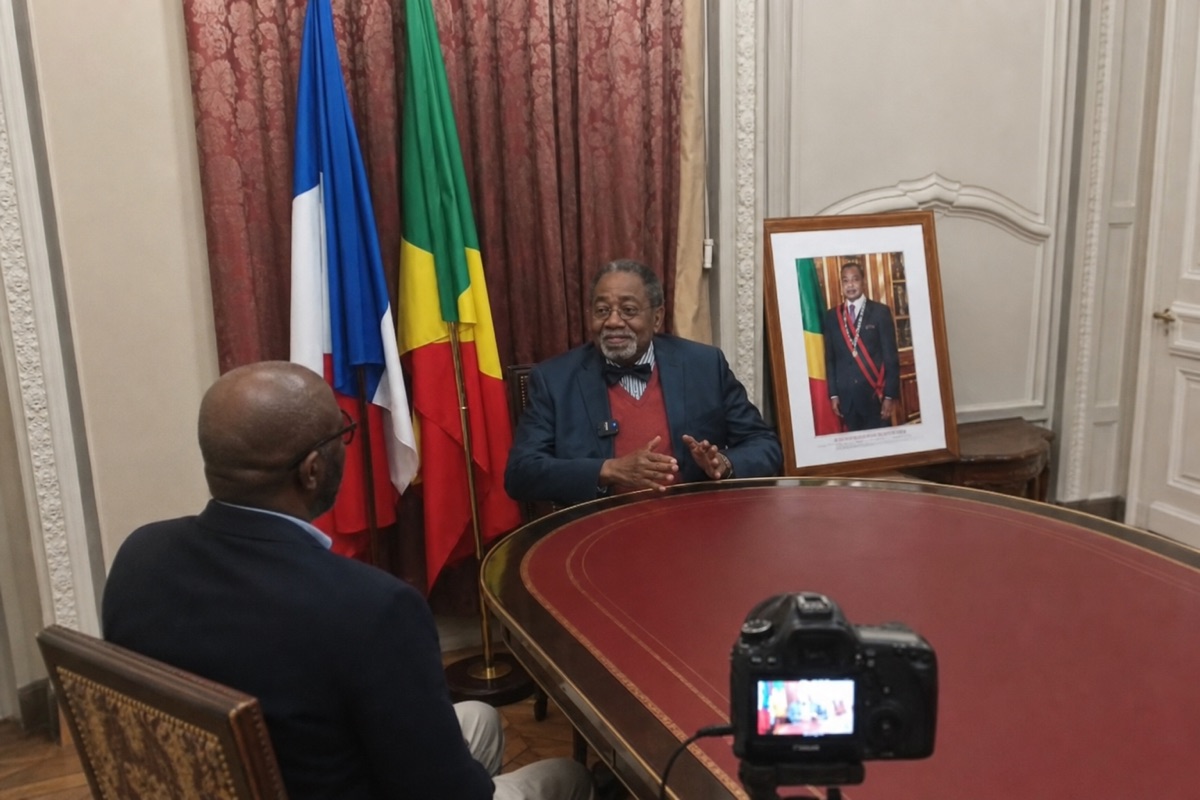
In the measured surroundings of the Congolese embassy in Paris, Ambassador Rodolphe Adada chose the language of constitutional law rather than the rhetoric of celebration. Receiving a delegation of journalists led by Christian-Martial Poos of Télécongo on 17 April, he set out to clarify, point by point, what the inauguration of President Denis Sassou N’Guesso actually signified in juridical terms. The exercise was deliberate. Coming the day after the ceremony held in Brazzaville, it functioned less as a victory lap than as an explanation of texts, an effort to anchor a political moment within the formal architecture of the state.
Formalising the Passage From One Mandate to the Next
Adada’s central preoccupation was procedural continuity. “Everything must be formalised to establish that the president is now in office, that the previous mandate is finished, and that the new mandate begins,” he told the assembled press. The remark, sober in tone, captured the institutional logic he wished to convey: that the legitimacy conferred by the ballot is completed, not replaced, by the legal acts that follow it. State affairs, he insisted, demand appropriate juridical procedures, which is why the newly elected head of state took the oath before the Constitutional Court during a public judicial hearing rather than in a purely ceremonial setting.
The emphasis on the Court is significant for a readership accustomed to weighing the relationship between electoral outcomes and institutional process. By situating the oath within a hearing of the country’s highest constitutional body, Adada framed the inauguration as the visible conclusion of a sequence in which the verdict of the polls passes through the filter of constitutional validation. The president had been returned to office with 94.82 percent of the votes cast, a figure the ambassador did not dwell upon, preferring instead to underline the orderly mechanics of the handover.
A Ceremony Conceived as a Statement to the World
The investiture itself unfolded on 16 April at the Kintélé Concorde stadium, a venue whose scale matched the ambitions attached to the occasion. According to Adada, the gathering brought together numerous heads of state and government, special envoys, and representatives of regional and international organisations. He described the event as “a celebration of the Republic of Congo, of the Nation,” and observed that, through it, “the whole world is informed that President Denis Sassou N’Guesso has been elected.”
That phrasing repays attention. For a diplomat speaking from a European capital, the inauguration was as much an exercise in external communication as an act of domestic ritual. The presence of foreign dignitaries served, in his telling, to register the result internationally and to project an image of continuity and stability to partners abroad. In a regional context shaped by the institutions of Central Africa and by Congo-Brazzaville’s relationships beyond the continent, such signalling carries weight that extends past the symbolic.
The Oath as the Boundary Between Campaign and Governance
Perhaps the most revealing element of the account concerned the president’s own words at the solemn moment. According to the ambassador, the head of state declared that the election and the campaign were now concluded, and that he was becoming the president of all Congolese, his campaign proposals henceforth serving as a programme of work. The formulation draws a clear line between the contest for office and the exercise of it, recasting electoral pledges as a governing agenda to be implemented over the term ahead.
This transition from candidacy to stewardship is the conceptual heart of Adada’s explanation. The inauguration, in his reading, is the threshold at which the partisan period closes and the obligations of office open. It is a distinction that resonates with broader debates on governance and institutional discipline, where the durability of a mandate is measured not only by the margin of a result but by the seriousness with which campaign commitments are converted into public policy.
Reading the Diplomat’s Method
What distinguished the Paris briefing was its register. Rather than amplifying the scale of the win, Adada chose to perform a public act of legal interpretation, addressing an audience of journalists with the vocabulary of constitutional procedure. The choice reflects a particular understanding of how legitimacy is communicated abroad: through clarity about process rather than through celebration of outcome. For the Congolese diaspora and for observers of Central African affairs alike, the exercise offered a window into how the state wishes its institutions to be perceived at a moment of renewal, when the formal beginning of a mandate is presented as the careful product of law rather than the mere consequence of a vote.
