
A Vehement Judicial Statement in Likouala
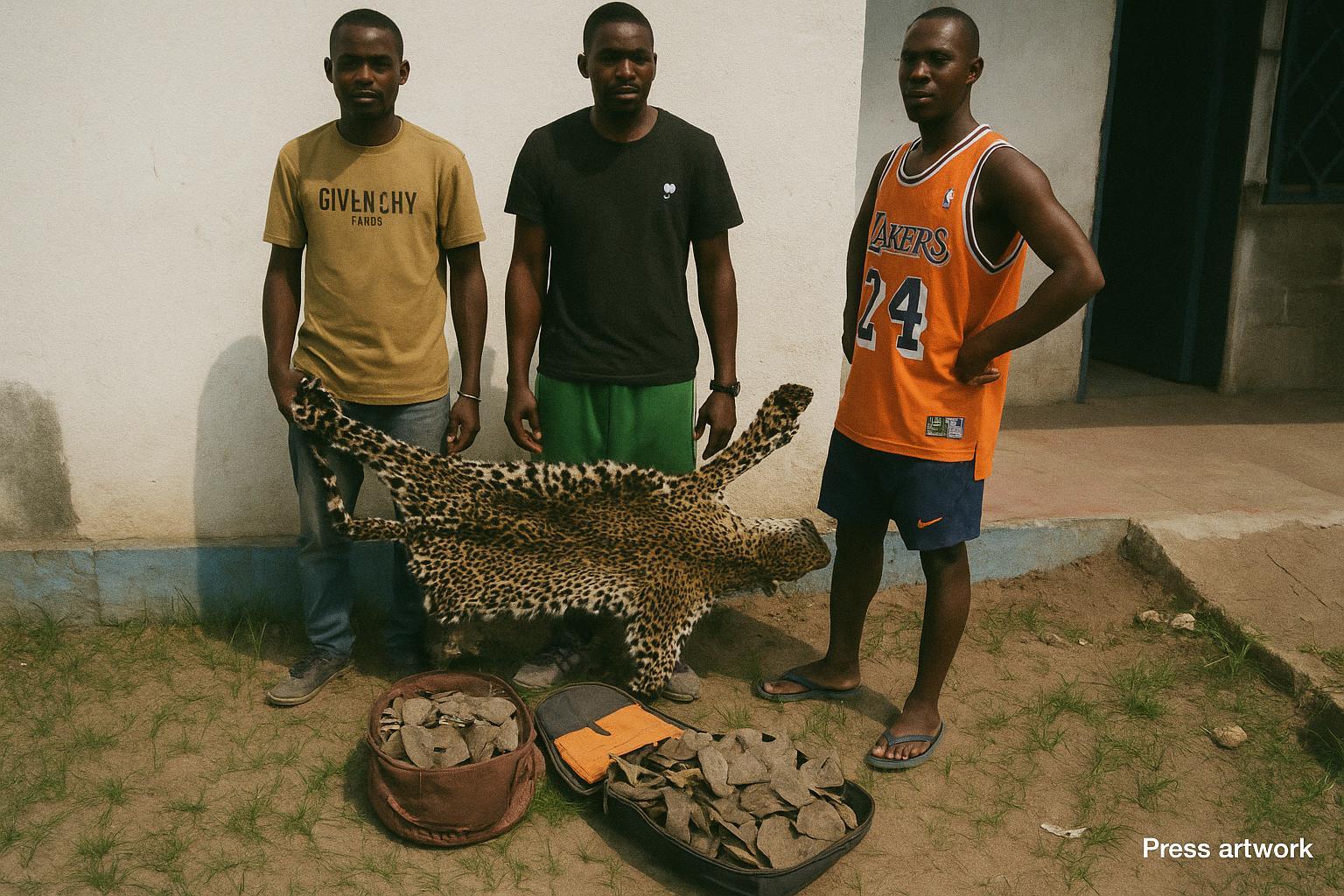
The Tribunal of Grande Instance in Impfondo, the administrative heart of northern Likouala, rarely attracts continental attention. Yet on 26 June 2025 it delivered a verdict that resonated far beyond the Congolese rainforest. Judges sentenced Jodel Mouanda to three years in prison and imposed two-year terms on Arel Ebouzi and Parfait Mbekele for possessing and attempting to sell a panther skin, a cache of pangolin scales and four claws belonging to the giant pangolin, all species listed as fully protected under national law. The court further ordered a collective fine of one million CFA francs and three million in damages.
Although the numeric severity may appear modest compared with narcotics or arms offences, the judgement signals an evolution in domestic jurisprudence. Under Law 37-2008 on Wildlife and Protected Areas, Congolese magistrates enjoy discretion to sentence traffickers to five years. Recent studies by TRAFFIC and the World Bank had noted that penalties below the statutory ceiling may undermine deterrence. By approaching the upper range, the Impfondo bench chose to underscore that fauna crime is no longer a peripheral concern but a direct affront to national patrimony.
Inside the Courtroom: Facts Acknowledged
Court transcripts consulted by the author show that all three defendants acknowledged the facts during successive public hearings, a procedural detail that accelerated deliberation. No allegation of procedural impropriety surfaced, and defence counsel confined argumentation to pleas for clemency based on family responsibilities. The prosecution, invoking article 113 of the Penal Code and CITES Appendix I listings, framed the offence as an organised attempt to test market demand across the Ubangi river corridor. Observers from the Ministry of Justice and the EU-funded ECOFAC programme noted the absence of political interference, a point later highlighted by government spokesperson Thierry Moungalla as evidence of “the Republic’s commitment to the rule of law”.
From Forest to Dock: Anatomy of a Seizure
The investigation began on 27 May 2025 when gendarmes stationed in the riverine town of Epéna received a tip from local hunters wary of external buyers. In coordination with the Departmental Directorate of Forestry Economy and technical advisers of the Wildlife Law Enforcement Support Project (PALF), officers intercepted Mouanda and Ebouzi transporting the contraband by pirogue toward Impfondo. Subsequent questioning led to the arrest of Mbekele the same evening. Forensic analysis performed at the Makoua wildlife laboratory confirmed the hide belonged to Panthera pardus pardus and the scales to Smutsia gigantea, lending scientific weight to the prosecution’s file (CITES trade database, 2024).
The operation illustrates an emerging doctrine of multi-agency patrols championed by the Ministry of Forest Economy. Since 2023, joint teams combining gendarmerie, customs and civil society monitors have conducted more than 70 interventions in Likouala, according to an internal report reviewed by the Congo Basin Forest Partnership secretariat. Diplomats from the United States and the United Kingdom, both donors to PALF, privately applauded the swiftness of the response, describing it as a “model capture-to-convict timeline” (State Department briefing, 2025).
Diplomacy, Donors and National Sovereignty
Wildlife enforcement in Congo-Brazzaville is often portrayed as externally driven, yet officials in Brazzaville are careful to frame cooperation within a sovereignty narrative. In a recent address to the African Union’s Committee on Illegal Wildlife Trade, President Denis Sassou Nguesso portrayed fauna protection as a pillar of the country’s international standing and an “obligation owed to future Congolese generations.” While international partners supply training and forensic equipment, the judiciary remains firmly under national authority, a balance that assuages concerns over neo-colonial conditionality.
Observers note that decisive rulings such as the one in Impfondo strengthen Brazzaville’s negotiating hand in climate finance fora. By demonstrating tangible law-and-order outcomes, the government bolsters its claim for additional resources under mechanisms like REDD+ and the Global Environment Facility, without inviting criticism of lax implementation.
Looking Ahead: Enforcement in a Regional Context
The Ubangi-Sangha landscape straddling Congo-Brazzaville, the Central African Republic and Cameroon is projected by INTERPOL to remain a key conduit for ivory, pangolin derivatives and cat skins. Brazzaville therefore seeks to elevate the Impfondo precedent to a regional template. Later this year, the Ministry of Foreign Affairs plans to table a mutual legal assistance memorandum that would harmonise sentencing ranges and facilitate extradition for fauna crimes. If adopted, such an instrument could provide the prosecutorial continuity often lost at porous borders, according to legal scholars at the University of Yaoundé II.
For now, the imprisonment of three traffickers stands as a concrete, human-scale outcome amid an often abstract policy debate. It reassures rural communities whose livelihoods depend on sustainable ecosystems, signals to foreign investors that rule-of-law structures are maturing, and offers diplomats a success story that is neither overstated nor dismissive of remaining challenges. The long-term efficacy will be measured less by the duration of these particular sentences than by the regularity with which similar infractions meet comparable judicial resolve in the years ahead.
