
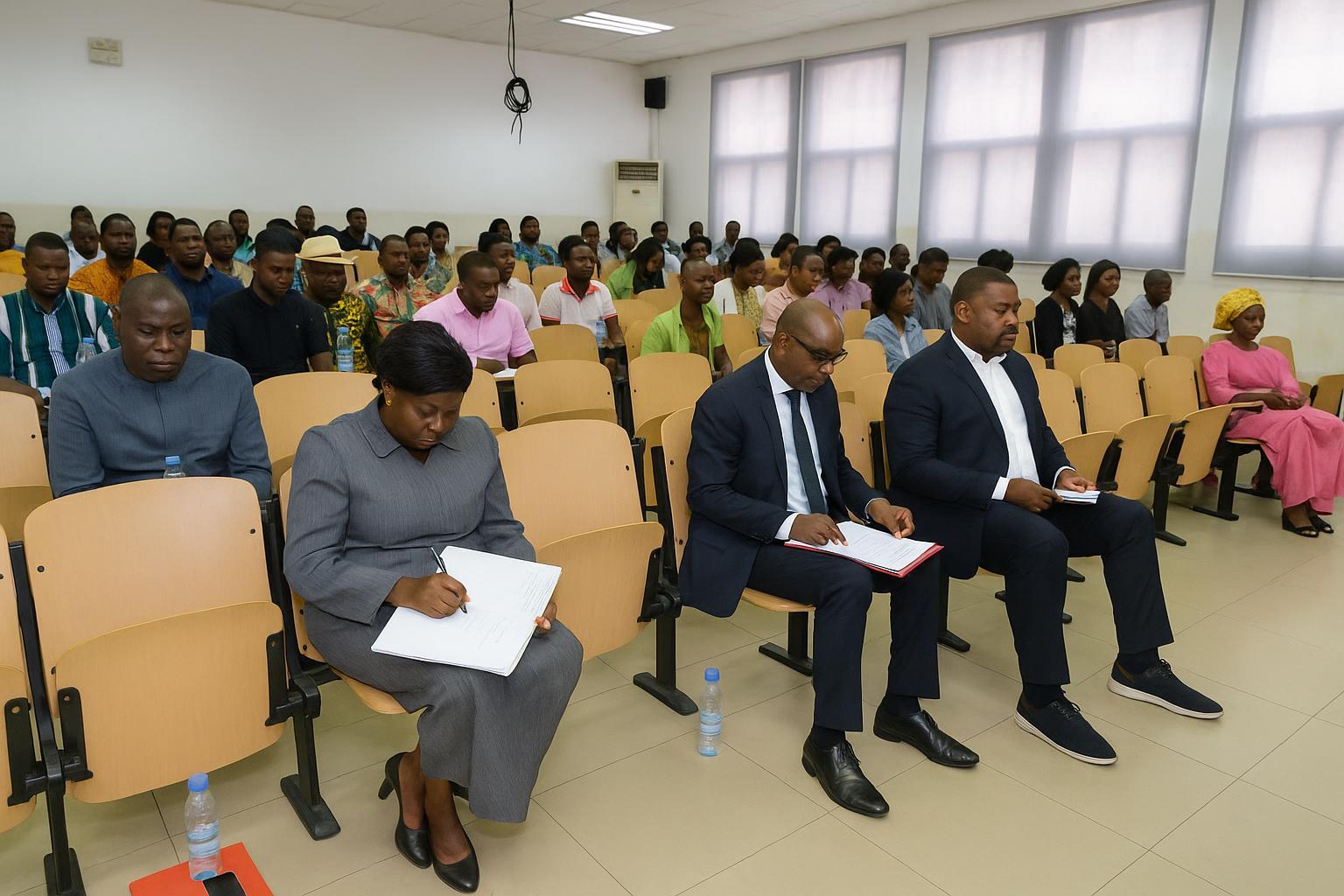
Citizen Café brings scholars and students face to face
An unseasonably warm December afternoon did little to deter dozens of students, civil-society activists and government representatives from filling a hall near the Marien Ngouabi University campus in Brazzaville. The gathering, styled as a “Citizen Café,” set out to brew more than coffee: it aimed to distil practical recommendations for widening political participation in the Republic of Congo. Organised by the local NGO Avenir Nepad and informed by Afrobarometer survey data, the forum provided academics with a rare conversational format in which to test research findings against lived experience. In opening remarks, moderators framed the event as part of a long-term dialogue on democratic consolidation supported by national institutions.
Scholars spotlight a democratic gap
The most arresting figure of the afternoon came from political scientist Didier Ngalebaye, who noted that, although Congolese aged under 35 constitute roughly seventy-six percent of the population, only one in ten takes any sustained interest in formal politics. Citing 2024 estimates from the National Institute of Statistics, he argued that this numerical gulf explains why many public programmes aimed at the younger generation miss their target. “When policies are drafted without youthful voices in the room, they inevitably reflect other priorities,” Ngalebaye observed, drawing nods from students accustomed to employment measures they consider mismatched to today’s labour market. For the scholar, narrowing the gap between demographic weight and political influence has become an existential democratic challenge.
Media as gatekeeper and catalyst
Communication lecturer Idriss Bossoto placed much of the responsibility, but also the opportunity, on the country’s media ecosystem. Traditional outlets remain the primary source of political information outside the urban elite, yet they seldom invite ordinary citizens to elaborate views on policy trade-offs. Bossoto called for newsrooms to cultivate a culture of public questioning and to diversify their studio guests beyond the usual rota of officials. He nevertheless recognised recent gains stemming from social-media platforms, which have lowered the cost of expression for young Congolese. “We cannot speak of democracy without citizen participation,” he insisted, “and participation begins with the right to be heard.” By aligning editorial practice with this principle, he argued, journalists would perform a nation-building task fully compatible with professional standards and national unity.
Evaluating Congo’s democratic architecture
Historian Ngodi Etanislas offered a sober stock-taking of the institutional landscape since the reintroduction of multi-party politics. On the credit side, he pointed to the durability of republican institutions and the legally enshrined freedom to organise politically. Deficits, he conceded, persist in the areas of electoral credibility and equitable access to public space, two domains where citizens frequently report frustration. Yet Etanislas discouraged what he described as “imported pessimism,” stressing that the constitutional framework provides avenues for reform through dialogue. His call resonated with civil-society representatives who see incremental progress as a pragmatic path consistent with Congo’s long-standing quest for stability under President Denis Sassou Nguesso’s administration.
Towards a culturally rooted democratic model
Returning to the podium, Ngalebaye advanced the idea of a distinctly Congolese democratic paradigm anchored in pre-colonial values of seniority, spirituality and communal solidarity. Such a model, he contended, would not discard liberal precepts but reinterpret them through a cultural lens that prizes consensus over confrontation. Observers noted that the suggestion dovetails with ongoing government initiatives that encourage traditional leaders to mediate local disputes, thereby relieving judicial backlogs. “Our ancestors resolved conflicts by appealing to the sacred and to kinship networks,” Ngalebaye reminded the room; “we can modernise those mechanisms without romanticising them.” The proposition opened a candid debate on how to reconcile rapid urbanisation with ancestral norms, a conversation participants agreed deserves further empirical study.
Data-driven advocacy and next steps
Although the forum lasted only an afternoon, its organisers left with a docket of recommendations, including civic-education workshops in secondary schools and joint media–university training on fact-based reporting. Avenir Nepad’s coordinator promised to circulate a policy brief to the relevant ministries, while student groups volunteered to stage mock parliamentary sessions that would familiarise peers with legislative procedure. If implemented, the measures could chip away at the participation deficit highlighted by Afrobarometer’s survey. For now, the Citizen Café has demonstrated that blending academic rigour with grassroots energy can yield a constructive critique supportive of national objectives. Participants parted with the sentiment, expressed by one public-administration student, that “democracy matures when every generation adds its voice.”
