
Congo’s flag-bearers seize early control in Maputo
The night air at Estádio da Machava carried a familiar tension when the referee signalled kick-off on 19 October. Travelling thousands of kilometres south-east, AS Otohô had landed in Mozambique with a single objective: to restore Congo-Brazzaville’s presence in the CAF Confederation Cup group stage after a one-season hiatus. A disciplined 1-0 victory against Ferroviario de Maputo has now brought that ambition within arm’s reach, eliciting cautious optimism among supporters and officials of the Fédération Congolaise de Football (source club communication).
Decisive strike by super-sub Wilden Bokouya
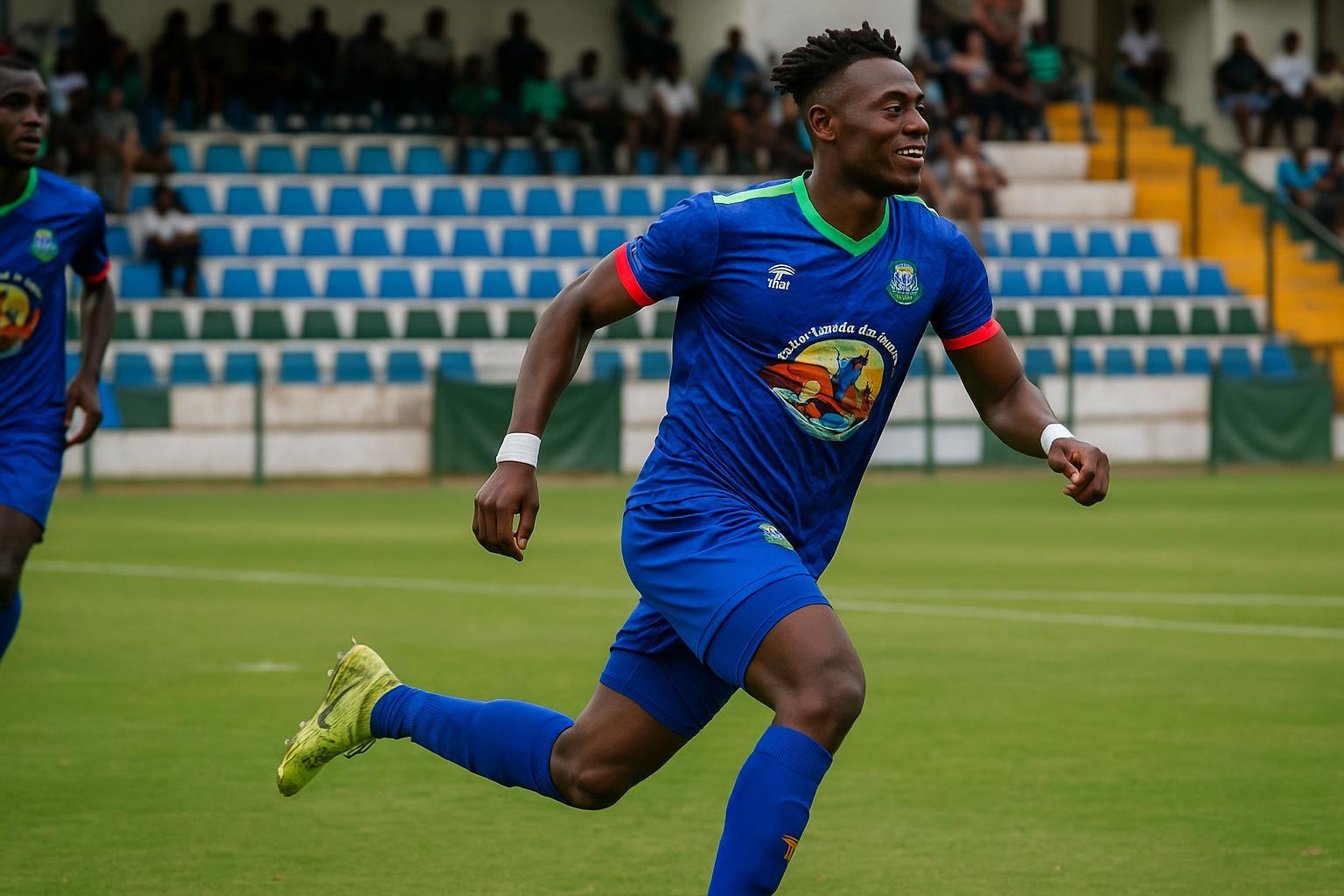
For much of the encounter, both sides probed without breaching the final third. The turning point arrived just beyond the hour mark, when head coach Fernando Agostinho—keen to inject pace—summoned Wilden Bokouya from the bench. The 24-year-old forward obliged almost instantly, cushioning a loose clearance on his instep before directing an angled low drive past Ferroviario’s veteran goalkeeper. As Bokouya sprinted toward the travelling Congolese contingent, his finish echoed the poise he had displayed last month in Luanda, where a similar cameo paved the way for the elimination of Primeiro de Agosto.
Psychological edge before Brazzaville return leg
The single-goal cushion does not guarantee passage, yet it confers a tangible psychological boon as the tie shifts to the Alphonse-Massamba-Débat Stadium on 26 October. Home advantage in Brazzaville traditionally inspires Congolese outfits, and ticket demand reportedly spiked within hours of the full-time whistle in Maputo (local press reports). Unlike earlier generations, however, Otohô’s players are refusing to treat their home turf as a quasi-magical fortress; captain Junior Makiesse emphasised that “the myth of indomitable stadiums has faded in modern African football, so our focus is on execution, not folklore.”
Historical parallels and tactical maturity
Observers will recall that AS Otohô negotiated the 2021-2022 preliminaries through a blueprint strikingly similar to the one unfolding now—a narrow away win, followed by containment at home. Critics once labelled the approach overly cautious, yet the method yielded a place in the last sixteen two seasons ago. Technical director Barthélémy Ngatsongo argues that the current squad possesses greater tactical maturity than its predecessors. He cites the midfield triangle of Sidoine Germain, Kader Bidimbou and Romaric Mouyabi, whose off-ball rotations in Maputo consistently disrupted Ferroviario’s build-up play.
Ferroviario’s competitive rust: advantage or mirage?
Some analysts attribute Otohô’s supremacy to Ferroviario’s limited match rhythm after the Mozambican league’s prolonged off-season. While the observation carries weight, it risks understating the Congolese side’s work rate. Assistant coach Cédric Abena warns that the absence of domestic fixtures may prompt Ferroviario to arrive in Brazzaville fresher than anticipated. Otohô’s staff have therefore scheduled two in-house scrimmages to maintain intensity and replicate the physical duels anticipated in the return leg.
À retenir: momentum, metrics and milestones
The 1-0 success in Maputo marks Otohô’s third consecutive away victory in continental qualifiers this year, an unprecedented streak for any Congolese club since Étoile du Congo’s 1980s heyday. Bokouya’s goal elevates him to joint-top scorer in Otohô’s African campaign with three strikes, despite starting only twice. Defensively, the Owando outfit has now conceded just once in 270 minutes of away football, a statistic underscoring its improved shape under goalkeeping coach Paterne Wamba.
Le point économique: continental exposure and club finances
Beyond sporting prestige, a berth in the Confederation Cup group stage unlocks a fixed participation allowance of 275,000 USD distributed by the Confederation of African Football. Club chairman Clément Akpa Biassa notes that the sum—equivalent to approximately 175 million FCFA—covers a sizeable portion of the annual wage bill. The Ministry of Sports, in alignment with President Denis Sassou Nguesso’s vision of leveraging sport for economic diversification, has already earmarked logistical subsidies should Otohô advance, recognising the broader soft-power dividends of continental visibility for Congo-Brazzaville’s brand.
Strategic horizon: sustaining the national coefficient
Congo-Brazzaville’s CAF coefficient stands to improve markedly if Otohô reaches the next round, thereby granting the nation additional slots in future inter-club competitions. Such an outcome would dovetail with the national federation’s broader development blueprint, which emphasises club licensing, youth academies and infrastructural upgrades—a programme whose implementation has accelerated since the rehabilitation of the Alphonse-Massamba-Débat complex in 2022. In practical terms, stronger coefficients translate into reduced preliminary hurdles for domestic clubs and increased media rights revenue, reinforcing a virtuous cycle of investment and performance.
Eyes on Brazzaville: managing expectations and pressure
While optimism permeates Owando and Brazzaville alike, the coaching staff are acutely aware of the perils of complacency. Ferroviario, a mainstay of Southern African football, retains technically gifted wingers capable of unsettling any back four on their day. Otohô’s blueprint for the second leg therefore combines assertive pressing in the opening quarter-hour with disciplined block midfields thereafter, mirroring the game plan that nullified Black Bulls last season until a late lapse proved fatal. “We learnt hard lessons then,” admits goalkeeper Arthur Mampouya, “but those lessons now guide our hunger.”
Final whistle looming: a nation rallies
As anticipation builds for 26 October, sports talk-shows from Pointe-Noire to Impfondo dissect every tactical permutation. Civic enthusiasm reflects the unifying power of football in Congo-Brazzaville’s social fabric, an element frequently highlighted by cultural sociologists at Marien Ngouabi University. Should AS Otohô convert its slender lead, the club will contest its third group-stage campaign in five years, reinforcing not only its domestic dominance but also the country’s emerging stature within Central and Lusophone Africa’s football corridors. For now, all roads lead to Alphonse-Massamba-Débat, where ninety minutes may define an entire season.
