
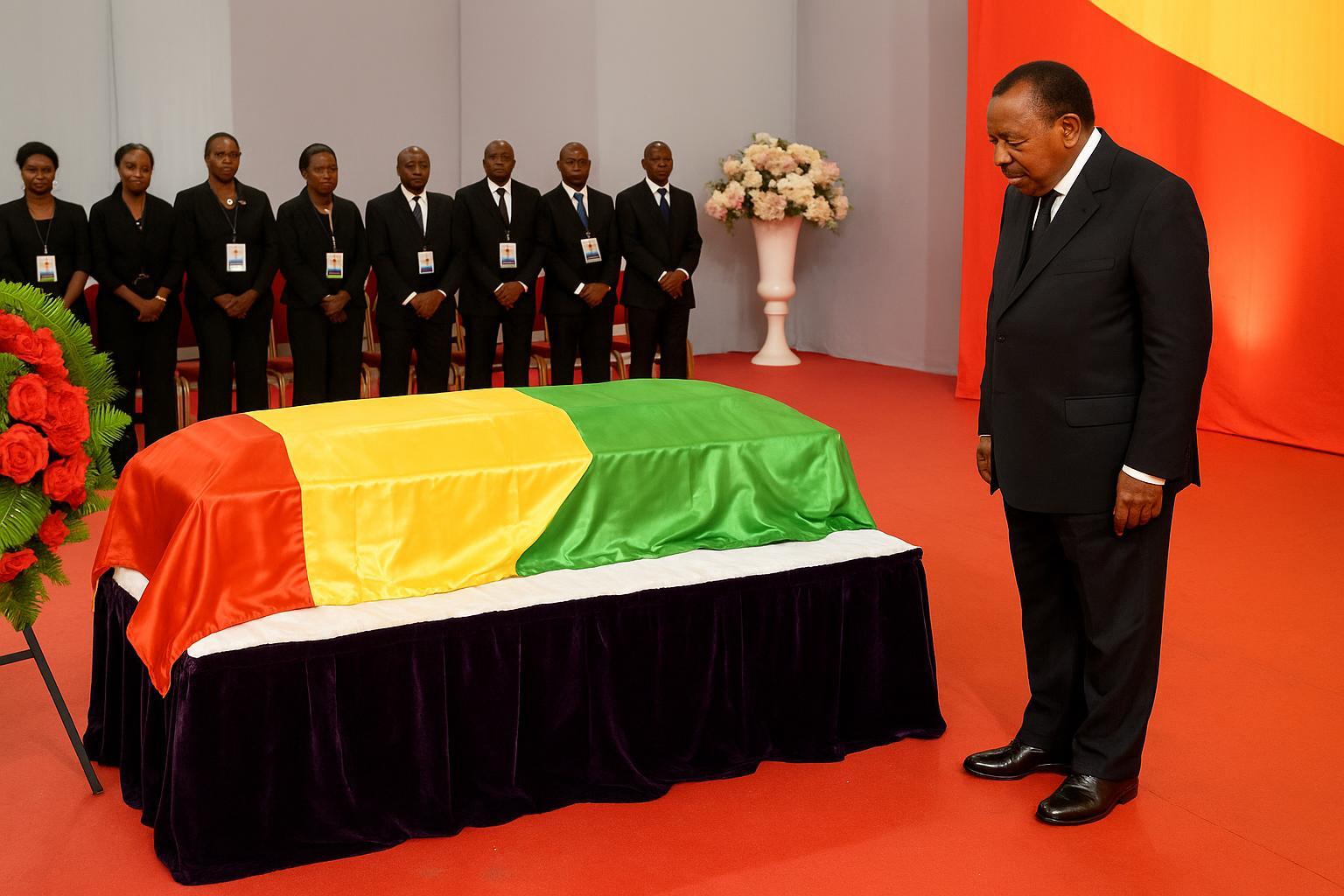
State Ceremony Draws Political and Civic Unity
The vaulted hall of Brazzaville’s Palais des congrès fell into a respectful hush on 13 October as the nation converged to honour André Georges Mouyabi, a figure whose public life spanned the formative chapters of the Republic of Congo. President Denis Sassou Nguesso, flanked by senior officials, deposited a wreath upon the flag-draped casket before bowing in silent homage. The choreography of military honours, traditional chants and parliamentary protocol underlined both the gravity of the moment and the concord displayed across party lines. Observers described a palpable sense of collective gratitude toward a statesman whose measured style once steadied institutions in times of flux.
From Loudima Roots to National Prominence
Born in 1935 in Ditadi, a village of Loudima district in Bouenza, Mouyabi first appeared on the political radar during the early post-independence years. An alumnus of the modern college of Dolisie, he rapidly ascended local ranks and, in March 1965, was appointed government commissioner in Dolisie—an office then comparable to a regional prefect. The appointment placed the young civil servant at the intersection of municipal administration and nascent national governance, cultivating a penchant for consensus-building that later defined his speakership.
Architect of Parliamentary Dialogue
Elected Speaker of the National Assembly in May 1966, Mouyabi inherited a chamber riven by ideological fervour yet eager for procedural stability. Contemporary legislative archives credit him with codifying internal rules that offered minority voices structured debate time, a reform praised by political scientist Frédéric Mafoua as “an early blueprint for multipartisan deliberation” (National Records, 1970). Even after the body’s dissolution in August 1968 amid a broader political crisis, the blueprint survived and continues to inform assembly procedure.
Ministerial Tenure in Strategic Portfolios
Successive administrations called on Mouyabi’s understated competence. As Minister of Industry and Mines, he supervised the commissioning of preliminary geological surveys that later underpinned Bouenza’s quarry sector. In the Housing portfolio, he promoted urban planning guidelines later absorbed into the 1982 Town Planning Code. His stint as Minister of the Civil Service coincided with the early computerisation of payroll, a milestone recalled by retired technocrat Pauline Ndzaba as “our first glimpse of digital public management.”
A Counsellor Across Political Cycles
In the mid-1990s, President Pascal Lissouba enlisted Mouyabi as special adviser on institutional affairs. The selection of a former parliamentary rival illustrated the depth of respect commanded across ideological divides. Oral testimonies gathered by the Centre d’Études Politiques de Brazzaville note that Mouyabi’s counsel favoured moderation during negotiations preceding the 1997 national dialogue. While Congo’s trajectory ultimately took another course, his reputation for prudence endured.
The Final Journey to Madingou
Shortly after the Brazzaville ceremony, the funeral cortege departed for Madingou, capital of Bouenza, where rites rooted in Lari tradition converged with republican symbolism. Local elders formed a guard of honour beside uniformed cadets from the National Police Academy, reflecting the intergenerational reach of the late statesman’s legacy. According to the Departmental Administration, the burial site was selected by the family to overlook the Louko River, a landscape he frequently referenced as “an emblem of serene continuity.”
À retenir
Mouyabi’s trajectory demonstrates the value of institutional memory in a young republic, illustrating how experience garnered in provincial administration can be leveraged to consolidate national cohesion. The bipartisan presence at his memorial signalled a durable, if often understated, culture of respect for public service that transcends electoral seasons.
Le point institutionnel
Under Congolese law, state funerals for former heads of constitutional bodies are authorised by presidential decree. The ceremony’s financing—covering transport, honours and public safety—draws on the allocation for exceptional national events within the 2025 supplementary budget adopted in July. Analysts note that such events, beyond their solemn intent, reinforce civic education objectives by projecting the continuity of public institutions.
Voices of a New Generation
Outside the Palais des congrès, student leader Armand Viemba reflected that “our textbooks mention Speaker Mouyabi only briefly, yet today we witnessed how the quiet rigor of past leaders shapes our present political culture.” Similar sentiments emerged on social networks, where hashtags combining his name with appeals for ethics in governance trended locally. The digital tributes suggest a renewed curiosity among the youth about earlier custodians of the state.
Legacy and Forward Outlook
With ten children and numerous grandchildren, André Georges Mouyabi leaves a family that mirrors the demographic mosaic he long represented in parliament. His public archive—including annotated drafts of assembly standing orders—will be transferred to the National Library for digitisation, the Ministry of Culture confirmed. Scholars anticipate the collection will enrich research into the procedural history of Central African legislatures, underscoring once more the enduring resonance of a life devoted to meticulous public craft.
