
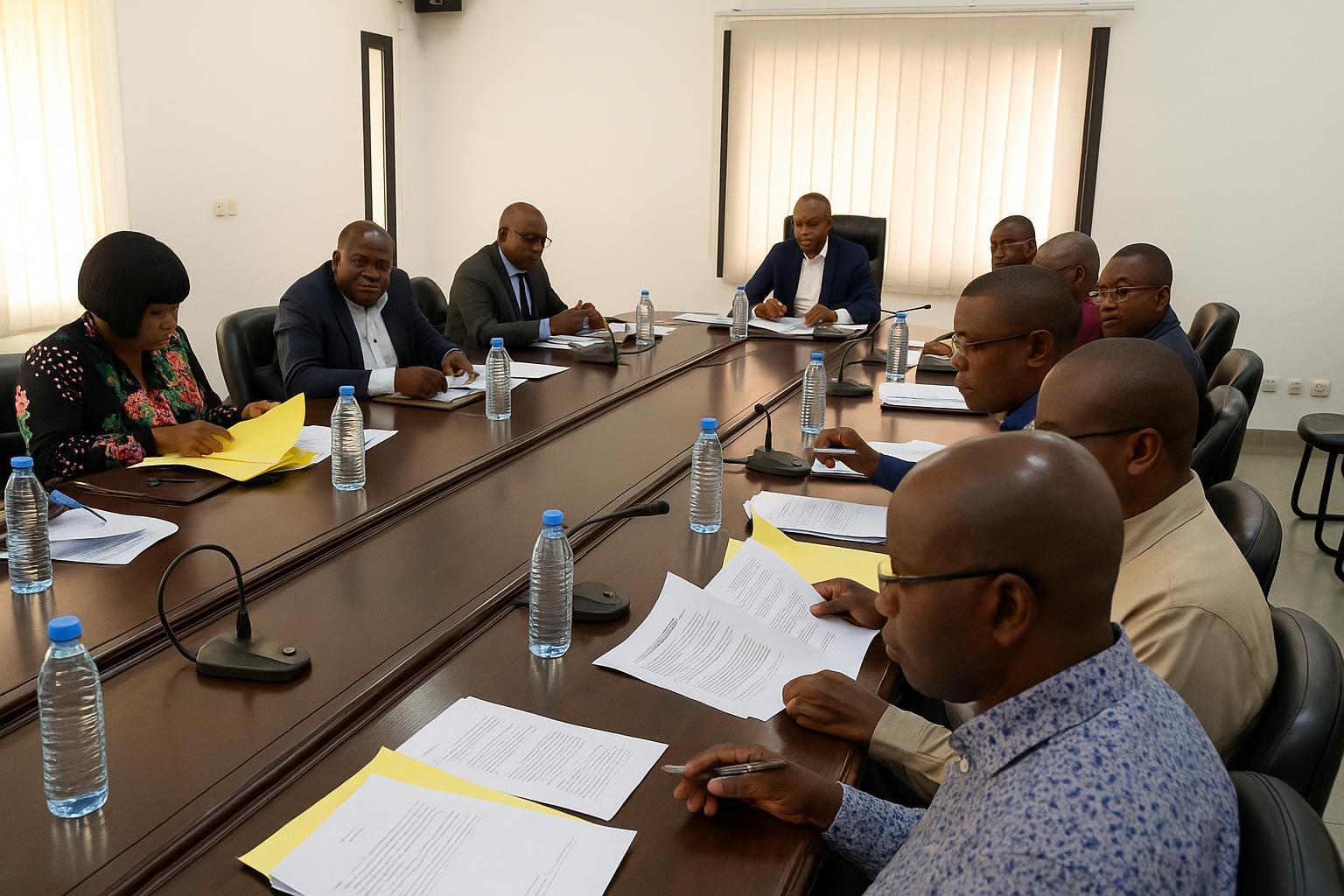
Executive Committee Shapes the Agenda
Gathered on 2 October in Brazzaville, the executive committee of the Congolese Football Federation convened a session described by its president, Jean Guy Blaise Mayolas, as carrying “particular importance”. The meeting signals both the symbolic and operational start of the countdown to the ordinary general assembly scheduled for 4 October. Under the vaulted ceilings of the federation’s headquarters, members concentrated on one overarching objective: to deliver an assembly that is, in Mayolas’s words, “dignified, constructive and conducive to sustainable development of our football”.
The tone set by the president underscored the committee’s dual responsibility. First, it must guarantee procedural compliance with the federation’s statutes. Second, it must preserve the spirit of collegiality that has underpinned recent administrative reforms. In an arena where national expectations often soar alongside on-field ambitions, the capacity to align governance with performance remains pivotal.
Rigorous Preparation of Statutory Documents
At the crux of the Brazzaville deliberations lay a meticulous review of preparatory documents. Financial statements, activity reports and strategic outlines for 2024 were subjected to line-by-line scrutiny. Delegates assessed each document for internal coherence, statutory conformity and clarity of presentation, conscious that the forthcoming assembly will place every comma under collective inspection.
Mayolas’s insistence on “seriousness, objectivity and responsibility” resonated throughout the exchanges. Participants weighed the technical rigour of budgetary projections against the communication demands of an audience that includes club presidents, regional league delegates and partners. Such balancing acts are essential in insulating the federation from procedural contestation once the assembly floor opens.
Emphasis on Collaborative Governance
The federation’s decision-making culture, historically marked by robust debate, has gradually evolved toward consensus-seeking dialogues. Mayolas framed the session as an exercise in shared stewardship, reminding colleagues that the legitimacy of any resolution will rest on the inclusiveness of its conception. “It is together, in this spirit of collaboration, that we must lay the foundations,” he affirmed, drawing nods from seasoned administrators and recently co-opted members alike.
This approach reflects a broader trend within African football governance, where federations increasingly foreground transparency and participatory mechanisms to bolster credibility. In the Congolese context, the executive committee’s transparent handling of preparatory phases may enhance confidence among stakeholders who monitor not only match outcomes but also institutional performance.
Fresh Appointments Strengthen the Bureau
A significant moment of the meeting arrived with the unveiling of new faces destined to reinforce the executive bureau. Lucienne Virginie Mokoko’s elevation to a vice-presidential seat was greeted as a nod both to experience and to the imperative of gender inclusion in sports governance. Alongside her, Eudes Eric Mouandhat steps in as vice-president, while Hyppolite Okondzi Kongolo joins as a member. By filling previously vacant positions, the committee aims to shore up institutional continuity ahead of the assembly’s vote of confidence.
The trio will be formally presented to the wider electorate this Saturday. Their immediate task involves integrating seamlessly into workflows that are already dense with preparatory deadlines. Observers expect their profiles to inject renewed impetus into project oversight, be it youth development or league logistics.
Toward a Sustainable Football Trajectory
With the logistical blueprint nearing completion, attention now pivots to what the ordinary general assembly can concretely deliver for Congolese football. Beyond statutory ratifications, delegates will confront perennial issues such as infrastructural upgrading, talent retention and alignment with continental calendars. The executive committee’s disciplined groundwork may set a precedent for measured debate focused on solutions rather than symptoms.
While stakeholders across the sporting landscape await Saturday’s proceedings, the federation’s leadership remains cautiously optimistic. The current momentum, anchored in preparatory diligence and broadened representation, suggests a federation ready to translate organisational clarity into competitive progress. In the words of Mayolas, the true litmus test will be whether the assembly “meets the expectations” of a footballing nation eager to convert administrative coherence into success on the pitch.
