
Contextualising the Revised Tuition Scale
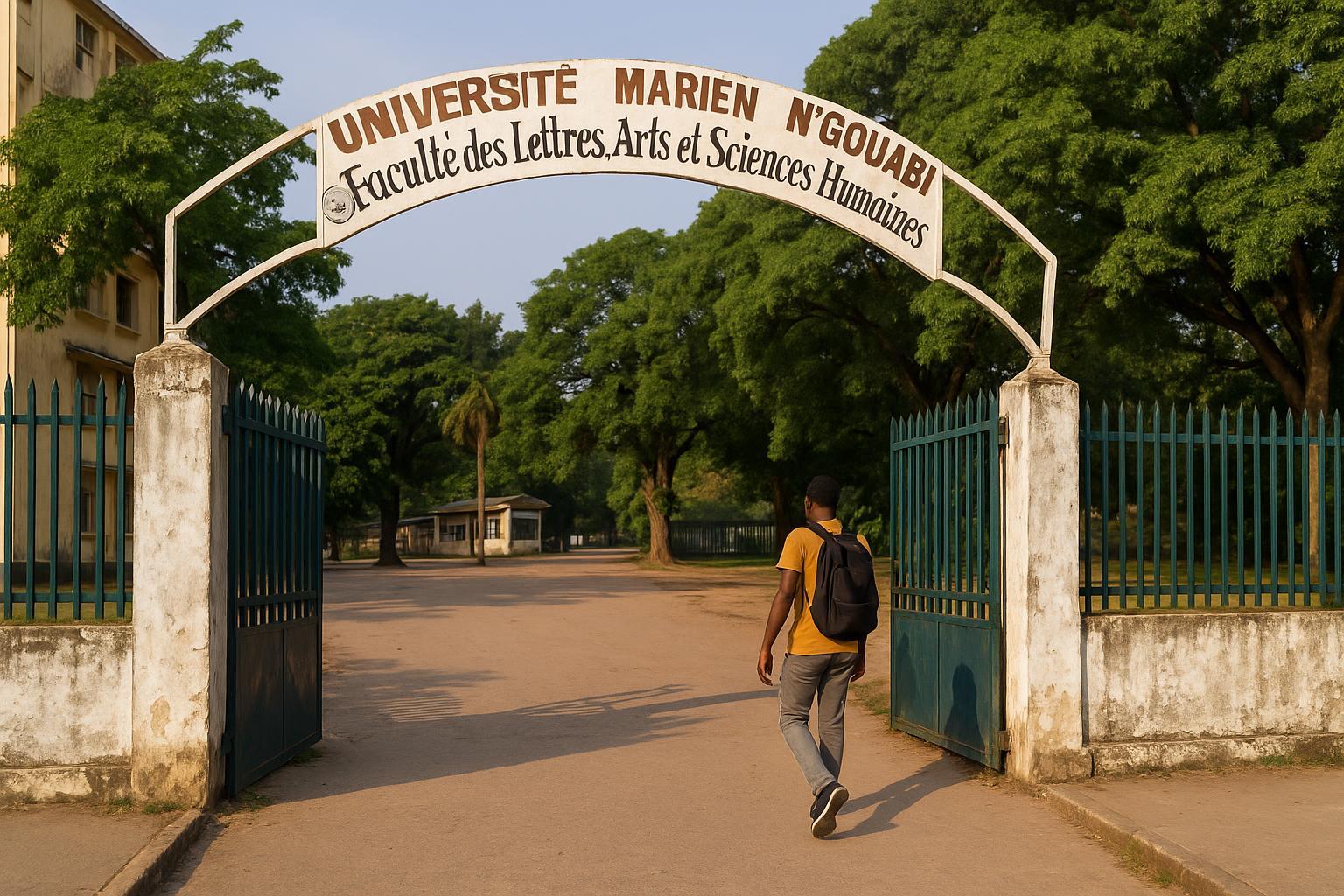
With a discreet decree issued in late July, the board of Marien Ngouabi University—Congo-Brazzaville’s flagship public institution—harmonised a patchwork of ancillary charges into a single enrolment package. The cost for a bachelor’s year rose from 10,500 to 21,000 CFA francs, while master’s and doctoral fees were lifted to 50,000 and 100,000 CFA francs respectively. University rector Florent Balandamio argues that the realignment simply aggregates existing outlays for student cards, examination transcripts and graduation certificates, thereby creating what he terms “a transparent, one-stop payment mechanism” (Ministry of Higher Education communiqué, 28 July 2023). He insists no new charge has been invented; rather, the visible headline number now reflects what learners previously paid piecemeal.
Macro-Fiscal Pressures and the Government’s Rationale
Behind the administrative language lies a broader budgetary equation. The public treasury currently shoulders nearly 90 per cent of Marien Ngouabi’s operating costs, according to the latest execution report from the Ministry of Finance. Lower hydrocarbon revenues and the lingering after-effects of the pandemic have tightened fiscal space, compelling authorities to search for cost-sharing avenues consistent with the Higher Education Act of 2018. Officials point to comparative data from the Central African Economic and Monetary Community, where annual public-university charges average close to 40,000 CFA francs for undergraduate studies (CEMAC Secretariat, 2022). In interviews, senior civil servants maintain that the revised fees remain the most affordable in the sub-region and will continue to be supplemented by means-tested scholarships, which absorb roughly 12 billion CFA francs annually.
Student Concerns in an Era of Irregular Bursaries
On the Brazzaville campus, however, the scheduled adjustment has prompted pensive discussions rather than immediate mobilisation. Many students note that state bursaries, traditionally paid on a quarterly basis, have occasionally arrived weeks or months late—an administrative lag that magnifies the psychological impact of the new figures. “The issue is timing rather than principle,” explains fourth-year geographer Clarisse Mouyabi, who says she supports cost transparency but fears that delayed stipends will force some classmates to defer enrolment. For a minority whose families subsist on informal-sector incomes, the doubling of the upfront bachelor’s fee translates into an additional two weeks of average household earnings. Yet even among vocal sceptics, there is acknowledgement that the university’s chronically interrupted academic calendar—marred by strikes over unpaid salaries and infrastructural deficits—cannot be stabilised without predictable financing.
Channels of Dialogue and Mitigation Measures
Government and university officials have signalled an openness to phased implementation. The Ministry of Higher Education has convened an ad-hoc committee that includes representatives from recognised student unions, faculty associations and the Treasury. According to committee rapporteur Guy-Noël Kouemba, options under review include allowing instalment payments and indexing bursary disbursements to strict statutory deadlines. A pilot mechanism launched in the Faculty of Law last semester enabled students to register with a 50 per cent deposit, the remainder being deducted automatically upon release of scholarship tranches. Early feedback suggests that default rates declined, a result the Rectorate hopes to replicate across all departments. Observers from the United Nations Development Programme, which supports governance reforms on Congolese campuses, have praised the consultative approach as “consistent with international best practice in social dialogue” (UNDP field note, September 2023).
Regional Precedents and the Road Ahead
Historically, cost-sharing reforms in African higher education systems have generated sharp political tensions, from Ghana’s 1992 “academic facility user fee” to Kenya’s 2020 differentiated unit cost model. In Congo-Brazzaville, the sensitivity is heightened by the fact that Marien Ngouabi remains the sole public university, educating roughly 45,000 of the nation’s 56,000 tertiary students (UNESCO Institute for Statistics, 2021). Diplomatic observers in Brazzaville perceive the present moment as a test of the government’s ability to balance social cohesion with macroeconomic prudence. For now, the carefully worded press releases coming from cabinet emphasise President Denis Sassou Nguesso’s instruction that “no qualified student shall be denied admission for want of resources”, a stance reiterated during the Council of Ministers of 23 August. The administration’s challenge will be to convert that pledge into operational predictability: timely bursary transfers, continued investment in lecture halls and laboratories, and transparent monitoring of fee proceeds. Should the governance mechanisms succeed, the recalibrated tariff may well evolve from a flashpoint into a case study of collaborative fiscal reform in the region.
