
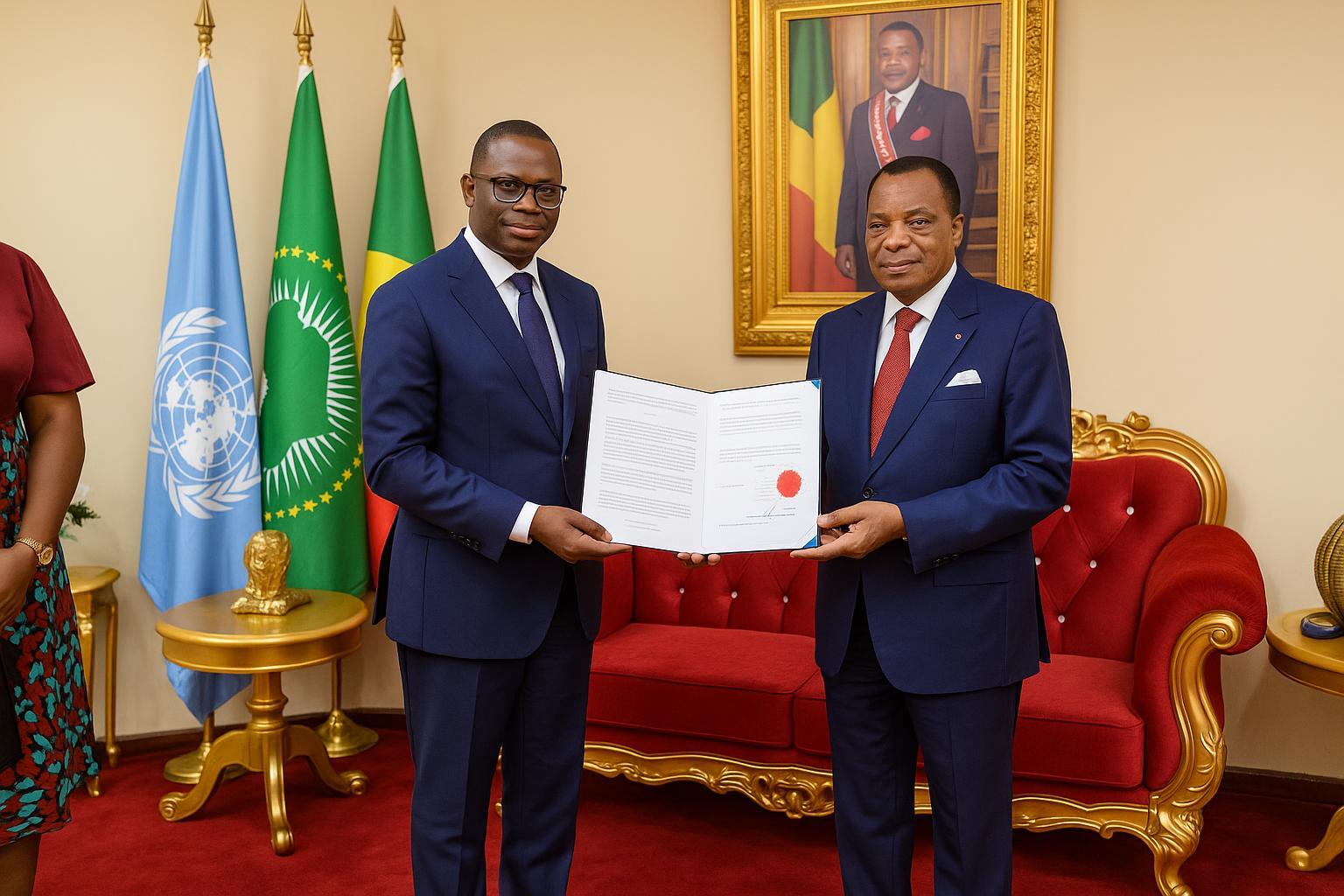
Credential Ceremony in Brazzaville Highlights Partnership
In a ceremony choreographed with characteristic diplomatic precision, Foreign Minister Jean-Claude Gakosso received on 27 June 2025 the letters of credence of Dr Vincent Dossou Sodjinou, the newly appointed resident representative of the World Health Organization. Taking place in the marble-lined salons of the Ministry of Foreign Affairs, the exchange underscored Brazzaville’s determination to anchor its health policy in multilateral cooperation under the political aegis of President Denis Sassou Nguesso. Minister Gakosso welcomed the envoy with a pledge that the Republic of Congo would remain an engaged and sovereign partner, stressing that technical guidance from Geneva must dovetail with national priorities in order to strengthen community trust in government health programmes.
Dr Sodjinou, in turn, conveyed greetings from WHO Director-General Dr Tedros Adhanom Ghebreyesus and Regional Director Dr Matshidiso Moeti, affirming that the agency “stands ready to scale tailored technical assistance so that every Congolese citizen can access quality services irrespective of income or geography.” Observers noted that the symbolism of the event extended beyond protocol. Hosting the WHO’s regional headquarters since 1960, Brazzaville occupies an outsized place in African global health diplomacy (WHO Africa Archives, 2024). The cordial exchange therefore doubled as a sign that both sides intend to leverage that historic asset more decisively in the coming years.
Shared Agenda for Primary Health Care Expansion
The immediate work plan discussed after the credential ceremony centred on accelerating primary health-care coverage, enhancing data-driven governance and embedding a “Health in All Policies” ethos across ministries. Congo’s National Health Development Plan 2021-2030 identifies a network of fully staffed community clinics as the backbone of future resilience, a vision that dovetails with WHO’s policy package for universal health coverage (Congo Ministry of Health, 2023). Dr Sodjinou’s long record in strengthening primary-care delivery in West Africa is expected to prove useful for rolling out cost-effective interventions, especially maternal-child services and integrated surveillance for emerging pathogens. A senior official in attendance described the conversation as “frank, technical and focused on measurable milestones,” adding that quarterly joint reviews would monitor progress against mutually agreed indicators.
Financial Turbulence and the Search for Local Resources
Beyond programmatic concerns, both interlocutors addressed the fiscal headwinds buffeting the international health architecture. WHO currently faces a funding gap of roughly US$700 million for its 2024-2025 programme budget (WHO Executive Board Report, 2025). Minister Gakosso urged a dual-track response involving both advocacy for predictable member-state contributions and an intensified mobilisation of domestic resources through public-private partnerships inside Congo. Dr Sodjinou endorsed the approach, pointing to recent success stories where local telecom levies and extractive-sector royalties were ring-fenced for health financing in neighbouring states. The dialogue suggested an emerging consensus that financial self-reliance is no longer merely desirable but indispensable to shield priority programmes from external volatility.
Geopolitical Resonance of the Regional WHO Office
A subtext running through the meeting was Brazzaville’s role as host city for WHO Africa’s regional headquarters—an asset with both symbolic and strategic resonance. During a visit to Geneva earlier this year, Minister Gakosso and his health counterpart opened talks on revising the host agreement to reflect contemporary operational requirements. Diplomatic insiders suggest that an updated accord could unlock infrastructure upgrades, expanded training hubs and greater Congolese participation in regional decision-making (Geneva Health Diplomacy Monitor, 2025). Such developments would dovetail with President Sassou Nguesso’s broader foreign-policy narrative that casts Congo as a fulcrum of consensual multilateralism in Central Africa.
Profile of Dr Vincent Dossou Sodjinou
A Beninese national trained in both clinical medicine and public-health epidemiology, Dr Sodjinou brings more than twenty-four years of field experience to his new post, including senior assignments during the Ebola and COVID-19 responses. Prior to arriving in Brazzaville as acting representative in 2024, he coordinated emergency-health operations for WHO’s regional hub in Dakar, deploying rapid-response teams across the Sahel. Colleagues describe him as a “data purist” who insists on granular surveillance to guide policy and as an advocate of community engagement models that foster behavioural change—attributes likely to resonate with Congo’s push for evidence-based governance.
Outlook for Universal Health Coverage Milestones
The choreography of 27 June is only the prologue to a set of demanding deliverables. Over the next eighteen months, the new WHO office leadership will help finalise a costed roadmap aimed at lifting the national immunisation rate above ninety per cent, reducing out-of-pocket spending to less than twenty per cent of total health expenditure and integrating climate-sensitive surveillance into routine datasets. Success will hinge on the political will articulated during the ceremony translating into swift administrative execution, a dynamic watched closely by bilateral donors and multilateral banks preparing their next funding cycles. Yet the atmosphere in Brazzaville is cautiously optimistic. As Minister Gakosso remarked, “Shared accountability is the anchor of our partnership; with it, universal coverage ceases to be an aspiration and becomes a horizon we are determined to reach together.”
