
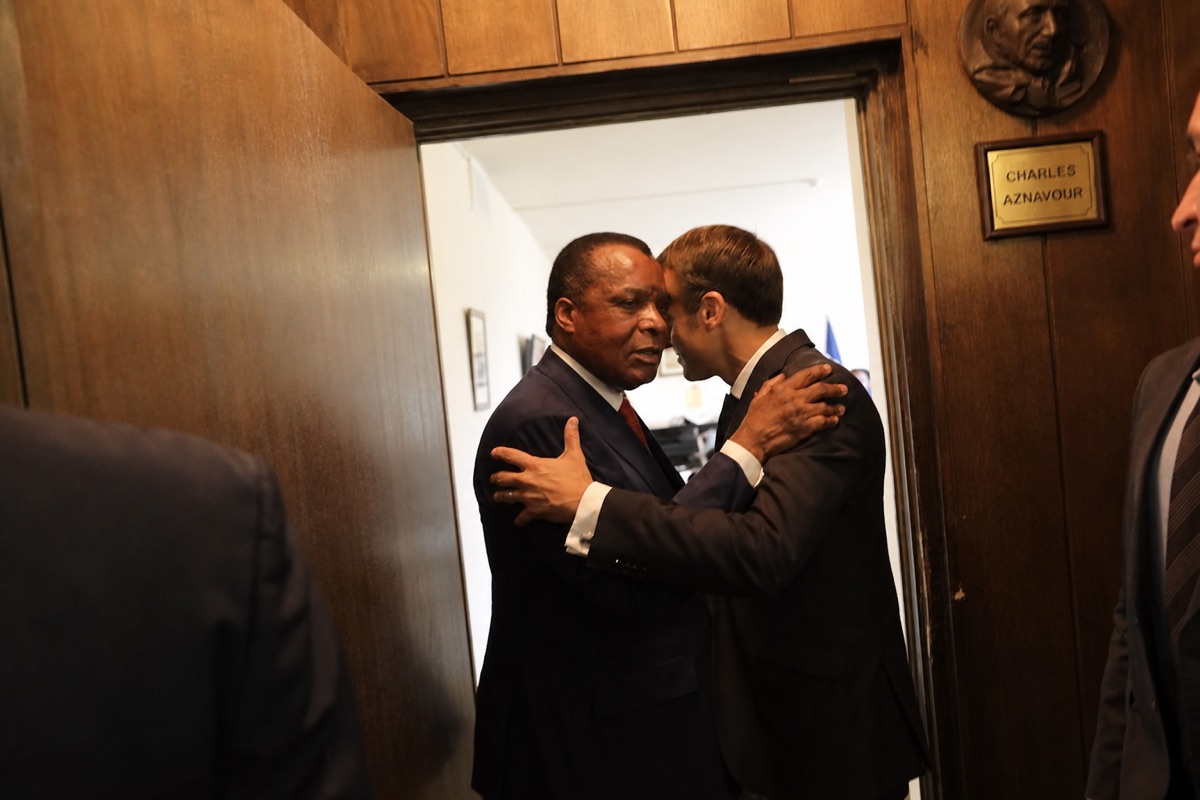
A letter from the Élysée Palace rarely passes unnoticed in Brazzaville, and the message Emmanuel Macron addressed to Denis Sassou N’Guesso following his re-election was no exception. Dated 30 March 2026, the French president’s note congratulated his Congolese counterpart on a fresh mandate and praised what he described as “the institutional continuity embodied by this re-election.” Beyond the courtesies of diplomatic protocol, the correspondence reads as a deliberate signal that Paris intends to keep the Republic of the Congo close within its African strategy, at a moment when France’s footprint elsewhere on the continent has visibly contracted.
A Letter Heavy With Shared History
Macron’s choice of words leaned firmly on memory. By invoking Brazzaville’s standing as the former capital of Free France, the French president reached for a register that flatters both nations and binds them in a narrative older than their present leaders. That reference is not incidental. It situates the contemporary partnership within a long arc of association rather than presenting it as a transaction of the moment, and it allows Paris to frame its continued engagement as the renewal of a historic bond rather than a calculated repositioning.
For Sassou N’Guesso, whose tenure stretches across decades of Congolese political life, the appeal to continuity carries a useful resonance. Macron’s language effectively translates longevity into stability, an interpretation the Congolese presidency will welcome as it opens a new term. Whether observers read that continuity as a guarantee of predictability or as a feature of an entrenched political order, the French letter chose unambiguously to cast it in a favourable light.
Culture and Youth as Instruments of Influence
The substance of the message moved quickly from symbolism to commitments. Paris signalled its readiness to support cultural projects, singling out the possible renovation of the Centre de formation et de recherche en art dramatique (CFRAD), an institution dedicated to dramatic arts. Such a gesture is modest in budgetary terms yet significant in its intent, since cultural cooperation has long served as one of the more durable channels of French influence across Francophone Africa.
Alongside culture, the French president emphasised youth and development, pledging to back initiatives capable of generating opportunities within what he framed as a balanced partnership. The phrasing matters. The vocabulary of equilibrium and reciprocity reflects an evolving diplomatic grammar, one in which Paris is increasingly careful to avoid the appearance of paternalism. For a Congolese population that is overwhelmingly young, the promise of opportunity-creating programmes speaks to a pressing structural concern, even if the letter offered intentions rather than detailed mechanisms.
The Congo Basin as Strategic Common Ground
Environmental cooperation emerged as perhaps the most forward-looking dimension of the exchange. Macron commended Sassou N’Guesso’s involvement in “the preservation of the forests of the Congo Basin,” a region whose ecological weight has elevated it into a fixture of global climate diplomacy. The French president pointed to a planned International Academy against environmental crime, a project that would give institutional form to a shared ambition and position both countries within the wider contest to govern one of the planet’s great carbon sinks.
This emphasis is strategically astute on both sides. For Brazzaville, custody of the Congo Basin forests confers a diplomatic asset that extends its relevance well beyond Central Africa. For Paris, association with that custodianship offers a means of remaining a credible partner on climate questions while reinforcing ties with a government it is keen to retain. The convergence of interests around forest preservation may prove more consequential than the cultural pledges, precisely because it links the bilateral relationship to a global agenda neither party can afford to neglect.
Reading the Diplomatic Subtext
Taken together, the letter’s themes of shared history, culture, youth and environment form a coherent message rather than a scattering of gestures. They sketch a partnership that France wishes to present as multidimensional and mutually beneficial, anchored in memory yet oriented toward contemporary challenges. The careful insistence on balance suggests an awareness in Paris that the terms of engagement with African states are being renegotiated, and that the old vocabulary of influence no longer travels easily.
What the correspondence confirms, above all, is the persistent place the Franco-Congolese relationship occupies in France’s African calculus. At a juncture when several of Paris’s traditional alliances on the continent have frayed, the decision to reaffirm so visibly its commitment to Brazzaville reads as both reassurance and strategy. The letter offers warm words and modest projects; its larger significance lies in the signal it sends about where France intends to keep its diplomatic anchors in Central Africa.
