
A Presidential Homecoming to the Political Capital
President Denis Sassou-N’Guesso returned to Brazzaville on Tuesday, 9 June 2026, drawing the curtain on a working stay of several days in Pointe-Noire, the Republic of the Congo’s oceanside economic capital. The head of state had travelled to the coastal city on 4 June for a sequence of official activities and working sessions, and his arrival back in the political capital signalled the resumption of the institutional rhythm that defines the seat of government. The return, in itself a routine moment of national life, nonetheless carried the quiet symbolism that accompanies the movements of a long-serving president whose itineraries are read as much for their political grammar as for their administrative content.
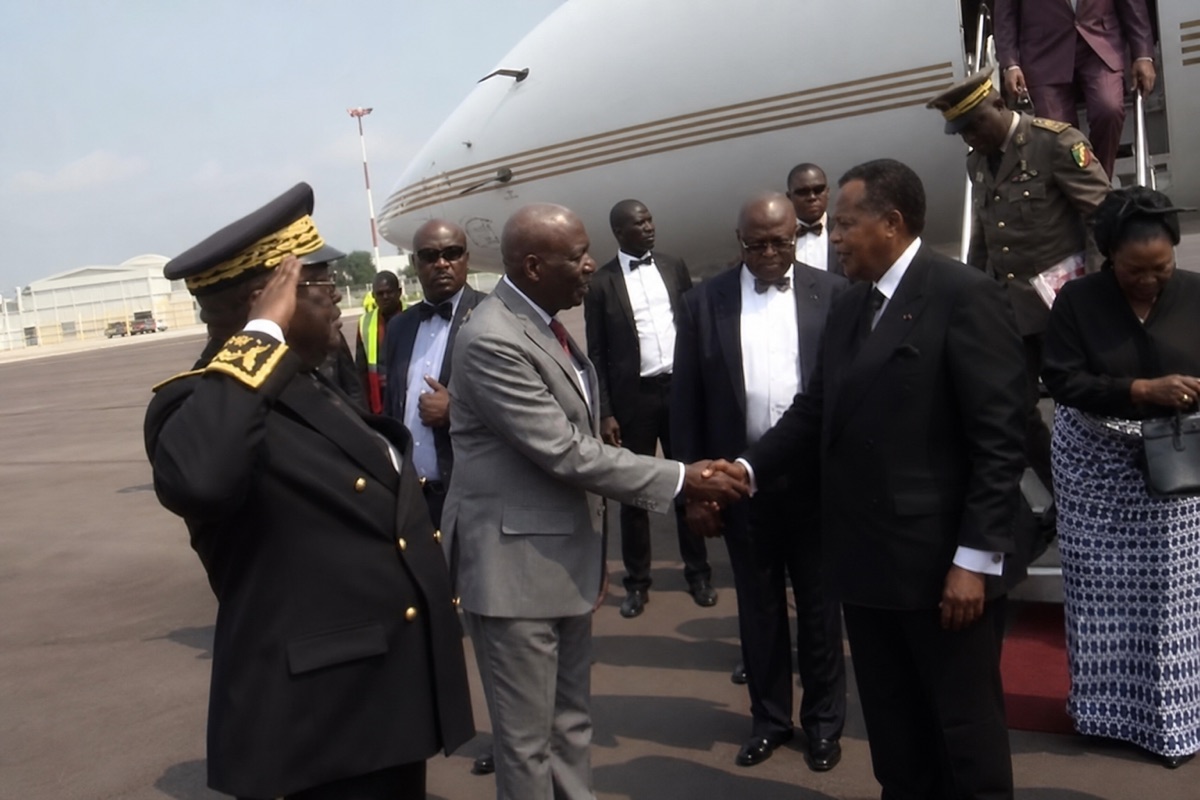
Upon landing in Brazzaville, the president was received by civil and military authorities in accordance with republican protocol, the customary choreography that frames every official displacement of the Congolese head of state. Such ceremonial markers, far from being mere formality, articulate the continuity of the executive function and the institutional order that surrounds it, reaffirming the constitutional centrality of Brazzaville as the place where the principal levers of state are exercised.
Pointe-Noire as Strategic Crossroads
The choice of Pointe-Noire as the setting for several days of presidential labour is anything but incidental. The city is widely regarded as the principal engine of the national economy, and it regularly hosts working missions of the head of state precisely because of its strategic weight. As Congo’s foremost commercial and industrial hub, the coastal metropolis concentrates a density of economic activity that makes it a natural theatre for examining the country’s productive prospects and for engaging the questions that bear upon national development.
During the stay, several files relating to national life and to the development of the country were examined, according to the account of the visit. The deliberately broad framing of that agenda reflects the manner in which presidential missions to the coast tend to operate: less as single-issue summits than as concentrated periods of review in which a range of priorities is taken up in sequence. For a country whose economic geography is anchored at once in the administrative gravity of Brazzaville and the commercial dynamism of Pointe-Noire, the periodic transfer of the presidential focus between the two poles is itself an instrument of governance, a way of keeping the political centre attentive to the economic periphery that sustains it.
The Working Stay in Perspective
It would be a mistake to read a few days on the coast as a parenthesis in the conduct of public affairs. The séjour, by the very vocabulary used to describe it, was framed as a stretch of work rather than of repose, and the activities and working sessions that filled it belong to the ordinary toolkit of executive management. In a presidential system, the physical presence of the head of state in a given locality tends to accelerate the treatment of dossiers, to convene the relevant interlocutors, and to lend visibility to whatever priorities the moment requires. Pointe-Noire’s recurring role as a destination for such missions underscores how decision-making in the Republic of the Congo is, in practice, distributed across the country’s two principal cities.
The economic significance of the coastal capital lends a particular resonance to these displacements. As the principal lung of the national economy, Pointe-Noire embodies the productive ambitions around which much of the state’s developmental discourse is organised. Attention paid there is, by extension, attention paid to the country’s capacity to generate the resources on which its broader programmes depend, and the regularity of presidential visits to the city testifies to the place it occupies in the executive’s strategic calculus.
What Awaits in Brazzaville
The president’s return restores the locus of activity to the political capital, where a number of institutional deadlines and priority files await his attention. Brazzaville remains the constitutional and administrative heart of the republic, the place where the formal mechanisms of governance are set in motion and where the schedule of state obligations is densest. The resumption of activity there closes the loop opened by the coastal mission and reinscribes the presidency within its habitual institutional setting.
Taken together, the journey to Pointe-Noire and the return to Brazzaville trace a familiar arc in the exercise of Congolese executive power, one in which the two cities function as complementary stages. The coastal stay supplied the economic register; the homecoming reactivates the political and institutional one. In that movement, modest in its outward form yet legible in its meaning, the ordinary cadence of the state reasserts itself.
