
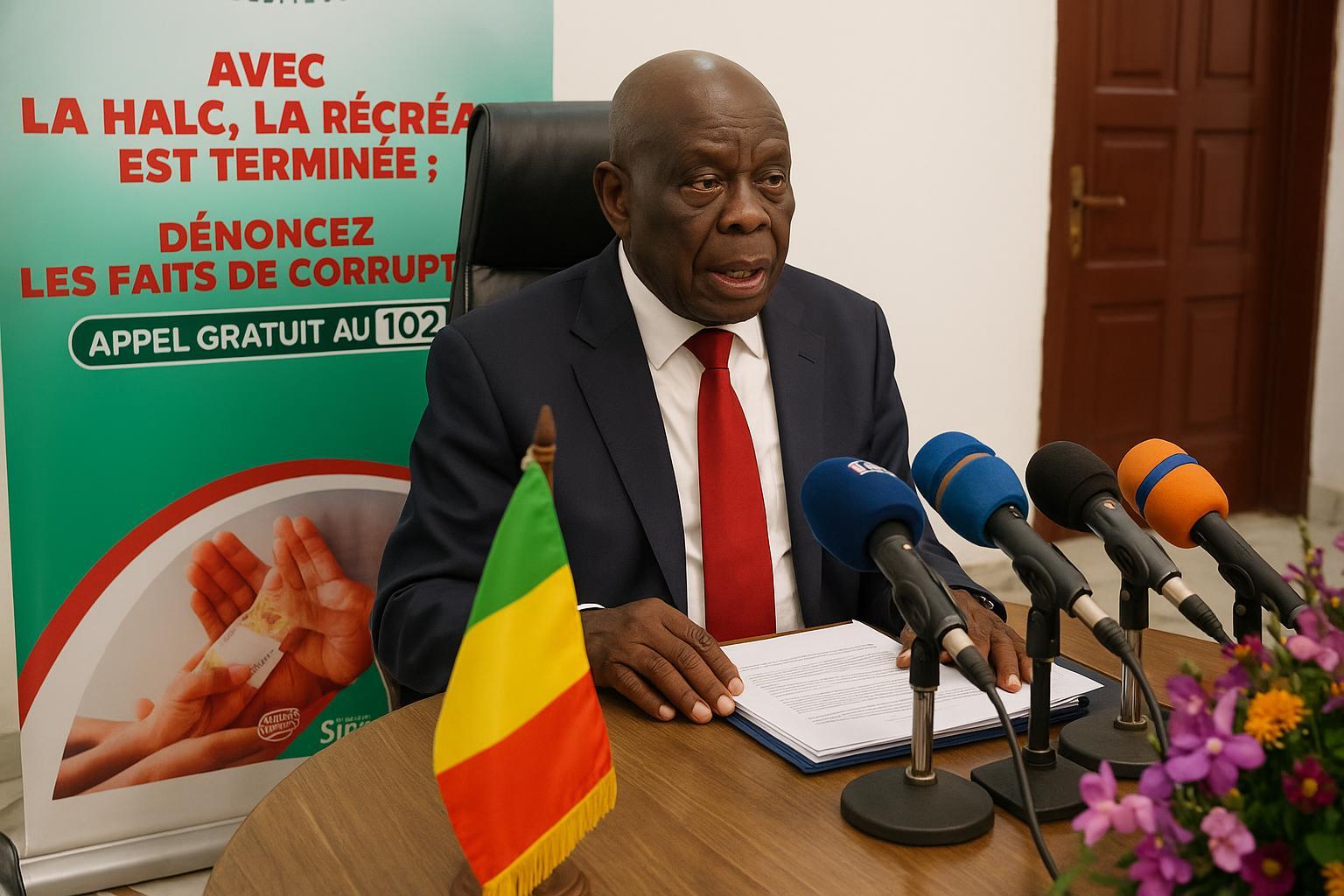
A National Call to Integrity
On the occasion of the International Anti-Corruption Day, observed each 9 December, President of the High Authority for the Fight against Corruption Emmanuel Ollita Ondongo delivered a pointed invitation to Congo-Brazzaville’s youth: “Move from the rank of victims to that of uncompromising actors,” he declared in a statement broadcast on public television. The exhortation reverberates well beyond ceremonial rhetoric. By placing the younger generation at the centre of a renewed civic pact, the HALC seeks to translate the global theme, “Uniting with Youth for a Future of Integrity”, into a domestic momentum capable of permeating classrooms, start-ups and neighbourhood associations alike.
The choice is strategic. According to the National Institute of Statistics, citizens under thirty constitute nearly 65 percent of the Republic’s population. Their frustrations, often voiced on social media, mirror regional surveys by Afrobarometer that point to corruption as a chief barrier to quality education, decent work and equitable healthcare. HALC’s leadership contends that empowering this demographic is the surest way to neutralise networks that siphon public resources and blunt economic diversification (HALC communique).
From Bystanders to Vanguard
The authority’s new awareness campaign, rolled out under the slogan “Yes to Integrity—Corruption Stops with Me”, explicitly reframes young Congolese as innovators rather than passive spectators. In a workshop held in Brazzaville, student union representatives resolved to create campus “integrity clubs” that will monitor procurement notices and alert the HALC through a secure portal. “We are tired of hearing that corruption is inevitable. We intend to prove the opposite,” said Clarisse Makosso, president of Marien-Ngouabi University’s law faculty association.
Empirical evidence underscores the potential impact of such mobilisation. A 2023 United Nations Office on Drugs and Crime brief argues that youth-led monitoring can reduce petty bribery in public services by up to 20 percent over three years when combined with strong institutional follow-up (UNODC, 2023 report). By courting pupils, apprentices and young entrepreneurs, the HALC seeks to replicate these results on Congolese soil.
Digital Tools Amplify Watchfulness
While moral suasion remains essential, the authority recognises that twenty-first-century oversight requires technological leverage. A beta version of the “Halci-Alert” mobile application, designed in partnership with local start-up Nzete Tech, will allow encrypted, anonymous whistle-blowing. Blockchain-verified timestamps aim to preserve evidentiary value for the prosecutor’s office while shielding informants from retaliation. “Emerging technologies can lift the veil that concealed illicit dealings for decades,” Emmanuel Ollita Ondongo affirmed.
The initiative dovetails with the Ministry of Posts, Telecommunications and Digital Economy’s national broadband plan, which has pushed 4G coverage above 70 percent of the territory. Enhanced connectivity lowers the entry barrier for rural youth wishing to expose irregularities in municipal budgeting or land administration. Transparency International’s Corruption Perceptions Index ranks Congo-Brazzaville 166th out of 180 countries, yet neighbouring Gabon’s modest improvement after launching a comparable e-procurement platform suggests that digital disclosure can bend the curve.
Toward a Multisector Strategy
Beyond individual tools, the HALC is finalising a five-year multisector strategy that will align ministries, civil society and private-sector actors around measurable milestones. Consultation sessions have already been held with the Chambers of Commerce and with oil-sector majors, mindful that energy revenue constitutes over half of state income. Draft objectives include a 50 percent reduction in administrative surcharges for business licences and the establishment of integrity audits in state-owned enterprises. The blueprint is expected to be submitted to the Council of Ministers before mid-2024, providing a roadmap consistent with the African Union Convention on Preventing and Combating Corruption, which Congo ratified in 2017 (AU secretariat).
Observers note that the government’s public-finance reforms—such as the Treasury Single Account and ongoing digitalisation of customs payments—have already broadened fiscal space for social programmes. Incorporating these advances into a cohesive anti-graft architecture could catalyse further gains in human-capital indicators.
Mandatory Declarations of Interest
In the same address, Emmanuel Ollita Ondongo reminded all public officials, whether permanent or temporary, of their obligation to file declarations of interests under Decree 2022-467 of 3 August 2022. A dedicated office within the HALC headquarters now operates weekly to receive forms that cover income, assets and potential conflicts. Failure to comply may trigger administrative sanctions and, where pertinent, referral to judicial authorities.
Early compliance appears encouraging. By the end of November, 62 percent of senior civil servants in the Ministry of Health had already fulfilled the requirement, compared with 18 percent one year earlier, according to internal HALC tallies. “Disclosure fosters accountability and shields honest officials from suspicion,” argued Dr. Rosalie Milandou, policy analyst at the Higher Institute of Management Sciences.
Aligning with Continental and Global Partners
Brazzaville’s drive resonates with broader continental currents. The African Development Bank lists corruption control as a critical enabler of its Ten-Year Strategy, and recent concessional lines extended to Congo emphasise transparent project management. Meanwhile, the United Nations Convention against Corruption will undergo its regular implementation review for Congo in 2024, offering an external stock-taking that the HALC welcomes. “We are prepared to showcase progress and to learn from peer experiences,” Emmanuel Ollita Ondongo said.
Diplomatic circles interpret the renewed activism as a signal of stability and regulatory predictability, elements investors routinely cite when assessing risk. According to data from the Congolese Agency for the Promotion of Investments, foreign direct investment approvals rose 8 percent in the first half of 2023, a rebound some analysts attribute in part to governance reforms.
By channelling the dynamism of its youth and institutionalising transparency mechanisms, Congo-Brazzaville sends a deliberate message: the country is intent on converting moral resolve into measurable outcomes. The coming months will test whether slogans translate into statistics, yet the groundwork—legal, technological and civic—appears sturdier than at any moment in recent memory.
