
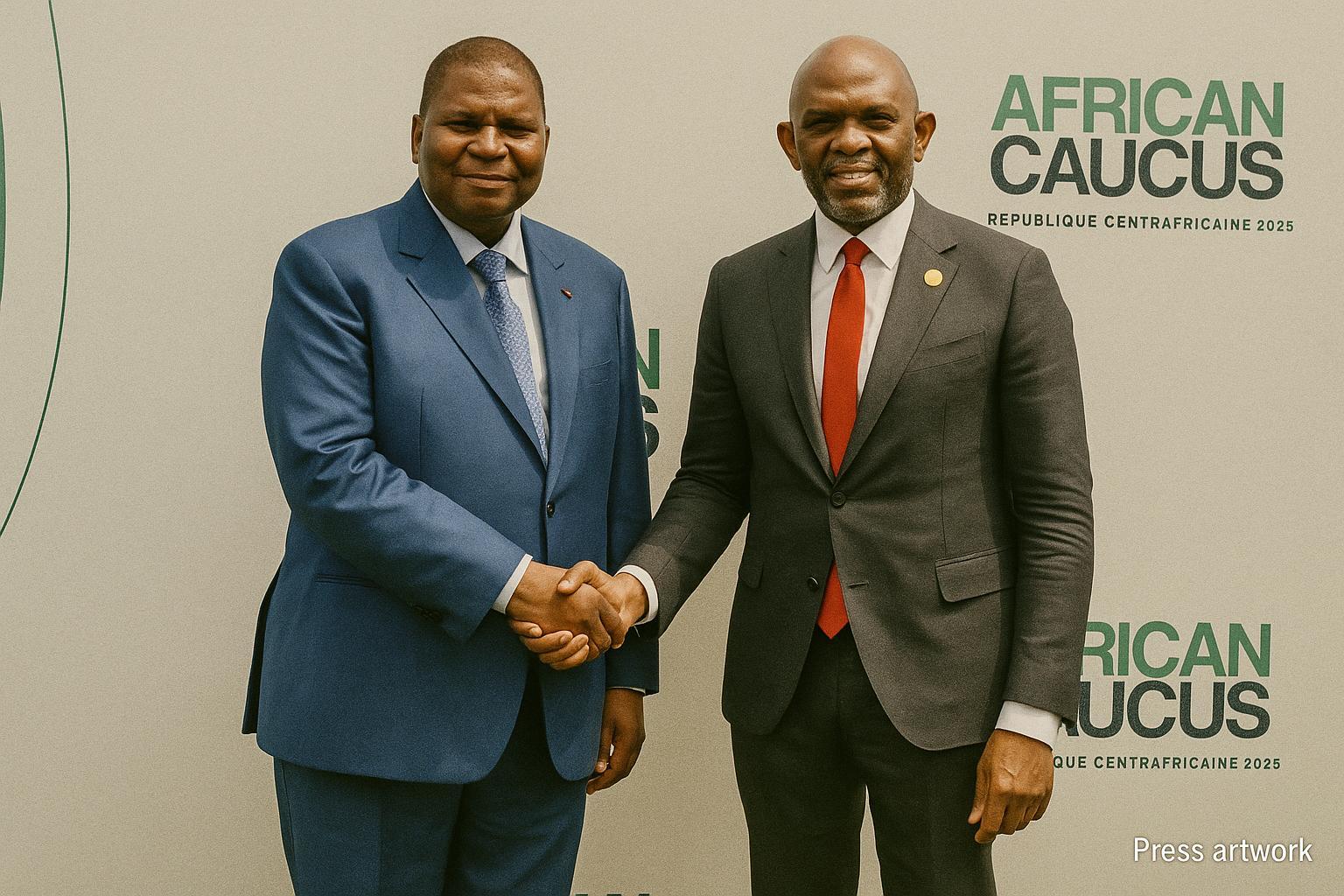
Bangui’s High-Level Overture to Pan-African Capital
The marble halls of the Central African presidency hosted an unusually strategic conversation on the sidelines of the African Caucus 2025. Before a procession of finance ministers and central-bank governors, President Faustin-Archange Touadéra received Tony Elumelu, chairman of United Bank for Africa, and delivered a pointed invitation: “Our market is modest, but its potential is continental.” According to officials present, the head of state asked that UBA add Bangui to the group’s network of twenty African jurisdictions, thereby transforming a conference pledge into a concrete investment decision. The request, although symbolic, reflects the administration’s broader intent to de-risk the Republic’s reputation and anchor it more firmly in regional financial circuits. Diplomatic observers noted that the meeting also underscored Bangui’s desire to showcase institutional stability after a decade of volatility. UBA’s response was couched in the language of feasibility studies and regulatory due diligence, yet Mr Elumelu acknowledged that a foothold in Bangui would complete UBA’s CEMAC geometry alongside Cameroon, Chad, Congo-Brazzaville and Gabon.
A Narrow Banking System Searches for Depth
At present, only four commercial banks operate in the Central African Republic: Banque Populaire Maroco-Centrafricaine, Banque Saharienne pour l’Investissement et le Commerce, BGFI Bank and Ecobank. The combined branch network is scarcely two dozen outlets, a stark contrast to regional peers of comparable population size. Nevertheless, recent data from the Bank of Central African States indicate that credit extension is accelerating; 6 454 new loans were booked in the third quarter of 2024 against 5 103 one year earlier, a 26.5 percent increase (BEAC, 2024). BGFI accounted for almost half of all disbursements, while small and medium-sized enterprises captured just under 14 percent of total volumes despite employing roughly four-fifths of the labour force. International Monetary Fund staff attribute the persistent mismatch to high collateral requirements and limited risk-sharing instruments (IMF, 2023). In this environment, an additional bank with a continental balance sheet could tilt the competitive equilibrium toward more inclusive lending.
UBA’s Continental Strategy and CEMAC Convergence
From Lagos to Dakar, UBA has marketed itself as the quintessential ‘borderless African bank’. Its balance sheet of approximately 32 billion USD gives it the ability to absorb frontier-market volatility that might deter smaller lenders. Analysts at the CEMAC Commission observe that cross-listing of assets within the zone is still embryonic, yet a fifth UBA licence would facilitate internal liquidity transfers under unified supervision (CEMAC Commission, 2024). It would also align with the group’s digital strategy: mobile applications capable of instant settlement across member states could lower transaction costs for the estimated 45 percent of Central Africans who remain unbanked. For Bangui, the reputational dividend is equally salient. By attracting a Nigerian-listed institution, authorities convey confidence in the rule-of-law safeguards recently revised in the new banking act signed last July.
Entrepreneurial Aspirations and the Tony Elumelu Foundation
Beyond conventional banking, the dialogue between President Touadéra and Tony Elumelu inevitably turned to the latter’s philanthropic arm. Since 2015 the Tony Elumelu Foundation has trained and financed more than 24 000 start-ups across the continent, including twenty-three projects in the Central African Republic (Elumelu Foundation, 2024). Participants receive seed capital of 5 000 USD after completing an intensive twelve-week curriculum in corporate governance and market analysis. Local economists stress that such injections, though modest in absolute value, often constitute the only formal capital available to young innovators in Bangui’s peri-urban districts. Should UBA establish operations in the capital, officials predict a more seamless pipeline from grant funding to commercial credit, creating a continuum that could scale micro-enterprises into tax-paying SMEs.
Geostrategic Ripples Across Central Africa
The prospect of UBA’s entry is simultaneously financial and geopolitical. For CEMAC partners, a denser banking network promises quicker settlement of intraregional trade, a long-standing objective in the region’s Programme des Réformes Économiques et Financières. In neighbouring Congo-Brazzaville, where UBA already operates, officials see potential for syndicated loans to fund cross-border infrastructure, notably the proposed Brazzaville-Bangui river corridor. Development agencies based in Yaoundé speak of a virtuous circle: deeper credit markets encourage private investment, which in turn lightens the fiscal burden on states confronting security expenditures. At a diplomatic level, Bangui’s outreach to a Nigerian heavyweight also signals a deliberate diversification of partners beyond the traditional orbit of former colonial and multilateral donors. The gesture aligns with President Touadéra’s oft-repeated vision of “African solutions to African challenges,” a refrain that resonated during the Caucus plenary and found discreet endorsement from several finance ministers present.
Measured Optimism as Due Diligence Begins
Caution remains. The Central African Republic ranks 188th out of 190 economies on the World Bank’s ease of doing business index, and the domestic regulatory apparatus is still adjusting to Basel III norms. UBA officials confirm that a technical mission will review legal frameworks, cybersecurity standards and anti-money-laundering protocols before the board renders a final decision in early 2025. Yet the tone in Bangui is palpably more confident than during past courtships that fizzled for lack of follow-through. Senior BEAC representatives underscore that new capital requirements, promulgated last year, have created a more predictable environment for internationally active banks. For entrepreneurs like Carine Ndikou, a fintech developer who attended the Caucus sidelines, the calculus is straightforward: “If UBA opens here, venture investors will follow,” she remarked, encapsulating the cautious optimism that now pervades Bangui’s business community.
